The Potential of Kava Extract Powder for the Brain and Pain
Oct 16, 2026
Kava extract powder, sourced from the dried rhizomes and roots of Piper methysticum, has attracted serious attention across the nutraceutical and wellness supplement industries. Known traditionally as Awa Extract in Pacific Island cultures, this standardized botanical ingredient delivers measurable concentrations of kavalactones—the bioactive compounds responsible for its calming, sleep-supporting, and nerve-relaxing properties. For B2B buyers seeking differentiated, science-backed botanical ingredients, understanding how this extract works, how it compares to alternatives, and how to source it responsibly is the first step toward building a stronger product line.
Understanding Kava Extract Powder and Its Benefits for Brain and Pain
What Is Kava Extract Powder?
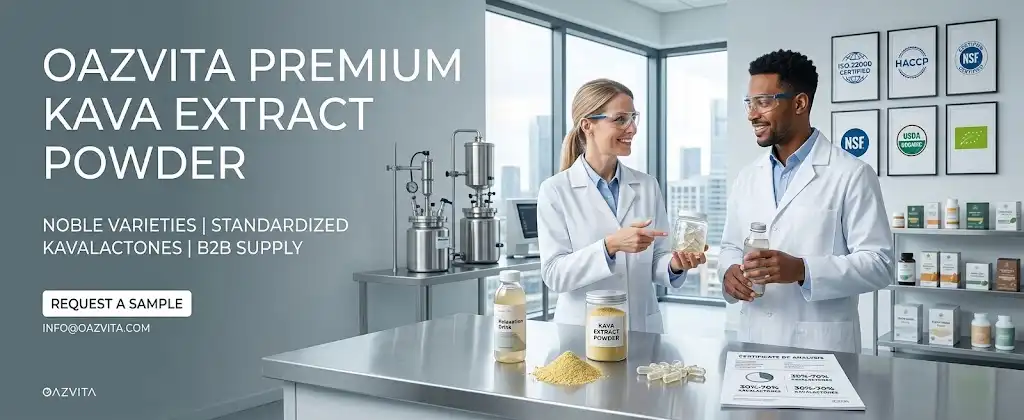
Concentrated kava extract powder can only be made from the side roots and rhizomes of certain types of Noble Piper methysticum plants. Vanuatu, Fiji, and Tonga are where most of these varieties are grown. A powder made from kava juice is used a lot in traditional medicine. High-performance liquid chromatography (HPLC) can be used to prove that the concentrations of kavalactone in this extract are between 30% and 70%. It is made using ethanol or supercritical carbon dioxide. Raw kava root powder, on the other hand, has different levels of potency and grainy material.
Traditional Background and Cultural Use
People from the Pacific Islands have used kava in ceremonies for hundreds of years. This is mostly because it makes people feel calm and peaceful. This tradition has been around for a very long time and has a strong ethnobotanical basis. Formulators today often use this background when describing their goods, especially in the US health and functional beverage industries.
Scientifically Validated Benefits
Research that has been examined by experts in the field demonstrates that kavalactones interact with GABA-A receptors to alleviate symptoms of anxiety and enhance the quality of sleep. When compared to a placebo, kava was shown to considerably reduce feelings of anxiousness, as demonstrated by research that was published in the Journal of Clinical Psychopharmacology in 2013. It was able to do this without the typical dangers of addiction that are associated with other pharmaceuticals. These findings indicate that it has the potential to be used in formulations for the treatment of anxiety, sleep, and nerve tension.
How Kava Extract Powder Works: Mechanism of Action
Kavalactones and Neurological Pathways
Kavalactones, mostly kavain and dihydrokavain, change the activity of GABA-A receptors, voltage-gated sodium channels, and MAO pathways. This multi-target activity is what makes the product able to ease nervous tension and help people sleep soundly at normal amounts without making them very sleepy. The Noble chemotype, which is usually marked 423xxx or 243xxx, is preferred by a natural kava extract manufacturer for these two kavalactones for both relaxation and mental focus.
Pain-Modulating Properties
Not only does kavain have an influence on the neurological system, but it also interacts with COX-2 pathways and sodium channels, both of which are mechanisms that assist in soothing neurons in the periphery. Because of these molecular interactions, kava extract is a scientifically fascinating ingredient for sports nutrition Products that concentrate on physical comfort and recovery after exercise. This is despite the fact that this is not a therapy claim.
Dosage and Formulation Considerations
Standardised extracts provide formulators with the ability to get precise quantities of kavalactone per serving, which typically range from fifty to two hundred and fifty milligrams in final goods used for business-to-business purposes. The inherent lipophilicity of kavalactones is addressed by water-dispersible grades, which are composed of cyclodextrin that has been encapsulated or maltodextrin that has been spray-dried. This indicates that they are suitable for use in powder drink mixes, functional teas, and clear beverage forms.
Comparing Kava Extract Powder with Alternative Products
Kava Extract vs. Raw Kava Root Powder
In general, raw kava root powder contains between three and ten percent kavalactones; however, the concentration of kavalactones fluctuates from batch to batch. For the production of new goods, kava extract powder with a standard of thirty to seventy percent is a significantly superior ingredient. It reduces the required dosage amounts by a significant amount, which is beneficial for pill and gummy forms where fill weight is an essential consideration.
Kava vs. Other Botanical Formats
The concentrations of standardised dry powders are greater than those of tinctures and teas, and they also have lasting power. Because it is simpler to handle, mix, and transport, powder form is obviously superior for business-to-business purchases in bulk. Additionally, powder form may be stored for a period of twenty-four months in a cold and dry location. The management of large-scale inventories and the design of manufacturing procedures are both directly impacted by these logistical benefits.
Kava vs. Valerian Root and Other Botanicals
In most cases, the action of valerian root is accomplished by valerenic acid's interaction with GABA receptors. The formulation process is made more challenging by the fact that it has a very strong odour. Kratom, on the other hand, is controlled by the government in the United States in a very strict manner. Kava is in a unique position because to the fact that it has a history of being safe from Noble-variety sources, that it is extensively used all over the globe, and that it is gaining more and more recognition in the natural supplement industry in the United States.
Sourcing and Procurement: Best Practices for Kava Extract Powder
Quality Indicators to Verify
There are a few quality standards that must be met by any kava extract powder seller. Here are the main things that buying teams should check before making large orders:
- Kavalactone standardization: Confirm the chemotype code and kavalactone percentage via HPLC-based Certificate of Analysis (COA).
- Flavokawain B control: Non-Noble (Tudei) varieties contain elevated Flavokawain B levels linked to liver safety concerns. Reputable suppliers keep this below 0.1%.
- Certification coverage: Look for HACCP, ISO 22000, NSF, HALAL, EU Organic, and USDA Organic certifications as baseline compliance markers for international markets.
You have to do these quality checks because they protect your company from legal and social risk in competitive markets like the EU and the US.
Evaluating Suppliers Reliably
The operational maturity of a supplier can be seen in their production capacity, record of batch consistency, and responsiveness. It is common for trustworthy suppliers to offer free samples before you decide to buy large amounts. Every batch, not just the first sample package, should come with verified third-party testing documents (COA, MSDS, TDS).
Logistics and Purchasing Structure
The minimum order quantity (MOQ) for most reliable providers starts at 1 kg, and they can adjust the packaging to fit your needs. This means that brands can get their products early in the formulation process. For shipping around the world, you should be able to choose from DHL, FedEx, UPS, Airmail Post, and sea. Lead times of 1–5 working days show that you're good at managing your inventory, which is a good sign of a stable supply chain for ongoing production needs.
Maximizing Business Benefits: How Kava Extract Powder Fits Your Product Line
Applications Across B2B Categories
It is possible to use kava extract powder effectively with a wide variety of various kinds of goods. When combined with L-theanine, magnesium glycinate, and ashwagandha, it is an effective component of Dietary Supplements that aid in the management of sleep and uneasiness. The use of water-dispersible grades enables businesses that produce functional beverages to produce beverages that are transparent and stable on the shelf without the need to add anything to emulsify them.
- It is recommended to use dietary supplement brands in the form of capsules, softgels, or gummies to improve the quality of sleep and relieve nervous tension.
- Sports nutrition companies could position their products as a recovery and post-training relaxation element in powders that are used for nightly recovery.
- It is recommended that makers of functional beverages include water-dispersible kava in relaxing drinks. According to market statistics from Grand View Research, this particular category is expected to have considerable growth until the year 2028.
The adaptability of the ingredient is shown by these applications, which provide procurement teams with more than one solution to transform a large quantity of material into a product.
Regulatory Compliance and Market Positioning
A well-established legal history in the United States under the DSHEA is associated with the noble form of kava extract, which is derived only from roots. Due to the fact that the European Union has previously investigated the safety of kava, it permits individuals to use it as a replacement in specific circumstances. Protecting market access between regions may be accomplished in the simplest manner possible by ensuring that your supplier provides you with documentation that can be traced back to Noble cultivars.
Conclusion
Kava extract powder is a market-relevant, scientifically proven plant ingredient that has demonstrated benefits for reducing anxiety, promoting rest, and reducing stress. It gives supplement brands, beverage makers, and private label buyers a unique ingredient that people really like when it comes from Noble cultivars, is standardized to checkable kavalactone profiles, and is backed by certifications like USDA Organic, ISO 22000, and NSF. To get its full business value, you need to work with a seller that combines technical know-how with a reliable supply chain and clear paperwork at every step of the way.
FAQ
1. What certifications should I require from a kava extract powder supplier?
Need at least HACCP, ISO 22000, and a batch-specific COA. Getting USDA Organic, EU Organic, or NSF certification is a great way to get into the U.S. and EU markets. For marketing routes in the Middle East, HALAL certification is important.
2. What is the minimum order quantity for bulk procurement?
The standard MOQ is 1 kg, and the package can be changed to fit the needs of production. This low threshold makes it possible for brands to test pilot formulations before going to full production volumes.
3. How does kava extract powder ship internationally?
Suppliers you can trust send packages by air, sea, DHL, FedEx, UPS, and airmail. With a lead time of 1–5 working days and a shelf life of 24 months in cool, dry storage, it's easy for both small brands and large manufacturers to plan their inventory.
Partner with OAZVITA for Premium Kava Extract Powder Supply
Noble-variety kava extract powder that is approved by OAZVITA comes with all the paperwork you need, like a COA, MSDS, TDS, and organic certificates. As a reliable company that makes kava extract powder for customers in North America, Europe, and Asia, we offer variable minimum order quantities, quick lead times, and OEM/ODM options. Get your free sample today and talk to our sourcing team directly. You can email us at info@oazvita.com.
References
1. Pittler, M. H., & Ernst, E. (2003). Kava extract for treating anxiety. Cochrane Database of Systematic Reviews.
2. Sarris, J., Stough, C., Bousman, C. A., et al. (2013). Kava in the treatment of generalized anxiety disorder. Journal of Clinical Psychopharmacology, 33(5), 643–648.
3. Anke, J., & Ramzan, I. (2004). Pharmacokinetic and pharmacodynamic drug interactions with kava (Piper methysticum Forst. f.). Journal of Ethnopharmacology, 93(2–3), 153–160.
4. Singh, Y. N. (1992). Kava: An overview. Journal of Ethnopharmacology, 37(1), 13–45.
5. Lebot, V., Merlin, M., & Lindstrom, L. (1992). Kava: The Pacific Elixir. Healing Arts Press.
6. Teschke, R., Schwarzenböck, A., & Akinci, A. (2008). Kava hepatotoxicity: A European view. New Zealand Medical Journal, 121(1283), 90–98.

Send Inquiry
Related Industry Knowledge
- Valerian Extract Powder For Sleep: Does It Actually Work, And How Do You Use It?
- Organic Inulin Powder Benefits: Improve Digestion & Gut Health Naturally
- Yucca Extract: Harnessing Nature's Gift for Sensitive Skin
- Everything You Need to Know About Pure Inositol Powder: Uses, Benefits, and More
- Complete Guide to Choosing the Best Pure NMN Powder for Anti-Aging
- Complete Guide to Chewable Probiotic Gummies
- Best creatine monohydrate powder: mixing, absorption and bioavailability tips
- MCT Powder Use Cases in Singapore’s Clinical Nutrition Sector
- What makes the best creatine monohydrate powder effective?
- United States B2B Sourcing Guide for Pure Sea Moss Capsules with Full Traceability