Yucca Extract Powder Benefits, Uses & Safety Guide
Sep 22, 2026
Yucca extract powder, derived from the dried root, stem, and leaves of Yucca schidigera (Mojave Yucca), has become a sought-after botanical ingredient across supplement, sports nutrition, functional food, and nutricosmetic manufacturing. Standardized for steroidal saponins, polyphenols, and resveratrol, this extract delivers measurable anti-inflammatory, antioxidant, and gut microbiota-regulating activity. For B2B procurement teams, understanding its validated benefits, correct application dosages, and supplier quality benchmarks is essential to building compliant, market-ready Products. This guide covers everything you need to source and formulate with confidence.
What Is Yucca Extract Powder?
Botanical Origin and Extraction Process
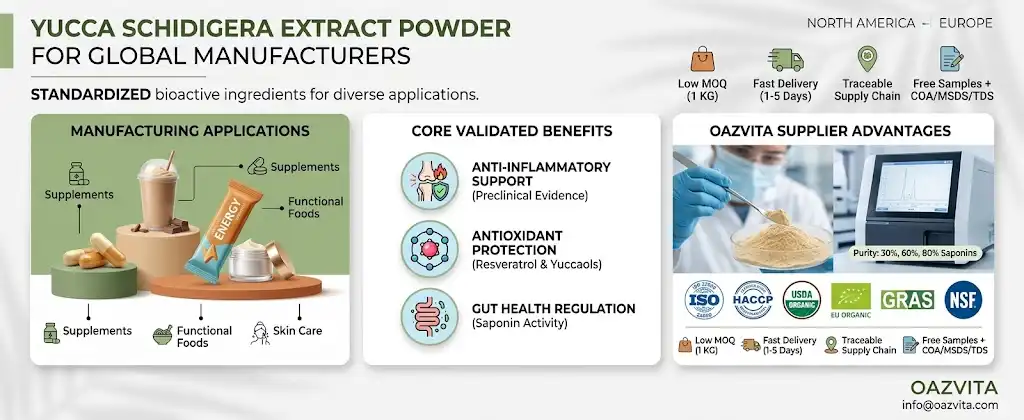
The powdered extract of Yucca schidigera that is sold by OAZVITA is made from the dried root, stem, and leaves of the Mojave Yucca plant. This particular plant is indigenous to the desert and has been used for a considerable length of time in the southwestern region of the United States. The method of extraction is used to extract two basic categories of active chemicals: steroidal saponins and polyphenol stilbenes. Both of these categories are involved in the extraction process. There are a few instances of polyphenol stilbenes, which are natural surfactants that interact with cell walls. Resveratrol and yuccaols are two examples of these. Steroidal saponins are regarded as natural surfactants in the scientific community. This procedure results in the production of a standard powder that may be evaluated as having thirty percent, sixty percent, or eighty percent yucca saponin. Because of this, formulators are able to have a high degree of control over the percentage of bioactive ingredients.
Extract Powder vs. Root Powder: What Procurement Teams Should Know
It is of the highest essential to have a thorough understanding of this difference when it comes to the stage associated with sourcing. The full plant structure, including the woody parts of the plant that have a lower concentration of saponin, is preserved by the use of yucca root powder. With its concentrated and standardised active profile, yucca extract powder, on the other hand, is an ideal option for use in functional drinks, capsules, gummies, and powder mixes. It is also an excellent choice for use in powder mixes. Root powder is preferable to extract powder in terms of its efficiency and its ability to be taken again in the same quantity. Root powder is also more difficult to consume. In particular, this is the case for companies that want to make assertions on certain physiological advantages, such as the management of gut flora or antioxidants.
Comprehensive Benefits of Yucca Extract Powder
The bioactive profile of Mojave Yucca extract makes a lot of different kinds of products more valuable. A yucca extract powder for supplement use contains saponins, polyphenols, and resveratrol, all of which have different functional properties that can be used to make claims about a product that will sell.
What follows is a list of the primary categories of advantages that have been supported by recent evidence:
- The anti-inflammatory properties of yucca saponins include the ability to inhibit some processes that promote inflammation. According to the findings of research that was published in the Journal of Inflammation in 2006, preparations of yucca that are rich in saponins were able to reduce the indications of joint inflammation in preclinical models. This implies that they might be used in supplements that provide support for the joints.
- Resveratrol and yuccaols, which are stilbene polyphenols that are uniquely present in Yucca schidigera, have a great deal of capacity to eliminate free radicals. This is part of the antioxidant protection that Yucca schidigera provides. Companies that are manufacturing skin health capsules and anti-aging supplement lines will find the extract to be a very enticing ingredient for this reason.
- Regulation of the gut microbiota: Researchers have discovered that steroidal saponins alter the composition of the gut flora, therefore reducing the amount of bacteria that produce ammonia while simultaneously preserving a healthy balance of germs. This characteristic is suitable for businesses that manufacture functional meals since it satisfies the growing demand from consumers for components that are beneficial to digestion.
As a result of these advantages, Yucca schidigera extract is more of a flexible raw material than it is a plant that has just one claim to make. The formulation process is simplified for OEM/ODM customers that deal with many SKUs in the healthcare industry because of this flexibility.
These features are being supported by an increasing amount of data that is being gathered. There is a connection between the consumption of saponins and alterations in the permeability of the intestines, according to a review that was published in the year 2021 in the journal Nutrients. Because of this, the argument in favour of including them in products for sports recovery and gut health becomes even more compelling. Because of these findings, it is now more apparent why purchasing teams at firms that manufacture functional beverages, Dietary Supplements, and sports nutrition products are actively searching for standardised yucca extract that can be produced in large quantities.
Practical Uses and Dosage Guidelines
Application Across Product Categories
Yucca schidigera juice works well in a lot of different types of products. When making capsules and tablets for dietary supplements, the dosages are usually between 100 mg and 500 mg per serving, depending on the amount of saponin and the goal. At a standardization level of 80% saponin, lower inclusion rates give the same amount of bioactive material as higher numbers of lower-grade material. This is an important cost-effectiveness factor for mass production.
In functional food and drink uses, the extract is mixed into protein powders, health teas, and fortified snacks. Its mild to slightly bitter taste note needs to be taken into account during tests for palatability. Topical and nutricosmetic uses benefit from its protective polyphenol content, which is usually found at levels between 0.5 and 2% in finished products.
Safety Profile and Regulatory Compliance
As a flavoring agent, yucca extract powder is GRAS (Generally Recognized as Safe) with the U.S. FDA, and it's on the EU's list of plant chemicals that can be used. The extract from OAZVITA is certified by HACCP, ISO 22000, NSF, HALAL, the EU, and the USDA as organic. Each batch also comes with full COA, MSDS, and TDS paperwork.
Procurement teams should make sure that the labels on final products show the suggested serving amounts and that sellers provide stable data that proves the shelf life. For example, OAZVITA's product has a confirmed 24-month shelf life when stored in a cool, dry place.
Choosing the Right Yucca Extract Powder Supplier
The selection of a yucca extract powder provider is the point at which the success of a recipe and the risk of the supply chain intersect. There are significant variations in the quality of yucca extract powder that is manufactured by various firms. In order to maintain the product's integrity, procurement teams need specific assessment criteria.
The following are characteristics that are essential to the credibility of a company:
- Look for a saponin content that has been evaluated by a third party and has a standardised purity grade of thirty percent, sixty percent, or eighty percent. Because of the lack of uniformity in the standardisation process, varied product performance and legal exposure are obtained.
- Compliance with several certifications: Certifications such as ISO 22000, HACCP, NSF, USDA Organic, and EU Organic demonstrate that manufacturing techniques satisfy worldwide standards for food safety and quality. This is a requirement for selling products in North America and Europe.
- Transparent supply chain: The ability to trace the raw plant material all the way through to the final extract is a factor that lends credence to clean label claims, which are something that an increasing number of high-end vitamin and cosmetic product businesses are looking for.
- The minimum order quantity (MOQ) for OAZVITA is one kilogram, and the company is able to package the product in any manner to meet the requirements of the customer. There are a variety of shipping options available, including air, sea, DHL, FedEx, UPS, and airmail. The wait time ranges from one to five working days. These buyers, who want to test the market with a private label, and distributors who purchase in bulk both benefit from this flexibility since it allows them to do so.
When vendors provide free samples and complete technical data prior to making a commitment, the procurement process is far less expensive and has a significantly lower level of risk. Before signing bulk contracts, it provides formulation teams with the opportunity to do their own testing, which demonstrates that manufacturers are confident in their products.
Conclusion
Yucca extract powder is a plant ingredient that has real cross-sector use and is backed by science and regulations. In dietary supplements, sports nutrition, functional foods, and nutricosmetics, its steroidal saponin and polyphenol makeup can help with gut bacteria, anti-inflammatory effects, and antioxidants. The most important thing to do when putting a yucca-based product on the market is to find a provider that offers uniform purity grades, full licenses, and dependable services. OAZVITA achieves all of these, with over USD 15 million in exports every year and a delivery rate of 99% or more on time for every order.
FAQ
1. What purity grades of yucca extract powder are available for supplement manufacturing?
OAZVITA can standardize Yucca Saponin at 30%, 60%, or 80%. Higher-grade extracts allow smaller inclusion rates while still keeping bioactive potency, which is helpful for pill and tablet formulas that need to stay under a certain weight limit.
2. Is yucca schidigera extract compliant with U.S. and EU regulations?
Yes. The extract is considered safe by the EU plant standards and is GRAS by the U.S. FDA as a flavoring agent. The OAZVITA product has certifications for HACCP, ISO 22000, NSF, USDA Organic, and EU Organic, which helps it get into both local and foreign markets.
3. Can I request a free sample before placing a bulk order?
OAZVITA gives free samples to B2B buyers who meet certain requirements. Each sample comes with a full COA, MSDS, and TDS, so your R&D and quality assurance teams can test it on their own before committing.
4. What is the minimum order quantity?
The minimum order quantity is 1 kg, and the package can be set up however you want for production. This low entry barrier is good for private label startups and buyers who want to test the market. Bulk price structures are good for distributors and big manufacturers.
Partner With OAZVITA — Your Trusted Yucca Extract Powder Manufacturer
With ISO 22000, HACCP, NSF, USDA Organic, and EU Organic standards, OAZVITA specializes in making plant extracts that are very pure. Our yucca extract powder comes in grades with 30%, 60%, and 80% saponin. We offer free samples, full scientific documentation, and a wait time of 1 to 5 working days. Our dedicated account managers provide one-on-one service from the time you make an inquiry until the product is delivered, whether you need help with OEM/ODM formulations, private label solutions, or a reliable bulk supply. To get your free sample right away, email us at info@oazvita.com.
References
1. Cheeke, P. R. (2000). Actual and potential applications of Yucca schidigera and Quillaja saponaria saponins in human and animal nutrition. Journal of Animal Science, 77(Suppl. 1).
2. Oleszek, W., & Biały, Z. (2006). Phytochemical methods applied to assess saponin content and composition in plant materials. Journal of Chromatography A, 1112(1–2).
3. Piacente, S., Pizza, C., & Oleszek, W. (2005). Saponins and phenolics of Yucca schidigera Roezl: Chemistry and bioactivity. Phytochemistry Reviews, 4(2–3).
4. Yucca schidigera extract: Safety, regulatory status, and applications. Natural Product Communications, 2009.
5. Singh, B., & Bhat, T. K. (2003). Potential therapeutic applications of some antinutritional plant secondary metabolites including saponins. Journal of Agricultural and Food Chemistry, 51(19).
6. Bahrami, A., Khalili, S. T., & Rahimian, Y. (2021). Dietary saponins and their effects on gut microbiota and intestinal permeability. Nutrients, 13(4).

Send Inquiry
Related Industry Knowledge
- Cistanche Tubulosa Extract Powder Background & Benefits
- How to use Tongkat Ali? 5 Different Ways to Best Consume Tongkat Ali
- Best and Original ashwagandha root powder health benefits
- The benefits of ginseng: properties, uses and health advice
- Pure Quercetin Powder | Everything about effect, intake & dosage
- Biotin, Pure 99.7%: The Beauty Vitamin Your Formulations (and Skin) Need
- Asia-Pacific Outlook for High-Purity NAD+ Precursors
- Ensuring Consistent NR Chloride Quality for Japanese Pharma Buyers
- The Complete Guide to Pure NAD+ Powder
- Spirulina chlorella tablets: nutrient profile and bioavailability