
Coenzyme Q10 Powder: A Comprehensive Analysis and Application Guide
Oct 30, 2026
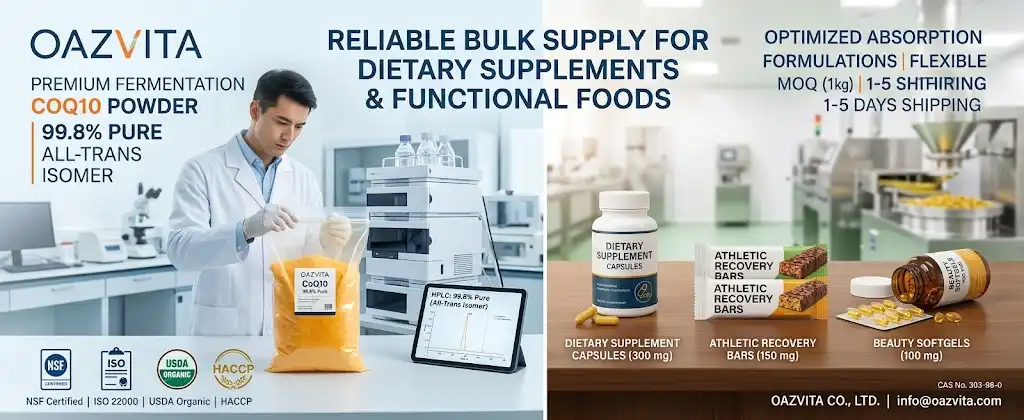
The biochemical process of microbial fermentation results in the formation of ubiquinone-10, which is also known as pure coenzyme Q10 powder (CAS No. 303-98-0). Ubiquinone-10 is a crystalline material that may vary in colour from yellow to orange. Not only does it perform the role of a lipophilic antioxidant, but it is also a vital component in the process by which mitochondria generate ATP. The business-to-business buyers in the dietary supplement, sports nutrition, functional foods, and nutricosmetics sectors are the target audience for this book. It covers everything from sourcing and formulation to bulk procurement, which will help you make decisions that are confident and well-informed when you make your first buy using this information.
Understanding Pure Coenzyme Q10 Powder: Properties and Benefits
Chemical Identity and Physical Properties
Each individual molecule of CoQ10 powder has a molecular weight of 863.34 grams, and the powder itself is made up of the building blocks C2H2O2. As a result of the fact that its melting point ranges from 48 to 52 degrees Celsius, it is essential that the temperature be maintained throughout the process of working with it. CoQ10 from OAZVITA is manufactured using HPLC and is 99.8 percent pure. After that, it is ground to a mesh size that ranges from sixty to eighty. For all intents and purposes, it seems to be a fine, crystalline powder that is yellow-orange in colour and does not smell like anything. In the presence of water, it does not undergo decomposition; nevertheless, when it is subjected to acetone, chloroform, and carrier oils, it does undergo decomposition. When seen from the perspective of formulation, this quality has an effect on each and every alternative that comes after it.
Fermentation Origin vs. Synthetic Production
You can only create the all-trans isomer of CoQ10 when you process it with organisms like Rhodobacter sphaeroides. To put it another way, this is the same structure that your body naturally produces. There are both cis and trans isomers present in the majority of the chemically produced variants. There is a consensus among the USP, EP, and JP standards that the cis form is not pure and does not possess any biological activity. This danger is eliminated when you use fermentation-grade CoQ10, and you also satisfy the requirements of authorities and consumers who want Products to have clean labelling thanks to your efforts.
Antioxidant Function and Application Scope
As a result of its ability to function with fat, CoQ10 is chemically safe for use in protecting cell membranes from oxidative stress. For this reason, it is used in a wide variety of products, including but not limited to health supplements, health beverages, protein bars, and softgels. Research that demonstrated the role that CoQ10 plays in the bioenergetics of mitochondria was published in the journal Molecular Aspects of Medicine in the year 2007. This provided researchers with a scientific justification for continuing to use it in a wide variety of nutritional products.
Comparing Coenzyme Q10 Powder Forms and Brands for Procurement Decisions
Pure Powder vs. Ubiquinol vs. Liquid Forms
Pure CoQ10 powder, also known as ubiquinone, is the most advantageous option for use as a foundation in the production of capsules and tablets due to its less expensive nature. This version of ubiquinol, which has already undergone modifications, is more expensive and functions most effectively in products that are designed for certain categories of individuals. When liquid CoQ10 is added to beverages, it works quite well; however, the beverages must be transported in a cold chain. Pharmaceutical-grade powder is still the ideal raw material for companies that need to produce a large quantity of items at a lower cost than any other material. It is more durable and may be used in a variety of ways.
Natural (Fermentation) vs. Synthetic: Quality and Price
Fermentation-derived ubiquinone powder costs a little more than synthetic CoQ10, but it consistently maintains the purity of the all-trans isomer. This difference affects how well companies can sell products that say they are "non-GMO" or "clean label." It is possible for synthetic CoQ10 to pass basic tests but fail HPLC analysis that looks for specific isomers. Managers in charge of buying things should always look at the certificate of analysis (COA) and ask for isomer profile data, not just the total purity numbers.
Certifications That Matter in Supplier Evaluation
Not every ticket in the US market is worth the same amount of money. When business-to-business buyers look over selling papers, they should pay attention to the following:
This label, NSF Certification, means that the supplement is safe and meets US standards for making it. It was also checked by a third party.
- NSF Certification confirms compliance with US dietary supplement manufacturing standards and independent third-party verification.
- HACCP and ISO 22000 demonstrate food-safety management systems throughout the production process.
- USDA Organic and EU Organic certifications support clean-label branding in both North American and European markets.
- HALAL Certification opens distribution channels across Middle Eastern and Southeast Asian markets.
- COA, MSDS, and TDS provide batch-specific quality data, safety profiles, and technical specifications for downstream formulation.
All of these licenses make it less likely that the government will take action and increase trust across all lines of distribution. All of these things are handled by OAZVITA, which helps people from other countries find sellers.
Optimal Usage and Dosage Guidelines for Pure CoQ10 Powder
Dosage Ranges by Application Type
The amount of CoQ10 that is usually found in different types of products varies. Dietary supplement pills for adults usually have between 100 and 300 mg in each dose. Some recovery foods for athletes use 100–200 mg per serving to help the body heal after working out. Supplements for beauty and skin health, such as pills, usually have 30 to 100 mg per daily dose. Functional uses in food and drinks usually range from 10 mg to 50 mg per serving, but this can change based on how the product is meant to be displayed.
Formulation Tips for Improved Absorption
Standard crystalline powder isn't very bioavailable when it's made wrong because coenzyme Q10 doesn't like water. Do the following to deal with this:
- Lipid-based delivery systems (softgels with MCT oil or sunflower oil) significantly increase absorption compared to dry powder capsules.
- Nano-emulsification or CWS (cold water-soluble) processing converts the crystalline powder into a water-dispersible form suitable for beverages and effervescent tablets.
- Micronized CoQ10 reduces particle size to increase surface area, which accelerates dissolution in carrier oils and improves bioavailability.
- Co-administration with fat-soluble ingredients (vitamin E, omega-3) in softgel formulas improves uptake in the gastrointestinal tract.
Lipid-based delivery methods, such as softgels with sunflower oil or MCT oil, are much better at getting into the body than dry powder pills. This process, called nano-emulsification or CWS (cold water-soluble), turns the solid powder into a form that can dissolve in water and be used in drinks and fizzy tablets.
Micronized CoQ10 powder has smaller particles, which increases its surface area. This helps it disperse more quickly in carrier oils and may improve its absorption by the body. Softgels containing fat-soluble ingredients like omega-3 and vitamin E can also support absorption.
OEM and Private Label Integration
Before you finalize your formula, make sure you choose the right way to transport it. This will save you time and money on production costs. The technical team at OAZVITA can help you come up with the best way to make your product based on the format you want it to be in.
Procurement Strategies: Buying CoQ10 Powder in Bulk
Key Sourcing Considerations
You should do more than just compare prices when you buy a lot of ubiquinone powder. Think about these things before choosing a supplier:
- Lead time: OAZVITA's lead time is 1–5 working days after order confirmation, which supports responsive supply chains.
- MOQ flexibility: A 1 kg minimum order quantity allows brands to test new formulas before scaling to production volumes.
- Packaging customization: Packaging can be configured according to buyer demand, reducing re-packaging costs at your facility.
- Shipping options: OAZVITA ships via Air, Sea, DHL, FedEx, UPS, and Airmail Post, covering North America, Europe, Asia, and the Middle East with tracked, insured logistics.
- Lead time: Once an order is confirmed, OAZVITA's lead time is between 1 and 5 working days. This is good for supply chains that need to act quickly.
Brands can try out new recipes before making big batches because the minimum order quantity (MOQ) is only 1 kg. You can customize the package so that it fits the needs of the buyer. This cuts down on the cost of repackaging at your location.
Storage, Shelf Life, and Sample Evaluation
These useful details are just as important as facts when you are in charge of making schedules for many markets.
How to Choose Trusted CoQ10 Powder Suppliers for Your Business
Supplier Evaluation Criteria
The US supplement market is run by FDA 21 CFR Part 111. It makes companies check that all food ingredients are what they say they are, are pure, are strong, and are made up of. Because of this rule, brands that sell in the US have to check out their suppliers. A reliable company that sells coenzyme Q10 powder should have third-party-checked certificates, batch-specific COA data with HPLC isomer profiles, production records that can be tracked, and helpful technical support.
What Sets OAZVITA Apart as a CoQ10 Powder Manufacturer
The company OAZVITA has been approved by HACCP, ISO 22000, NSF, HALAL, EU Organic, and USDA Organic. These meet all the requirements to sell in the US, EU, and other markets around the world. North America, Europe, Asia, South America, and Africa are all places where the company ships goods. They send over USD 15 million worth of goods abroad every year and are on time more than 99% of the time. Account managers are in charge of the whole service cycle, from the first sample request to large-scale production orders. There is a support team that speaks more than one language to make sure that communication is clear no matter what time zone it is in.
Conclusion
CoQ10 powder has been used in business for a long time and has a lot of scientific support. Pure coenzyme Q10 powder can still be used by supplement, sports nutrition, functional food, and beauty brands. The first step in making a product that works well in preparation and passes regulatory review is to choose the right form: fermentation-derived, all-trans isomer, 98% HPLC purity. It is legal and can save you money to buy things in bulk if you work with the right person. OAZVITA's approved, high-purity CoQ10 ingredient portfolio helps brands at every step, from checking the first sample to making sure they have enough of the product to last for a long time.
FAQ
1. What is the difference between fermentation-derived and synthetic CoQ10 powder?
It is only the all-trans isomer of CoQ10 that is made by fermentation that is chemically the same as the CoQ10 your body makes. Labs often mix cis and trans isomers when they make drugs. In living things, the cis form doesn't do anything. Because it's the right thing to do and to make sure the isomer is pure, OAZVITA only sells fermentation-grade CoQ10.
2. Why does CoQ10 powder clump or darken during storage?
It doesn't melt very easily—around 50°C. It doesn't like light or water either. It clumps and changes color if you keep it above 25°C or in places with a lot of water. Bins that don't let light or air in should be kept somewhere cool and dry.
3. Can CoQ10 powder be dissolved directly in water?
It doesn't like water, no. For uses in water, you need nano-emulsification, CWS processing, or lipid-based emulsion devices.
4. Does particle size affect bioavailability?
Yes, micronized CoQ10 does have a bigger surface area, which helps it mix with carrier oils and get into the body more easily.
Partner with OAZVITA for Reliable Pure Coenzyme Q10 Powder Supply
It is safe to buy pure coenzyme Q10 powder from OAZVITA. They work with brands in North America, Europe, and other places. Our 98% HPLC-grade CoQ10 ships in one to five business days, and you only need to order one kg at a time. We can also help you get certified for NSF, ISO 22000, and USDA Organic. Email our team at info@oazvita.com right now to get a free sample and a custom bulk price.
References
1. Littarru, G. P., & Tiano, L. (2007). Molecular Aspects of Medicine, 28(5–6), 635–645.
2. Bhagavan, H. N., & Chopra, R. K. (2006). Drug Metabolism and Pharmacokinetics, 21(4), 268–280. — Coenzyme Q10: Absorption, tissue uptake, metabolism, and pharmacokinetics.
3. Pravst, I., Žmitek, K., & Žmitek, J. (2010). Critical Reviews in Food Science and Nutrition, 50(4), 269–280. — Coenzyme Q10 contents in foods and fortification strategies.
4. Hargreaves, I. P. (2014). Mitochondrion, 18, 76–84. — Coenzyme Q10 as a therapy for mitochondrial disease.
5. United States Pharmacopeia (USP 43-NF 38). (2020). — Ubidecarenone (Coenzyme Q10) monograph.
6. Crane, F. L. (2001). Journal of the American College of Nutrition, 20(6), 591–598. — Biochemical functions of coenzyme Q10.

Send Inquiry

Related Industry Knowledge
- Valerian Extract Powder for Stress Support: Benefits and How to Use
- Everything You Need to Know About Nettle: Benefits, Uses, and Natural Habitat
- How is the quality of pure curcumin powder tested?
- What is pure acai powder?
- Hericium Erinaceus Extract Powder: Beginner's Guide & Benefits
- What Is Vitamin D3 Bulk Powder?
- How to Choose the Best Chicken Collagen Peptides for Your Skin
- China OEM Production of Pure Ashwagandha Capsules with Scalable Supply Capacity
- TUDCA Powder Manufacturing Excellence Serving South Korea’s Pharma Sector
- Applications of high purity magnesium glycinate powder in sleep support