
How is the quality of pure curcumin powder tested?
Jul 22, 2026
Quality testing of pure bulk curcumin involves multiple analytical techniques to ensure purity, safety, and efficacy. The industry standard relies on High-Performance Liquid Chromatography (HPLC) to accurately measure total curcuminoid content—typically targeting ≥95% for pharmaceutical-grade material. Complementary methods include heavy metal screening via ICP-MS, pesticide residue analysis through GC-MS, microbiological testing, and solvent residue verification. These rigorous protocols guarantee that curcumin powder meets international compliance standards and delivers consistent performance for supplement manufacturers, functional food producers, and cosmeceutical brands.
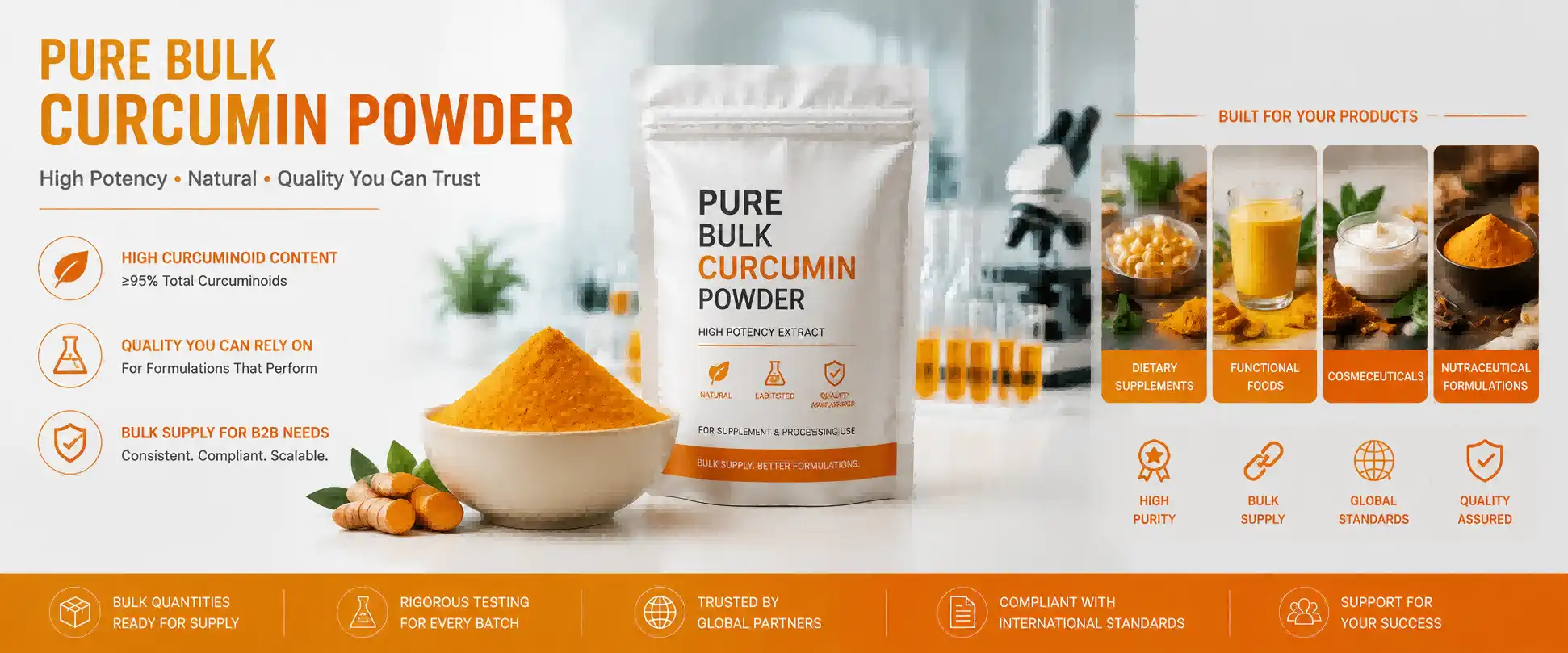
Understanding Quality Challenges in Pure Curcumin Powder
Getting high-quality pure bulk curcumin is not easy and has direct effects on how the product is made and approved by regulators. There are still problems with the consistency of curcuminoid concentration, as some batches have much lower amounts of active compounds than what was claimed. This difference is caused by choosing different types of turmeric, using different soil conditions, and harvesting at different times.
Contamination Risks and Adulteration
Heavy metal contamination is very bad for your health and can stop whole production runs in their tracks. Lead, arsenic, cadmium, and mercury can build up in turmeric roots that are grown in dirty soils, especially in places where farmers aren't closely watched. Traditional farming methods leave behind pesticide residues that make it harder to follow the rules. This is especially true for goods going to European markets, where strict Maximum Residue Limits (MRLs) apply.
Fraud is another major issue that needs to be addressed. Some dishonest sellers may mix curcumin with artificial colours, starch fillers, or lower-quality turmeric powder to make more money while lowering the quality of the product. Some companies even sell synthetic curcumin that comes from oil, which doesn't have the natural isotopic signature of plant-based material. If you don't do the right checks, these fakes can get into your supply chain without being seen.
Extraction Method Impacts
The method used for extraction and preparation has a big impact on the quality of the end product. When you use ethanol or acetone to extract something, the purity level and residual profile are different from those when you use supercritical CO₂ extraction. If the amounts of residual solvents go over the limits for USP Class 3, the batches may not be suitable for use in Dietary Supplements. Heat during processing may break down curcuminoids, which lowers their protective power and changes the balance of curcumin, demethoxycurcumin, and bisdemethoxycurcumin.
The conditions of storage also affect stability. Curcumin is very sensitive to light and breaks down quickly when it comes in contact with water, heat, or light. Suppliers who don't have climate-controlled warehouses or follow the right packing rules may send materials that don't have a long shelf life, which can make it hard for makers to make recipes and cause them to lose overstock.
By understanding these quality problems in Pure Bulk Curcumin, procurement teams can come up with useful criteria for judging suppliers. The next part talks about the scientific techniques that can help find these problems and stop them before they affect production.
Key Quality Testing Methods for Pure Curcumin Powder
Premium turmeric extract powder is separated from inferior material by strict quality tests. Several types of analysis are used together to make a full quality profile that helps with purchasing decisions.
Chemical Composition Analysis
The best way to profile curcuminoids is with high-performance liquid chromatography. This method separates and measures the three main curcuminoids: curcumin (about 70–75% of the total), demethoxycurcumin (15–20%), and bisdemethoxycurcumin (3–5%). This gives a correct total curcuminoid percentage. The three-peak design shown here should be present in a real 95% natural pure bulk curcumin. Single-peak results usually mean that the compound was made in a lab or that it was processed too much, which destroyed its natural diversity.
UV-Vis spectroscopy can be used to measure concentrations as well, but it isn't specific enough to make claims of purity. This method checks absorption at specific wavelengths, but it can't tell the difference between curcuminoids and other substances that look similar in structure. Instead of just accepting UV-based tests, people who work in procurement should insist on HPLC data.
Contaminant Screening Protocols
With a precision of parts per billion, ICP-MS (Inductively Coupled Plasma Mass Spectrometry) can find heavy ions. To meet the safety guidelines set by California Proposition 65 and other countries, good suppliers keep lead levels below 0.5 ppm, arsenic levels below 1 ppm, and overall heavy metal levels below 10 ppm. These limits keep people's health safe and stop people from breaking the law.
Gas chromatography-mass spectrometry finds leftover solvents, pesticide residues, and polycyclic aromatic hydrocarbons (PAHs). Because of very strict rules in Europe about PAH levels for plant extracts, suppliers that sell to EU markets must do these tests. Ethylene oxide residues are getting more attention from regulators; GC-MS proof makes sure that current rules are followed.
Physical and Microbiological Testing
Finding out the moisture level stops microbes from growing and increases the shelf life. Premium curcumin powder keeps its wetness level below 5%, which lowers the risk of caking and breaking down. Karl Fischer titration is a precise way to measure moisture for quality control purposes.
Microbiological screening finds viruses, dangerous bacteria, yeast, and mould. The total number of plates, the number of coliforms, and specific disease tests for E. coli, Salmonella, and Staphylococcus aureus make sure that the food is safe. These tests are especially important for materials that will be directly consumed or for Products that are meant for people with weakened immune systems.
Authentication and Identity Verification
The best way to tell the difference between natural and synthetic curcumin is to use carbon-14 dating. Radioactive carbon isotopes are found in natural plant-based material because plants absorb CO₂ from the air during photosynthesis. Synthetic curcumin, on the other hand, comes from petroleum and doesn't have any of these isotopes. Beta analytical testing gives you proof that you are who you say you are, that certificates of analysis alone can't give.
OAZVITA gives full third-party testing records for each batch of turmeric extract powder, which include heavy metal screening, microbiological assays, pesticide residue reports, and HPLC curcuminoid profiles. We offer natural 95% and synthetic 98% types (CAS NO.: 458-37-7) that are fully backed by HACCP, ISO 22000, NSF, HALAL, EU organic, and USDA organic certifications, as well as full COA, MSDS, and TDS paperwork. These titles give B2B buyers the proof they need to move forward with trust.
How Does Pure Bulk Curcumin Quality Impact Your Supply Chain?
Differences in the quality of pure bulk curcumin have effects on the whole production process, on following the rules, and on the brand's image. Knowing about these effects helps make the case for spending money on high-quality materials and carefully screening suppliers.
Formulation Consistency and Product Efficacy
The amount of curcuminoid used directly affects how much to take and what the label says. When standards aren't met, manufacturers have to make tough decisions: they can either change the recipe in the middle of production or change the serving sizes, or they risk putting out goods that aren't dosed correctly. Each choice has big effects on costs and schedules.
Variability from batch to batch makes stable tests and shelf-life validation harder. Products made with inconsistent raw materials may break down in unpredictable ways, which could mean expensive reformulation work or an early expiry date that makes the product less marketable. For athletes to trust and buy from sports nutrition brands that make performance-enhancing products again and again, they need to be completely consistent.
Regulatory Compliance Across Markets
GMP-certified factories need to get their ingredients from sources that follow the same high-quality standards. When heavy metal limits, pesticide thresholds, or microbiological requirements for curcumin powder are not met, whole production batches cannot be sold. Costs of disposal, downtime in production, and late product launches all cut into profits and hurt relationships with customers.
There are different rules for each market. In the US, the FDA is in charge of dietary supplement laws, which are different from the novel food laws and EFSA guidelines in Europe. Products with curcumin that are going to be exported to more than one region must meet the strictest standard that is available. Suppliers who offer materials that are compliant with international standards make it easier to follow the rules and speed up market entry.
Case Application: Supplier Selection Optimisation
A mid-sized supplement company recently had to deal with multiple production delays because of a supplier's inconsistent curcumin quality, which was focused on price. After three batches were turned down in six months—one for having too much lead, another for not having enough curcuminoid, and a third for having too many microbes—the buying team put in place a thorough process for evaluating suppliers.
The new system gave more weight to suppliers who had GMP certification, regular testing by a third party, and clear batch tracking. By working with a supplier that cares about quality and provides thorough paperwork and consistent HPLC profiles, the maker was able to get rid of quality-related production delays, lower the number of batches that were rejected to almost nothing, and speed up the approval process for new product lines by regulators. A little more expensive raw materials didn't matter when compared to the benefits of less downtime and a better reputation in the market.
This shows that what you learn from quality testing of Curcuma Longa Powder directly affects how resilient your supply chain is. When evaluating suppliers, procurement teams that know how to use analytical methods can ask sharp questions, check claims by looking at the paperwork, and set up quality agreements that protect manufacturing operations.
Conclusion
High-tech analytical methods are used to check the quality of pure bulk curcumin. These include HPLC for profiling curcuminoid compounds, ICP-MS for finding heavy metals, GC-MS for screening for pesticides, and microbiological assays for making sure the product is safe. These ways find out how pure something is, if it contains any impurities, and if it comes from a natural or artificial source. For people who buy things from other businesses in the supplement, functional food, and cosmetics industries, knowing these testing procedures helps them choose suppliers in a way that protects product quality, follows the rules, and makes the supply chain more resilient. When you work with certified suppliers who offer full documentation, strict testing schedules, and clear traceability, buying raw materials goes from being a cost centre to a strategic advantage that helps your brand's reputation and success in the market.
FAQ
1. Which analytical method is the most reliable way to check the purity of pure bulk curcumin?
High-performance liquid chromatography is the most accurate and widely accepted way to check the purity of curcumin. This method separates the curcuminoids curcumin, demethoxycurcumin, and bisdemethoxycurcumin, giving a precise measurement of the total curcuminoid content. Because UV-Vis spectroscopy is less specific and cannot find many common adulterants, HPLC is the best measure for B2B purchase verification.
2. How can buyers be sure that a supplier is following international quality standards?
Ask for up-to-date proof of certification, such as GMP, ISO 22000, HACCP, and any relevant organic certifications. Check the expiration dates and issuing bodies of credentials to make sure they are still valid. Check the Certificates of Analysis for testing results that are specific to each batch and come from approved labs. Ask for audit reports from a third party and proof that each batch can be tracked. Good providers will happily give you this information, but vague answers could mean that they aren't following the rules.
3. What are the risks of buying cheap curcumin powder that hasn't been tested?
Material that hasn't been tested could have harmful heavy metals, chemical levels that are higher than what the law allows, or microbial pathogens that cause product recalls and harm to consumers. Adding synthetic colourants or fillers to a product makes it less effective and makes the label claim less accurate, which can lead to legal problems. Curcuminoid content that isn't constant breaks down the uniformity of the formulation and may be against the rules set by regulators. These risks cause costs that are much higher than the initial savings in buying. These costs include rejecting batches, delaying production, getting fined by regulators, and damage to the brand.
Partner with OAZVITA for Premium Pure Bulk Curcumin Supply
OAZVITA sells Pure Bulk Curcumin powder that is safe for use in medicines and has been through a lot of quality tests and approved by international organisations. As a well-known company that makes pure material, we offer both Natural 95% and Synthetic 98% purity grades (CAS NO.: 458-37-7) with full analytical documentation for each batch, such as COA, MSDS, and TDS. Our sites keep their HACCP, ISO 22000, NSF, HALAL, EU Organic, and USDA Organic standards up to date to make sure they are in line with regulations in all global markets. We offer free samples for you to try, adjustable MOQs starting at 1 kg, packages that you can customise, and quick lead times of 1 to 5 days. We make it easier for supplement brands, functional food manufacturers, sports nutrition companies, and cosmetics companies to buy things by offering reliable international shipping through DHL, FedEx, UPS, and air/sea freight, as well as dedicated multilingual customer service. Email our team at info@oazvita.com to get samples, talk about custom formulations, or get a full quote for your next production run.
References
1. Hewlings, S.J. and Kalman, D.S. (2017). "Curcumin: A Review of Its Effects on Human Health." Foods, 6(10), 92.
2. Tayyem, R.F., Heath, D.D., Al-Delaimy, W.K., and Rock, C.L. (2006). "Curcumin Content of Turmeric and Curry Powders." Nutrition and Cancer, 55(2), 126-131.
3. Oskoueian, E., Abdullah, N., and Oskoueian, A. (2011). "Effects of Flavonoids on Rumen Fermentation Activity, Methane Production, and Microbial Population." BioMed Research International, 2011, Article ID 501276.
4. Priyadarsini, K.I. (2014). "The Chemistry of Curcumin: From Extraction to Therapeutic Agent." Molecules, 19(12), 20091-20112.
5. Aggarwal, B.B. and Harikumar, K.B. (2009). "Potential Therapeutic Effects of Curcumin, the Anti-inflammatory Agent, Against Neurodegenerative, Cardiovascular, Pulmonary, Metabolic, Autoimmune and Neoplastic Diseases." The International Journal of Biochemistry & Cell Biology, 41(1), 40-59.
6. Kocaadam, B. and Şanlier, N. (2017). "Curcumin, an Active Component of Turmeric (Curcuma longa), and Its Effects on Health." Critical Reviews in Food Science and Nutrition, 57(13), 2889-2895.

Send Inquiry


Related Industry Knowledge
- Hydrolyzed Keratin: The Secret Sauce for Happy Hair
- Does Hericium Erinaceus Extract Powder actually work?
- Coconut Milk Powder: A Secret Ingredient for Anti-Aging
- Are Super Greens Powder Packets actually good for you?
- Are Shilajit Drops Good? Exploring Its Benefits and Uses
- The Ultimate Chewable Collagen Gummies Guide
- Top 7 Benefits of Using Pure Bovine Collagen Peptides in Skincare
- Pure Bovine Collagen Peptides vs Marine Collagen: Key Differences Explained
- How to choose high-quality spirulina chlorella tablets?
- How does pure NMN powder support cellular energy and repair?