
D-Mannose for Urinary Health: What You Need to Know
Oct 26, 2026
If you work in dietary supplement manufacturing, functional food production, or private label sourcing, you have likely heard growing buzz around D-mannose powder. This naturally occurring monosaccharide (CAS NO.: 3458-28-4, also known as D-Mannopyranose powder) has gained serious traction in the urinary health category. Derived primarily from non-GMO corn or birch wood, it works through a targeted anti-adhesion mechanism that prevents E. coli bacteria from binding to urinary tract walls. For B2B buyers, understanding what it is, how it performs, and how to source it properly is the first step toward building a credible, market-ready product.
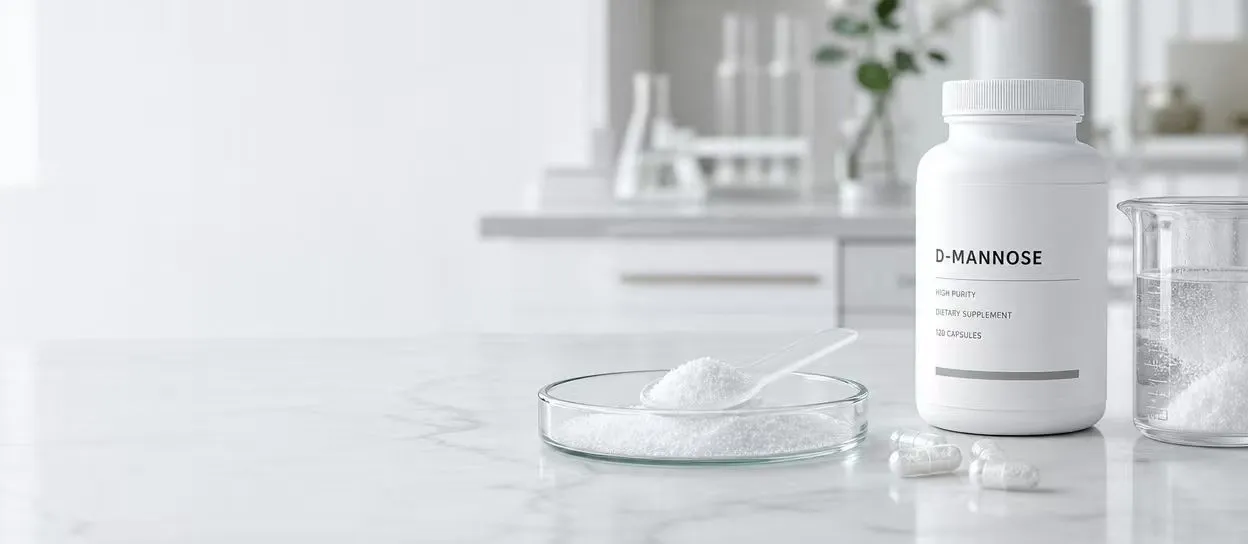
Understanding D-Mannose Powder and Its Role in Urinary Health
What Is D-Mannose Chemically?
It turns into glucose, which is another name for the simple aldohexose sugar, when broken down. It shines like a white diamond and is about 60% as sweet as sugar, but it's much better for you. When you eat D-mannose, about 90% of it goes straight into your pee without being changed in any way. It's good for bladder health because of this, and most people don't have to worry about their blood sugar.
How Does It Work Against UTIs?
There are a lot of details about the process. The fimbriae on the surface of uropathogenic E. coli bacteria have fimH lectins on them. To connect to the cells that line the bladder, they use these. D-mannose binds to these FimH lectins and makes it impossible for bacteria to stick to them. The bacteria are then flushed out of the body when you pee. A study published in 2014 in the World Journal of Urology found that D-mannose powder cut the number of recurrent UTIs by about the same amount as low-dose antibiotic prevention. It did this without changing the bacteria in the gut.
Organic vs. Synthetic Variants: What Procurement Teams Should Know
Labels that say "hypoallergenic" or "corn-free" can use the more expensive D-mannose that comes from birch trees. The standard in the business is variants made from corn using enzyme isomerization because they are cost-effective and easy to scale up. In both sources, the molecule is made of the same chemicals. For people who work in sourcing, the purities, mesh sizes, and certifications that come with a source material are what make it different from other sources.
Comparing D-Mannose Powder with Alternative Solutions
D-Mannose vs. Cranberry Supplements
There is a different way that cranberry proanthocyanidins work against germs that stick to the urinary system, but they still do it. Cranberry has less consistent clinical evidence across different groups of people, and it can be hard to make functional drinks taste good. On the other hand, D-mannose has a mild, neutral taste that mixes well with pills, drink mixes, and powder boxes. Companies that want to make healthy foods with low sugar and clean labels have more ways to do so with bulk D-mannose powder.
D-Mannose vs. Antibiotics
Antibiotic prevention is still the standard way to treat UTIs that keep coming back, but people's needs have changed. Antibiotic resistance is going up, gut change is happening, and people want non-drug options more and more. This has made it possible for the market to really open up. This hole is filled by D-mannose, which doesn't need a prescription. In most foreign areas, like the US, EU, and Canada, you can buy it as an ingredient in Dietary Supplements.
Powder vs. Capsule vs. Gummy Formats
Every style is good for a different kind of person and dish. Powder forms let you use less and dissolve faster, so you can decide how much to use. It is easier to make capsules, and they let you control the dose more precisely. The equipment used to make gummies needs to be able to handle high temperatures. D-mannose can stick around up to 130°C, but it needs to be added when the mixture is cooling so that it doesn't react with anything that would turn the sugar brown. If buying teams know these format-specific needs, they can better make sure that the right product design is used on their line.
Procurement Considerations for D-Mannose Powder
Key Certifications to Require from Suppliers
You have to pass a strict licensing check before you can get D-mannose on a large scale. People in the US and EU should demand at least GMP, HACCP, and ISO 22000 paperwork. Foods with clean labels and organic certifications look better in stores thanks to rules set by the USDA and the EU. More people in North America and the Middle East will buy from you if you have NSF and HALAL certifications. All of these things show that OAZVITA's D-mannose powder is safe. There is a full COA, MSDS, and TDS for each batch.
MOQ, Pricing, and Lead Time Realities
People who buy this ingredient in large quantities don't always know how long it takes to test a formulation. When you buy OAZVITA, you have to buy at least 1 kg. Before you buy a lot, you can get free trials. This makes buying during the research and development process less risky. You can ship by air, sea, DHL, FedEx, UPS, or airmail post. The lead time is one to five business days. The product has a size range of 30 to 80 mesh and is said to be 99% pure by HPLC. This puts it right in the middle of the range for food and medicine. Keeping it somewhere cool and dry is easy, and it will last for 24 months.
OEM and Private Label Opportunities
There is a real chance for people who buy private label because brand-name urinary health supplements are becoming more popular. OEM and ODM creation are both things that OAZVITA can do. They can come up with formulas, make capsules and powders, and make unique packages. This "turnkey" feature speeds up the time it takes for distributors to get their Products to new markets or for supplement brands to launch a UTI support line. This is done without the need for the company to have its own manufacturing facilities.
Usage Guidelines and Applications in B2B Context
Standard Dosage Parameters and Formulation Tips
You should take 2 grams of China D-mannose powder once or twice a day as part of most clinical plans to help the urinary tract. Powder bags break down quickly in water at room temperature, which is good for consumer goods that are meant to be easy to use. When formulators make capsules, they need to think about how dense the capsules are and how well they flow. Particles with a normal size of 40 to 60 mesh don't separate much during high-speed sealing. D-mannose stays chemically stable in functional drinks with a pH between 3.0 and 5.0. This means that it can be used in drinks with a lemon taste.
Expanding into Veterinary and Pet Health Applications
There is a B2B niche market for pet products that is growing quickly, but not many names are in it yet. Dogs, especially females, get UTIs about as often as people do, and veterinary clinics are looking for more non-antibiotic ways to help dogs go to the bathroom. D-mannose is often used in pet formulas at doses that are based on the animal's weight. It is safe, which makes it a good addition to pet supplement lines. When a company already makes supplements for people, it's easy for them to make more supplements for pets by using the same main ingredient.
Synergistic Formulation with Other Ingredients
Hibiscus extract, probiotics (especially Lactobacillus rhamnosus and L. reuteri), and cranberry extract all work well with D-mannose when used together in formulas to help with UTIs. These sets are good for people who want thick, all-around clothes. D-mannose doesn't break down much at temperatures up to 130°C, so candy makers can use the same tools they normally use to work with sweets.
Reviews, Scientific Data, and Market Feedback
What Clinical Research Shows
In a 6-month study, Kranjec et al. (2014) found that d-mannose powder significantly reduced the number of recurrent UTIs while being safer than antibiotics. In a different review, Cochrane found evidence that it can be used as a first-line supplement for prevention. So long as supplement brands follow the rules set by the FDA and EFSA for urine health lines, these results directly support what they say about their products.
What B2B Buyers Report
Three things are always at the top of the list for buying teams when they buy a lot of D-mannose: making sure the product is pure, making sure the supply chain is stable, and making sure all certifications are complete. People who buy COAs that have been checked by a third party and keep HPLC data that is the same from batch to batch are less likely to have quality problems in the future. These problems are taken care of at the purchasing level by OAZVITA's 99% HPLC purity standard and per-batch paperwork. This makes it easy for producers who buy in bulk to follow the rules.
Market Trajectory
By 2030, the world market for UTI vitamins should have grown at a rate of more than 7% per year. More and more people are aware of antibiotic resistance and want to use health products that protect them. D-mannose is the main thing that is causing this trend. Supplement brands that get their hands on high-quality ingredients first will have an advantage in this product category for a long time.
Conclusion
There is a lot of research on D-mannose powder, and it has been shown to be useful in functional drinks, urinary tract supplements, and pet health products. People who make functional foods, supplement brands, and OEMs should choose this because it doesn't stick to things, doesn't raise blood sugar, and works well with a lot of different formulations. As the need for bladder support that doesn't use antibiotics grows, the fastest way to get a product that can compete is to buy approved, high-purity bulk material from a site you can trust.
Frequently Asked Questions
1. Is d-mannose powder safe for people managing blood sugar?
Yes. Because approximately 90% of ingested D-mannose passes into urine without being metabolized for energy, it has minimal impact on blood glucose compared to sucrose or glucose. That said, individuals with diabetes should monitor their levels when adding any new supplement to their routine.
2. What certifications should I require when sourcing bulk D-mannose?
At minimum, require GMP, HACCP, ISO 22000, and a full COA with HPLC purity verification. For US market products, NSF certification adds credibility. For clean-label or international distribution, USDA Organic, EU Organic, and HALAL certifications open broader channels.
3. Can d-mannose powder be used in gummy formulas?
Yes. It is heat-stable up to approximately 130°C. In gummy production, add it during the cooling phase to prevent Maillard browning if proteins are present in the formula.
4. Does d-mannose interact with common medications?
No significant drug interactions have been documented in peer-reviewed literature. It is not metabolized through hepatic pathways that affect most pharmaceutical compounds. Always recommend that end consumers consult a healthcare provider before combining supplements with prescription medications.
Source OAZVITA D-Mannose Powder — Request a Quote Today
A pharmaceutical-grade D-mannose powder is made by OAZVITA. Their products are 99% pure by HPLC, have a 30–80 mesh standard, and are certified by HACCP, ISO 22000, NSF, HALAL, USDA Organic, and EU Organic. We help brands at every stage, from testing samples to making a lot of OEMs. Our lead times are between 1 and 5 working days; our MOQs are flexible, starting at 1 kg, and we ship all over the world with DHL, FedEx, UPS, and Sea Freight. Email us at info@oazvita.com to find out prices and get free samples.
References
1. Kranjčec, B., Papeš, D., & Altarac, S. (2014). D-mannose powder for prophylaxis of recurrent urinary tract infections in women. World Journal of Urology, 32(1), 79–84.
2. Schaeffer, A. J., & Nicolle, L. E. (2016). Urinary tract infections in older men. New England Journal of Medicine, 374(6), 562–571.
3. Foxman, B. (2014). Urinary tract infection syndromes: Occurrence, recurrence, bacteriology, risk factors, and disease burden. Infectious Disease Clinics of North America, 28(1), 1–13.
4. Acheson, D. W. K., & Luccioli, S. (2004). Microbial-gut interactions in health and disease: Mucosal immune responses. Best Practice & Research Clinical Gastroenterology, 18(2), 387–404.
5. Bien, J., Sokolova, O., & Bozko, P. (2012). Role of uropathogenic Escherichia coli virulence factors in development of urinary tract infection and kidney damage. International Journal of Nephrology, 2012, 681473.
6. Gupta, K., Hooton, T. M., Naber, K. G., et al. (2011). International clinical practice guidelines for the treatment of acute uncomplicated cystitis and pyelonephritis in women. Clinical Infectious Diseases, 52(5), e103–e120.

Send Inquiry

Related Industry Knowledge
- The Hidden Benefits of Cistanche Tubulosa Extract Powder for Men's Sexual Health
- Best NAD+ Supplement for Energy, Brain Function & Healthy Aging
- Tribulus terrestris for natural energy, balance & strength
- A Formulator’s Guide to Unlocking Milk Thistle’s Full Potential
- Pure Bulk Curcumin: Overview of Extraction Methods, Health Benefits
- How Much Vitamin D3 Should Athletes Take?
- Discovering the Benefits of Raw Cacao PowderIs 100% raw cacao good for you?
- Complete Guide to Chewable Probiotic Gummies
- China-Based Expertise in High-Purity Glutathione Powder for Global Markets
- Best Pure Fish Collagen Peptide for Health and Beauty