Pure Bulk Curcumin: Overview of Extraction Methods, Health Benefits
Jul 24, 2026
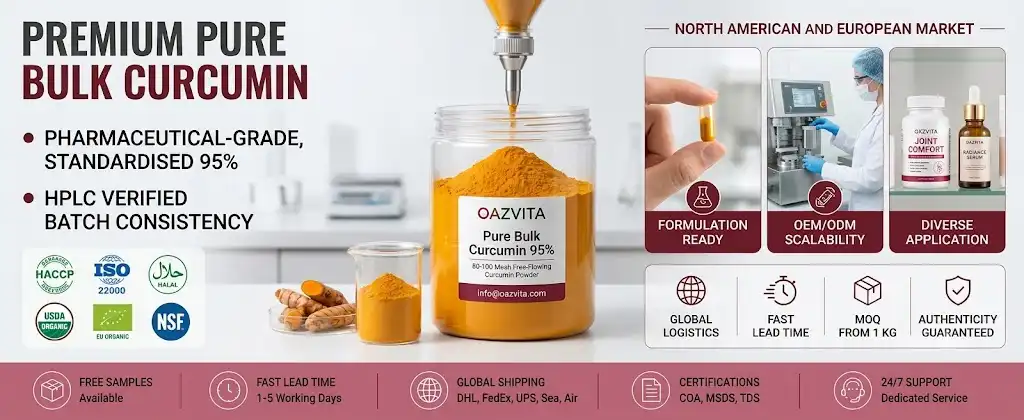
Pure Bulk Curcumin is a pharmaceutical-grade, standardised extract from Curcuma longa rhizomes that has been carefully processed to contain at least 95% total curcuminoids. Unlike regular turmeric powder, which only has 2-5% active compounds, this concentrated form is always strong enough for supplement makers, functional food makers, and cosmetics brands that need stable bioactive ingredients. The substance has three different curcuminoids: curcumin, demethoxycurcumin, and bisdemethoxycurcumin. This makes it an important part of anti-inflammatory Products and natural colourants in the nutrition business.
Understanding Pure Bulk Curcumin and Its Extraction Methods
What Distinguishes Pure Bulk Curcumin from Raw Turmeric?
The quantity and density of raw turmeric are different from those of refined turmeric. There are different amounts of curcuminoids in raw turmeric root, along with starches, fibres, and other plant materials. This plant turns into a solid, orange-yellow powder that has the formula C₂₁H₂₀O₆ and a freezing point of 183°C when it is processed. We use materials that meet USP, EP, and JP pharmacopeial monographs, which guarantee batch-to-batch reliability that is important for mass production. This standardisation solves a problem that has been around for a long time in supplement production: the unpredictable strength of raw biomass makes it hard to make sure that the mixture is always the same.
In business settings, the physical properties are very important. A mesh size of 80 to 100 makes sure that the material flows smoothly through capsule filling machines. Its lipophilic nature—it dissolves in ethanol and acetone but not water—requires specific formulation methods. These technical factors have a direct effect on how well the product is made and how stable it is when it's finished. Because of this, B2B procurement teams must take them into account when they are reviewing supplier specs.
Traditional vs. Advanced Extraction Techniques
The way an extraction is done has a big effect on the final product's quality and market value. Traditional ethanol extraction is still used a lot because it is cheap and easy to scale up. To do this, ground turmeric rhizomes are soaked in food-grade ethanol to dissolve the curcuminoids. The mixture is then filtered, concentrated under vacuum, and crystallised. The method gives good yields, but it needs to be tested carefully for residual solvents to meet USP <467> standards, which usually limit ethanol residues to Class 3 solvent levels.
For markets that are recognised as organic, supercritical CO₂ extraction has become the best option. By using certain levels of pressure and temperature, this technology carefully separates curcuminoids without using chemical solvents. The result is very clean material that doesn't contain any traces of petrochemicals. The higher capital investment means higher prices—usually 15–25% more than ethanol-extracted grades—but it has clear benefits for brands that sell their goods as "clean label" or that are going after European markets with strict rules about contaminants.
Carbon-14 isotope analysis is a key quality check that tells the difference between natural and synthetic curcumin. Radioactive carbon isotopes from photosynthesis are found in natural extracts, but "dead" carbon is found in synthetic versions that come from petroleum. We suggest Beta Analytic testing for procurement verification. This will protect buyers from economic fraud that hurts claims of product authenticity. Synthetic curcumin that is 98% pure is now available at much lower prices, which makes this testing necessary. Buyers who are only interested in price may not understand the legal and social risks.
Raw Material Sourcing and Purity Standards
Where curcuminoids and contaminants come from has a big effect on their profiles and levels. If turmeric is grown in areas with high levels of lead in the soil, it may be higher than the limits set by California Proposition 65. This means that it needs to be processed using chelation or regional sourcing methods. Good makers use rules at the farm level, choosing where to grow crops based on past soil tests and following organic farming methods to keep pesticides from getting into the crops.
When it comes to analysis, purity grade follows strict rules. High-Performance Liquid Chromatography (HPLC) is the best way to make sure that an assay is correct, and it can show where all three curcuminoids are found. UV-Vis spectroscopy is less expensive, but it is not very specific, which means that it can be fooled by substances that absorb light at similar wavelengths. The certificates of analysis for Pure Bulk Curcumin must say that the HPLC method showed at least 95% of the total curcuminoids, with curcumin making up 70–75%, demethoxycurcumin making up 15–20%, and bisdemethoxycurcumin making up 3–5%. Single-peak chromatograms suggest that the substance is synthetic or that it has been processed too much, which removes natural cofactors.
Comprehensive Health Benefits of Pure Bulk Curcumin
Anti-Inflammatory and Antioxidant Properties
The compound's reputation as a medicine comes from its molecular-level ability to change inflammatory pathways. NF-κB transcription factors control the production of inflammatory genes in joints, heart cells, and neural systems, according to new research. This mechanism backs up claims about the ingredients in joint comfort products aimed at active older adults and sports recovery supplements that deal with inflammation caused by exercise.
Based on their ORAC (Oxygen Radical Absorbance Capacity) values, curcuminoids are some of the best natural substances for getting rid of free radicals. This feature can be found in topical cosmeceuticals as well as supplements, where tyrosinase prevention supports claims of brightening the face. Formulators who are making anti-ageing serums use these qualities, though applying raw powder can be tricky because it can stain the skin. Advanced delivery systems that use tetrahydrocurcumin or nanocarriers stop colour transfer while keeping the antioxidant activity.
Addressing Bioavailability Challenges
Curcuminoids are broken down quickly in the liver through glucuronidation and sulfation, which stops them from reaching the general bloodstream. Studies show that curcumin that hasn't been improved doesn't have high plasma concentrations, even when taken by mouth in large amounts. This means that there is a gap between what happens in lab studies and what happens in real life.
This limitation is fixed by a number of enhancement strategies. According to a written study, taking piperine with other drugs inhibits enzymes in the liver, which increases bioavailability by about 2000%. Liposomal and phytosome technologies protect curcuminoids during passage through the digestive tract by encasing them in phospholipid complexes. Although these formulations cost more, they have significantly better absorption rates that explain their higher market placement. Supplement brands that want to attract customers who care about effectiveness are mentioning these improved forms more and more in their marketing materials, making product lines that are different in competitive categories.
Dosage Considerations and Safety Profile
Doses of standardised extract ranging from 500 mg to 2000 mg per day are commonly used in clinical trials. These doses set safety standards for product developers. In most markets, curcumin is considered generally recognised as safe (GRAS), which means that it can be used as a supplement without needing to be put through a lot of toxicology studies. But, because it can cause platelets to stick together slightly, formulators need to be aware of possible interactions with blood thinners. They also need to be careful with high doses that go over 8g per day, as these may cause stomach problems in sensitive people.
Monographs from the European Food Safety Authority (EFSA) and records of bad events kept by national regulatory bodies are helpful for teams working on new turmeric extract powder products. This research backs up label claims that can be defended and the right kind of warnings. This lowers the risk of liability while still protecting consumers.
Key Market Comparisons and Decision-Making for Bulk Buyers
Purity Levels: 95% Natural vs. 98% Synthetic
The difference in purity between natural and synthetic grades leads to strategic decisions about what to buy. Natural extracts that are standardised to contain 95% total curcuminoids keep the native curcuminoid complex, which some research suggests has benefits beyond those of isolated curcumin. Clean label trends are supported by this content, and "whole plant" marketing stories that appeal to health-conscious customers are also supported.
Synthetic curcumin is 98% pure because it is made using chemicals. It is cheaper than extracting curcumin from plants by 30 to 40 per cent. But regulatory environments are looking more closely at synthetic chemicals in natural product groups. Carbon-14 testing clearly shows that something is manmade, which makes brands that say they are natural vulnerable. Allegations of adulteration do more damage to a company's reputation than they save in short-term costs. For procurement departments that care about quality, authentication testing is a smart investment.
Organic Certification Implications
The price of organic curcumin is 25–35% higher than that of regular grades. This is because organic farming has tougher rules for farmers, it costs more for a third party to check the quality of the curcumin, and the crops produced are smaller. For USDA and EU organic certifications, full supply chain documentation is needed from getting the seeds to making sure there are no synthetic pesticides, banned fertilisers, or GMOs in the final packaging.
These certifications open up certain market segments, especially in European distribution channels, where more than 40% of supplements are organic in some categories. Organic certification is important for brands that want to sell natural foods or use premium positioning strategies to get on store shelves and build trust with customers. The investment pays off because there is less opposition in the market, and the company is in line with retailer sustainability programmes that favour certified suppliers more and more.
Form Factor Considerations: Powder vs. Enhanced Delivery
Manufacturers who can encapsulate their products in-house have the most formulation options when they use the raw powder form. The substance can be put into pills, tablets, functional drinks that need to be emulsified, and skin treatments with the right carriers. But the fact that it doesn't mix with water makes clear drinking systems and ready-to-drink forms more difficult to make.
To make steady watery dispersions, water-dispersible curcuma Longa powder grades use colloidal suspensions or cyclodextrin complexation. These special formats work well for beverage makers who don't have emulsification equipment, but they cost 50–70% more than regular powder. Based on the target product formats and manufacturing infrastructure, procurement teams must decide if adding more functionality is worth the extra money.
Conclusion
To find good curcuminoids that come from turmeric, you have to deal with a lot of complicated technical requirements, legal requirements, and supplier verification protocols. Differences in extraction methods, purity grades, and licensing standards have a direct effect on how well a product works, how well it meets legal requirements, and how it positions itself in the market. If procurement teams know about HPLC verification, bioavailability enhancement strategies, and authentication testing, they can make decisions that balance quality needs with cost concerns. Anti-inflammatory botanicals are becoming more and more popular around the world in food, supplements, and beauty products. To stay ahead of the competition and ensure a steady supply, it's important to work with certified suppliers who offer clear documentation and technical support.
FAQ
1. How can I verify whether curcumin is naturally extracted or synthetically produced?
Carbon-14 isotope tests at approved labs like Beta Analytic are the only way to be sure of someone's identity. Natural plant extracts have radioactive carbon from photosynthesis, but synthetic curcumin made from petroleum has no C-14. When qualifying a supplier, it's important to ask for C-14 analysis reports, especially when looking at offerings that are surprisingly cheap and could mean that synthetic material was misrepresented as natural.
2. What certifications should I prioritise when selecting a supplier?
GMP certification makes sure that quality systems are used in manufacturing, and organic certifications (from the USDA and the EU) check that farming methods are followed and that the supply chain is honest. ISO 22000 shows how to manage food safety, and HACCP implementation shows how to control hazards. Also, make sure that sellers show proof of testing by a third party for heavy metals, pesticide residues, and microbiological contamination that meets the needs of the target market.
3. Why does water-insoluble curcumin pose formulation challenges?
Because the substance is lipophilic, it doesn't dissolve directly in water-based systems like drinks or clear vitamins. To get stable water dispersions with this property, manufacturing methods like emulsification, cyclodextrin complexation, or liposomal encapsulation are needed. Standard powder works well for standard pills and oil-based products, but it needs to be improved with new technologies for water-based products.
Partner with OAZVITA for Premium-Quality Curcumin Supply
Pharmaceutical-grade turmeric extract powder (CAS NO.: 458-37-7) is sold by OAZVITA. It has many approvals, such as HACCP, ISO 22000, NSF, HALAL, EU Organic, and USDA Organic. Our natural 95% curcuminoid standardised material goes through strict testing by a third party. Each batch comes with COA, MSDS, and TDS paperwork that proves it meets international standards. As a well-known pure bulk curcumin supplier, we keep our annual export volumes above USD 15 million by ensuring consistent quality and on-time delivery to companies that make functional foods, sports nutrition products, and dietary supplement brands in North America and Europe.
To speed up the time it takes to make a product, our technical team offers free samples and detailed application advice. We can work with both new brands trying formulations, and established makers needing container-load shipments because our minimum order quantity (MOQ) starts at 1 kg, and our packaging solutions can be changed to fit your needs. Our 99%+ on-time delivery record shows that we are very good at what we do, and our 24/7 customer service and dedicated account management make sure that we can communicate with people in different time zones. Email us at info@oazvita.com to talk about your curcumin needs and get access to technical resources that can help you reach your formulation goals.
References
1. Hewlings, S.J. & Kalman, D.S. (2017). Curcumin: A Review of Its Effects on Human Health. Foods, 6(10), 92.
2. Prasad, S. & Aggarwal, B.B. (2011). Turmeric, the Golden Spice: From Traditional Medicine to Modern Medicine. In Benzie, I.F.F. & Wachtel-Galor, S. (Eds.), Herbal Medicine: Biomolecular and Clinical Aspects (2nd edition). Boca Raton: CRC Press.
3. Gupta, S.C., Patchva, S. & Aggarwal, B.B. (2013). Therapeutic Roles of Curcumin: Lessons Learned from Clinical Trials. The AAPS Journal, 15(1), 195-218.
4. Tayyem, R.F., Heath, D.D., Al-Delaimy, W.K. & Rock, C.L. (2006). Curcumin Content of Turmeric and Curry Powders. Nutrition and Cancer, 55(2), 126-131.
5. Anand, P., Kunnumakkara, A.B., Newman, R.A. & Aggarwal, B.B. (2007). Bioavailability of Curcumin: Problems and Promises. Molecular Pharmaceutics, 4(6), 807-818.
6. European Food Safety Authority (2010). Scientific Opinion on the Re-evaluation of Curcumin (E 100) as a Food Additive. EFSA Journal, 8(9), 1679.

Send Inquiry

Related Industry Knowledge
- 6 Health Benefits of Hericium Erinaceus Extract Powder
- Cordyceps Sinensis Extract Powder Guide: Energy & Performance Boost
- Cordyceps Sinensis Extract Powder: A Guide to Its Benefits
- Liquid Shilajit Drops: Benefits, Dosage & Comparison
- Pure Inositol Powder or Inositol Complex? Best Choice for Supplement Users
- Australia Procurement Considerations for High-Purity Pure Ashwagandha Capsules
- Best TUDCA Powder Uses for Liver Support in the Medical Industry
- Bovine Collagen Peptides Trusted by Medical Nutrition Firms in France
- How to choose high-quality spirulina chlorella tablets?
- How does pure NMN powder support cellular energy and repair?