
High purity magnesium glycinate powder: mixing behavior, flavor-profile and solubility
May 28, 2026
Making things is hard for the nutrition business, but High Purity Magnesium Glycinate Powder helps with some of them. Different kinds of magnesium salts don't mix as well with this completely reactive material. It tastes bland and breaks down faster. Firms that know about these traits can make their goods taste better, be easier to digest in many settings, and run their production lines more smoothly.
Understanding High-Purity Magnesium Glycinate Powder
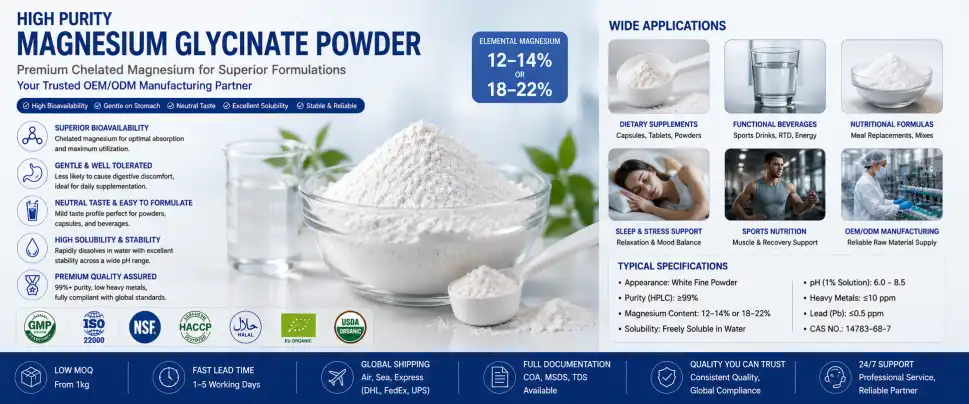
The chelated structure of magnesium glycinate makes it a good choice for B2B makers who need stable raw materials. This good stuff connects magnesium ions to glycine amino acids through coordinated covalent bonds. This is not the same as simple magnesium salts, which could make your stomach upset. Strict quality tests have shown that OAZVITA's magnesium diglycinate (CAS NO.: 14783-68-7) always has a magnesium amount between 12–14% and 18–22%.
Chemical Composition and Purity Standards
A molecular weight of about 172.42 g/mol can be found from the formula Mg(C₂H₄NO₂)₂. This helps formulation scientists figure out doses correctly. Premium types are more than 99% pure because they are made with improved methods that get rid of reaction waste and limit the amount of heavy metals that get into them. The FTIR test shows full binding, which is what makes real goods different from mixes of magnesium oxide and glycine.
Bioavailability and Safety Profile
Since chelated minerals are moved through dipeptide transport routes instead of passive diffusion processes, the body can take them in more easily. Patients are more likely to follow instructions since the medicine works better and they need less of it. People can make medicine that helps them sleep and deal with stress out of the glycine part.
Mixing Behavior of Magnesium Glycinate Powder in Formulation Processes
The effectiveness of manufacturing depends a lot on being able to predict how the ingredients will mix during production cycles. The bulk density of High Purity Magnesium Glycinate Powder is between 0.6 and 0.9 g/mL, which makes it easy for automatic equipment to handle the powder consistently.
Particle Size Distribution and Flow Properties
The best particle size distribution stops particles from separating during mixing, making sure that the finished goods have a uniform distribution. The powder's circular shape keeps it from crossing and rat-holing in hoppers, which keeps production from stopping. Angle of repose readings are usually between 25 and 35 degrees, which means the flow is good enough for high-speed sealing lines.
Equipment Compatibility and Processing Parameters
When it comes to handling magnesium glycinate formulas, V-blenders and ribbon mixers work better. To keep particles from falling apart and get a uniform spread, mixing should last between 10 and 15 minutes at low speeds. Chelates stay intact during long working steps when the temperature is kept below 40°C.
Troubleshooting Common Processing Challenges
Because magnesium glycinate is moderately hygroscopic, it is important to keep the humidity under control while mixing. Using climate-controlled settings stops caking and keeps the flow characteristics constant. Adding the right desiccants or flow agents to a recipe with moisture-sensitive ingredients can solve any clumping problems that might come up.
Flavor Profile and Its Impact on Product Development
Although some things taste bad, people still try to accept them. Additionally, this is very important for drinks and pills that you chew. Either magnesium sulfate or magnesium citrate will taste heavy and bad. But pure magnesium glycinate doesn't taste very good.
Sensory Characteristics and Consumer Appeal
Review groups that test foods always say that chelated magnesium tastes better than conventional salts. Glycine gives it a light sweetness that hides any mineral taste that may still be there. So, clean-label goods can be made without adding a lot of flavorings. This bland quality works great in drinks and pills that kids can use, since it can be hard and expensive to hide tastes.
Flavor Stability Across pH Ranges
High Purity Magnesium Glycinate Powder has a neutral taste in most drinkable pH ranges (3.0-7.0), while magnesium compounds that are sensitive to pH develop bitter notes when they are introduced to acidic environments. Because it is stable, it can be used in many ways to make sports drinks, functional waters, and acidified foods without changing the taste or needing extra filling agents.
Solubility Characteristics Critical for Procurement Decisions
Solubility factors have a direct effect on how quickly the product is made, how well it works, and how accessible it is. It's easier for magnesium glycinate to mix with water than magnesium oxide, and it stays the same when the pH level is normal. Because the best OAZVITA breaks down completely in water, it can be used in a lot of different ways.
Dissolution Kinetics and pH Stability
It spreads out quickly and breaks down fully in 5 to 10 minutes at room temperature, according to tests. When the pH level changes from 2.0 to 10.0, the chelated structure stays the same. This means that magnesium is always available, even if the stomach acid level changes. A magnesium carbonate safety is very different from this because magnesium carbonate can only dissolve in acidic conditions.
Processing Implications for Liquid Formulations
The compound's ability to stay in solution and not separate during storage is good for people who make drinks. Clear solutions don't settle, so they keep their sharp look, which is important for high-end healthy drinks. Besides that, they don't need anything to keep the drink stable or systems that stir it all the time. These traits improve the product's look on the shelf and make the plan easier to follow. The cost of making the goods goes down, too.
Choosing and Procuring High-Purity Magnesium Glycinate Powder: A Decision Support Guide
Before making a purchase choice, you need to carefully look at the skills, quality certifications, and expert support services of the seller for High Purity Magnesium Glycinate Powder. OAZVITA gives a lot of paperwork, like HACCP, ISO 22000, NSF, HALAL, EU Organic, and USDA Organic certificates, to make sure that it follows all foreign rules.
Quality Assurance and Testing Protocols
Every package comes with a Certificate of Analysis (COA), Material Safety Data Sheet (MSDS), and Technical Data Sheet (TDS). These documents provide quality assurance for each batch. Lead content is below 0.5 ppm, arsenic is below 1.0 ppm, and cadmium is below 0.5 ppm, which are all levels that are needed for special supplement uses. Microbiological testing makes sure that Salmonella and E. coli tests come back negative, and overall plate counts stay below 1,000 CFU/g.
Supply Chain Reliability and Logistics
Minimum order amounts that are flexible and start at 1 kg can be used for both research and development (R&D) trials and business production. Shipping choices like air, sea, DHL, FedEx, UPS, and airmail post make sure that packages get delivered on time all over the world. Lead times of 1–5 working days help with just-in-time inventory management, and a shelf life of 24 months in cool, dry storage cuts down on waste and the cost of keeping goods on hand.
Conclusion
High Purity Magnesium Glycinate Powder has unique performance benefits thanks to its excellent mixing properties, neutral taste, and exceptional absorption properties. Manufacturers can make unique Products with better bioavailability, better customer acceptance, and more efficient production methods thanks to these technical benefits. This ingredient is the best choice for tough nutraceutical uses because it meets proven quality standards, has a stable supply chain, and comes with full expert support.
FAQ
1. What distinguishes high-purity magnesium glycinate from buffered alternatives?
Real, high-purity magnesium glycinate has 11.7% elemental magnesium and is made up of 100% fully chelated magnesium bisglycinate. Buffered forms add magnesium oxide to dilute this to falsely raise the amount of elemental magnesium to 20–30%. This makes it much less bioavailable and increases side effects in the gut.
2. How can manufacturers verify complete chelation in magnesium glycinate powder?
The Fourier-Transform Infrared Spectroscopy (FTIR) study proves beyond a doubt that chelates have formed. Fully processed products have unique spectrum fingerprints that show how the absorption bands of amino and carboxyl groups change, which means they are properly connecting with magnesium ions. If these spectrum changes aren't happening, it means that the reaction or mixing isn't complete.
3. Does magnesium glycinate maintain stability in varying beverage pH levels?
It is true that chelated magnesium glycinate is very stable over a wide pH range. The bisglycinate chelate stays whole and dissolves in neutral or slightly acidic beverage recipes, while magnesium carbonate needs acidic conditions to dissolve. This means that the bioavailability stays the same.
4. What storage considerations apply to magnesium glycinate powder?
Even though it is fairly hygroscopic, storing it in moisture-barrier packaging with desiccants keeps the flow properties and stops caking. The package for OAZVITA says that it will stay stable for 24 months if it is kept in a cool, dry place below 25°C with a relative humidity of less than 60%.
Partner with OAZVITA for Premium Magnesium Glycinate Solutions
As a reliable provider of high-purity magnesium glycinate powder, OAZVITA offers pharmaceutical-grade materials backed by a wide range of certifications and technical know-how. Our free sample program, flexible packaging choices, and customer service that is available 24/7 make it easy for us to fit into your product creation processes. With over USD 15 million in yearly exports and 99% on-time delivery rates, we can give you the steadiness and dependability you need to grow your business. Get in touch with our expert team at info@oazvita.com to talk about your needs and find out how our quality magnesium glycinate can help your formulations.
References
1. Nielsen, F.H. "Magnesium deficiency and increased inflammation: current perspectives." Journal of Inflammation Research, vol. 11, 2018, pp. 25-34.
2. Coudray, C., et al. "Study of magnesium bioavailability from ten organic and inorganic Mg salts in Mg-depleted rats using a stable isotope approach." Magnesium Research, vol. 18, no. 4, 2005, pp. 215-223.
3. Schuette, S.A., et al. "Bioavailability of magnesium diglycinate vs magnesium oxide in patients with ileal resection." Journal of Parenteral and Enteral Nutrition, vol. 18, no. 5, 1994, pp. 430-435.
4. Walker, A.F., et al. "Mg citrate found more bioavailable than other Mg preparations in a randomised, double-blind study." Magnesium Research, vol. 16, no. 3, 2003, pp. 183-191.
5. Mühlbauer, B., et al. "Magnesium-L-aspartate-HCl and magnesium-oxide: bioavailability in healthy volunteers." European Journal of Clinical Pharmacology, vol. 40, no. 4, 1991, pp. 437-438.
6. Fine, K.D., et al. "Intestinal absorption of magnesium from food and supplements." Journal of Clinical Investigation, vol. 88, no. 2, 1991, pp. 396-402.

Send Inquiry
Related Industry Knowledge
- Chewable Collagen Gummies vs Powder: A Side-by-Side Comparison
- Pure Creatine Monohydrate Gummies: how they work, benefits, and safety considerations and certification
- What are Shilajit drops used for?
- A Complete Guide to Consuming Shilajit Drops for Maximum Benefits
- China Scalable Production of Lion’s Mane Mushroom Extract Capsules for Global Supply
- Germany Demand for Highly Bioavailable Pure Magnesium Glycinate Capsules
- What Is Pure NAD+ Powder and How Does It Work in Anti-Aging
- Best TUDCA Powder Uses for Liver Support in the Medical Industry
- Avoiding Batch Variability in Fish Collagen Peptides for EU Buyers
- High purity magnesium glycinate powder: absorption and bioavailability