
What are Shilajit drops used for?
Jun 10, 2026
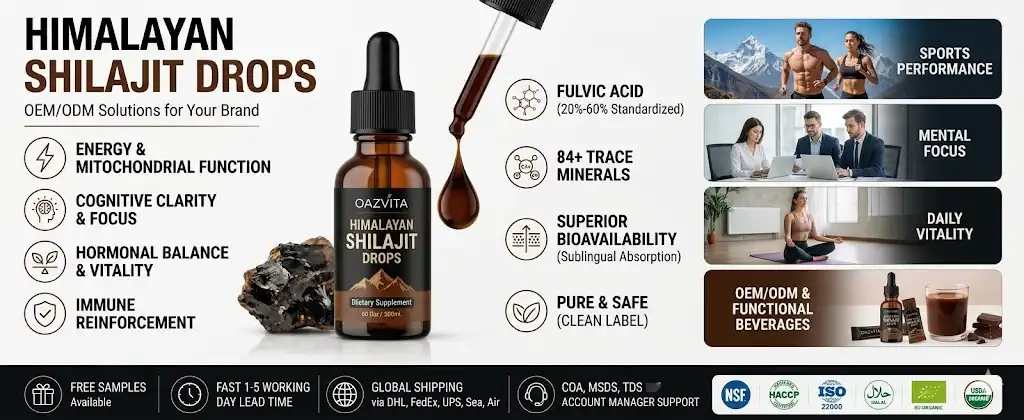
Products/shilajit-drops">Shilajit Drops are a liquid product made from minerals found at high elevations, mostly in the Himalayan, Altai, and Caucasus mountain areas. There are over 84 trace elements in these soluble drops, along with abundant fulvic acid and humic chemicals. People take them to boost their energy, mental focus, hormonal balance, and general health. The liquid form is better at being absorbed than the plastic or powder forms, which is why it is the most popular choice for modern health routines and useful product formulas.
The Evolution of an Ancient Adaptogen into Modern Liquid Form
Shilajit is a naturally occurring mineral that has been used for hundreds of years in traditional medicine. The interesting thing about the liquid drop style is that it solves problems that buying managers and formulators face every day.
When I first saw shilajit resin many years ago, it was very hard to work with because it was sticky and thick like tar. To get exact amounts, the mixture had to be heated, scraped, and dissolved, which felt more like science class than health support. Everything changed when the drops hit.
Modern methods of mining keep the good parts while getting rid of the bad ones that are bad for the environment. Dibenzo-alpha-pyrones and other beneficial molecules stay intact when they are processed at low temperatures. The end result is a standard, easily measured liquid that can be used in everyday life or in business products.
Seven Core Applications That Drive Market Demand
Supporting Daily Energy and Mitochondrial Function
Cellular energy creation is the main reason why people use these drops. Fulvic acid is a messenger molecule that makes it easier for nutrients to get into cells. This process helps make ATP, which is the cell's main source of energy.
This app has been especially useful for athletes who train at high elevations. The mineral complex helps the body use oxygen, which is very important when the amount of oxygen in the air drops. Brand owners who are making performance goods are aware of this niche market potential.
Cognitive Clarity and Mental Performance Enhancement
Working settings require you to keep your mind on the task at hand. The drops have chemicals in them that help neurotransmitters work and keep brain circuits safe from reactive stress. Users say they can focus better on difficult jobs.
Himalayan shilajit juice is often mixed with other adaptogens by people who make cognitive support stacks. The combined effect works on several processes, including neuroinflammation, the stress response, and the function of mitochondria in brain tissue. People who want all-around mental performance help will like this multi-target method.
Hormonal Balance and Vitality Support
Researchers have found that fulvic acid and minor minerals help the endocrine system work. Men who want to boost their testosterone naturally have shown a lot of interest. Women who are going through menstrual changes may also find these drops helpful for their overall health.
The liquid delivery method lets the chemical be absorbed under the tongue, so it doesn't get broken down in the digestive system. Because drops are more bioavailable, they are better for hormone-related uses where accurate dosing is important.
Immune System Reinforcement
Zinc, selenium, and iron are all part of the chemical group and are necessary for defence cells to work. Fulvic acid has qualities that help the body's natural reaction systems work better without making them too active.
A lot of people use these drops as part of larger health routines when the seasons change. Companies that make immune-supporting products use flexible liquid ingredients because they mix easily with vitamin C, elderberry extracts, and other ingredients that work well together.
Detoxification and Heavy Metal Chelation Properties
The chelating qualities of fulvic acid can be used in an interesting way. It binds to heavy metals and toxins, which might help the body get rid of them. People who are worried about their exposure to the world will like this quality.
Here, quality control is very important. In a strange way, shilajit that hasn't been properly handled can add the contaminants that it's supposed to get rid of. ICP-MS tests from a reputable China Shilajit Drops Supplier show that the amounts of lead, mercury, arsenic, and cadmium are well below what is considered safe. Before buying, you should always check these certificates.
Anti-Aging and Cellular Protection
Another important application driver is antioxidant ability. Over time, damage from free radicals builds up, which leads to noticeable ageing and cell failure. There are several antioxidants in the drops that get rid of reactive oxygen species.
Nutricosmetics companies have taken advantage of this benefit by making products that are "beautiful from the inside out." When you mix shilajit extract with collagen peptides, hyaluronic acid, and plant vitamins, you get complete formulas that work on many ageing processes at once.
Sports Recovery and Muscle Support
Recovery from exercise involves a lot of complicated bodily processes, such as lowering inflammation, fixing damaged tissues, and regenerating energy. These healing processes are helped by the electrolyte balance and mineral makeup of these drops.
Functional drink companies have added them to healing elixirs and protein shakes as extras. Minerals in powder form can sometimes clump together, but minerals in liquid form dissolve easily. Cold-fill production lines keep the quality of the ingredients while they are being made.
Why Liquid Drops Outperform Traditional Formats
The benefit of liquid goes beyond ease of use. Active chemicals can get into the bloodstream within minutes through sublingual absorption, so they don't have to go through first-pass processing in the digestive system. When compared to pills or tablets, bioavailability goes up by a huge amount.
For industrial products, dosage accuracy is important. Even experienced formulators have trouble correctly measuring thick glue. Drops get rid of this uncertainty, making sure that the uniformity from batch to batch that regulators and brands that care about quality require.
Another thing to think about is temperature sensitivity. Traditional glue needs to be heated to dissolve, which could damage enzymes and chemicals that are sensitive to heat. Since liquid drops don't need to be heated, all of their health benefits stay intact.
Quality Indicators That Separate Premium Products from Inferior Alternatives
When judging providers, you should look closely at a number of technical factors. Instead of using inaccurate colourimetric methods, HPLC analysis should be used to make sure that the fulvic acid level is between 20 and 60 per cent. The specific gravity is usually between 1.1 and 1.3, which shows that the percentage is right.
Microbiological tests must show that E did not exist. coli, Salmonella, and too much mould or yeast. The organic source material naturally has pollution risks that need to be removed through proper handling.
Solvent residue analysis checks to see if enough ethanol or other liquids used for extraction have been removed to be safe. Check the GC-MS testing records of goods that say they are "alcohol-free" to be sure.
There should be at least 60 different elements in trace mineral samples. Iron, magnesium, calcium, and potassium should all be present in meaningful amounts. Mineral patterns that are suspiciously regular could mean that the spikes were made in a lab instead of being natural.
Colour uniformity means that standardisation is done right. Drops of good quality stay a dark brown to black colour from batch to batch. Large differences in colour could mean that the processing wasn't done correctly or that fillers were added.
Integration Scenarios Across Different Product Categories
Making functional drinks comes with its own set of problems. The drops can be easily mixed into coffee options, energy shots, and elixirs that help the body adapt. Their natural earthy flavour goes well with chocolate and herbal notes, and makes them seem more real.
Soft gel formulations can have standardised liquid extracts added to them by capsule makers. This method gives people liquid absorption in the pill form that many people are used to.
Topical applications represent an emerging frontier. Some skincare formulators experiment with adding diluted Himalayan Shilajit Liquid drops to serums, leveraging the antioxidant and mineral content for external applications. The science here remains preliminary, but innovation often begins at the experimental edge.
Regulatory Compliance and International Market Access
For global delivery to work, different legal environments must be navigated. Getting certificates like HACCP, ISO 22000, and NSF shows that you care about food safety. Halal certification opens up markets in the Middle East, and EU and USDA organic certifications appeal to people who like to buy products with clean labels.
There should be Technical Data Sheets, Materials Safety Data Sheets, and Certificates of Analysis for each batch in the documentation package. These papers speed up the customs clearance process and meet the due diligence needs of big businesses.
California has the fifth-largest economy in the world, and following Proposition 65 is important for its spread. Heavy metal tests must show levels below danger levels so that labelling rules don't have an effect on how people think about the product.
Real-World Success Stories from Brand Partners
A sports nutrition company from North America came to us looking for a natural ingredient that would help their line of products for older athletes. They needed flexible MOQs so they could test the market without having to commit to a huge amount of goods. We did 100-bottle test runs and kept full records of the tests.
The product went on sale successfully, and within eight months, we were shipping containers every month. As the partnership grew, special recipe creation for their line of healing products was added.
A new healthy drink company in Europe needed a unique flavour to stand out in a crowded market. Together, we made a special mix of our drops, cordyceps extract, and a B-vitamin complex. Their time to market went from 18 months to 4 months with the full solution, which included formula creation, production, and packing.
These relationships work because we know how the whole business works, not just how to source ingredients.
Addressing Common Concerns About Authenticity and Purity
Shilajit adulteration is a big problem in the business. Some sellers mix the real extract with humic acid that doesn't come from mountains, or even worse, they use man-made chemicals that look like the real thing but don't work.
Specialised tests are needed for authentication. By looking at material fingerprints that are only found in certain mountain areas, isotope ratio mass spectrometry can prove where something came from. Carbon dating proves that the biological matter came from a long time ago and not from recent industrial production.
Manufacturers who are responsible spend money on these testing methods and share the results in a clear way. When providers avoid having in-depth technical conversations or don't provide thorough testing paperwork, you should be very careful.
How to Incorporate These Drops into Commercial Formulations
Start by thinking about accessibility. Since sublingual forms allow for the most absorption, the best goods are those that are meant to be taken by mouth. Tablets and powders don't have this benefit, but they are easier to use and last longer.
Some recipes have trouble with flavour hiding. It tastes naturally sour and earthy, which goes well with coffee, chocolate, and tea. To keep the taste profile balanced, fruit-based formulas need stronger flavouring systems.
Under hurried settings, stability tests should last at least 24 months. When properly prepared and packed in amber glass or HDPE bottles that block light, quality drops keep their effectiveness without adding any stabilisers.
Products made with a combination of methods are often better. When mixed with ashwagandha liquid extracts, it provides full support for the stress reaction. Adding CoQ10 and PQQ makes the effects of mitochondria even bigger. Strategic stacking makes goods stand out in markets with lots of competition.
Future Trends Shaping This Ingredient Category
Personalisation represents the next frontier. Consumers increasingly seek products tailored to specific needs rather than one-size-fits-all solutions. Modular formulations allowing customers to mix complementary drops according to daily requirements are gaining traction.
Sustainability documentation will grow more important. Ethical harvesting practices that prevent ecological damage to sensitive mountain ecosystems matter to conscious consumers. Traceability from the collection site through processing to final packaging will become standard expectations.
Nanotechnology applications might enhance bioavailability even further. Liposomal delivery systems protect sensitive compounds through the digestive tract, potentially offering capsule convenience with liquid-level absorption.
Conclusion
The versatility of shilajit drops spans energy support, cognitive enhancement, hormonal balance, immune reinforcement, detoxification, anti-ageing, and recovery applications. Their superior bioavailability and precise dosing make them ideal for both consumer products and commercial formulations. Quality verification through comprehensive testing ensures safety and efficacy. As the wellness industry evolves toward personalised, science-backed solutions, these ancient compounds in modern liquid format offer compelling differentiation opportunities for brand builders worldwide.
Frequently Asked Questions
1. What makes liquid drops more effective than resin or powder?
Liquid drops offer superior sublingual absorption, bypassing digestive breakdown that reduces bioavailability. The pre-dissolved format ensures consistent dosing without the measurement challenges of sticky resin or clumping powders. Compounds reach the bloodstream faster, typically within 10-15 minutes versus 45-60 minutes for solid forms.
2. How do I verify authentic quality when sourcing from suppliers?
Request complete testing documentation, including ICP-MS heavy metal analysis, HPLC fulvic acid verification, and microbial testing results. Authentic products show specific gravity between 1.1 and 1.3 and contain 60+ trace minerals. Geographic authentication through isotope analysis provides additional verification for premium products.
3. What shelf life can I expect for liquid formulations?
Properly processed drops maintain potency for 24 months when stored in cool, dry conditions away from direct light. Amber glass or UV-blocking plastic containers preserve stability. Refrigeration after opening extends freshness, though it's not required for quality products with proper processing.
4. Can these drops integrate into both food and dietary supplement applications?
Yes, food-grade certifications allow use in functional beverages, energy bars, and fortified foods. For Dietary Supplements, the same ingredient works in capsules, tablets, or direct-consumption formats. Regulatory classification depends on claims made and dosage levels in the final product.
Partner with OAZVITA for Premium Shilajit Drops
As an experienced Shilajit Drops manufacturer, OAZVITA delivers uncompromising quality backed by comprehensive certifications including HACCP, ISO 22000, NSF, Halal, EU Organic, and USDA Organic. Our 24/7 customer support and dedicated account managers ensure seamless communication across all time zones. We provide free samples with full Certificates of Analysis, flexible MOQs starting at just 100 bottles, and complete OEM/ODM customisation. Whether you need turnkey formulations or bulk raw material supply, our proven track record serving brands across North America, Europe, and Asia demonstrates a reliable partnership. Contact info@oazvita.com today to discuss your specific requirements and access our rapid 1-5 day lead times.
References
1. Carrasco-Gallardo, C., Farías, G., and Fuentes, P. (2012). Shilajit: A Natural Phytocomplex with Potential Procognitive Properties. International Journal of Alzheimer's Disease, Volume 2012, Article 674142.
2. Pandit, S., Biswas, S., Jana, U., De, R., Mukhopadhyay, S., and Biswas, T. (2016). Clinical evaluation of purified Shilajit on testosterone levels in healthy volunteers. Andrologia, Volume 48, Issue 5, Pages 570-575.
3. Stohs, S. J. (2014). Safety and efficacy of shilajit (mumie, moomiyo). Phytotherapy Research, Volume 28, Issue 4, Pages 475-479.
4. Goel, R. K., Banerjee, R. S., and Acharya, S. B. (1990). Antiulcerogenic and antiinflammatory studies with shilajit. Journal of Ethnopharmacology, Volume 29, Issue 1, Pages 95-103.
5. Agarwal, S. P., Khanna, R., Karmarkar, R., Anwer, M. K., and Khar, R. K. (2007). Shilajit: a review. Phytotherapy Research, Volume 21, Issue 5, Pages 401-405.
6. Wilson, E., Rajamanickam, G. V., Dubey, G. P., Klose, P., Musial, F., Saha, F. J., Rampp, T., Michalsen, A., and Dobos, G. J. (2011). Review on shilajit used in traditional Indian medicine. Journal of Ethnopharmacology, Volume 136, Issue 1, Pages 1-9.

Send Inquiry

Related Industry Knowledge
- Shilajit Drops Benefits, Uses: The Ayurvedic Secret to Strength, Energy & Longevity
- What defines the best spirulina chlorella tablets?
- China OEM Manufacturing of Pure Sea Moss Capsules for International Brands
- Germany Demand for Highly Bioavailable Pure Magnesium Glycinate Capsules
- What Are the Benefits of Pure Bovine Collagen Peptides for Joint Health?
- Pure NMN powder: ingredient quality and purity standards
- Ensuring EU GMP Compliance for NMN Powder Shipments to Germany
- How the best creatine monohydrate powder supports cognitive and physical performance?
- Inositol Powder Market Opportunities in India’s Metabolic Therapies
- Applications of high purity magnesium glycinate powder in sleep support