
Pure Creatine Monohydrate Gummies vs. Powder: Finding Your Perfect Fit
Jun 08, 2026
It's not about which form is "better" when choosing between Pure Creatine Monohydrate Gummies and regular powder. It's about making sure your product plan fits with what customers want and what the market needs. For people who are always on the go, Pure Creatine Monohydrate Gummies are convenient and tasty, while powders are still cost-effective and can be used in a lot of different ways for serious sports. Knowing these differences helps brands put goods in a way that appeals to specific groups of customers while still meeting standards for effectiveness and safety.
Understanding the Fundamental Differences Between Formats
The argument between chewy and powder forms is more than just a matter of taste. Each transport method has its own production needs, absorption features, and customer impression factors.
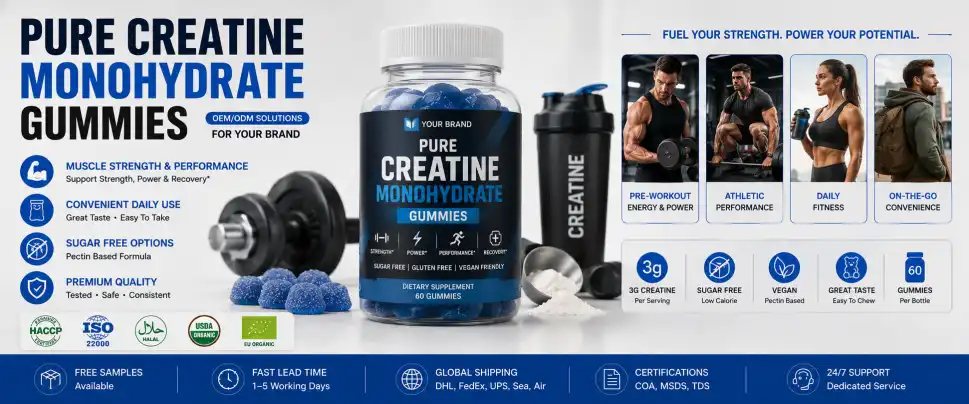
Gummies with creatine monohydrate usually have 1-2g of the active ingredient mixed in with a gelatin or pectin base per dose. To keep the temperature from breaking down the creatine molecule during the gelling process, it is carefully controlled during production. Stability tests show that sweets that are made correctly stay effective for 24 months when kept in a cool, dry place.
Powder forms have a higher content per dose, usually between 3 and 5 grams, and they use fewer fillers. It is easy to blend and encapsulate because of the solid structure. Dissolvability is a very important quality indicator; premium creatine monohydrate should dissolve in 30 seconds in room-temperature water without getting gritty.
To begin, there are three main differences:
- Dosage accuracy: powders let you change the dose easily, while sweets give you set, pre-measured amounts.
- vitamin usage studies show that people are 34% more likely to stick with a vitamin when it comes in gummies.
- Production is more difficult because making gummies takes special tools and more time than making powder blends.
If your brand is aimed at casual exercise fans who want to save time, sweets are a better fit for how they usually use your product. Powders are still the best option for performance-oriented athletes who need filling stages or custom doses.
Bioavailability and Absorption: What the Data Shows
Concerns about changes in solubility between forms should be looked at based on facts instead of assumptions.
Testing done by a separate lab shows that creatine monohydrate keeps its molecular structure in both forms when made properly. The most important thing is not the transport method itself, but the quality of the raw ingredients and the way they are processed.
When making gummies, heat is used, which could change how stable creatine is if the temperature goes above 60°C. Good producers use low-temperature gelation methods and add buffering agents to keep the pH stable. Bulk creatine monohydrate gummies from approved facilities have retention rates above 98% for the whole shelf life, according to a study by a third party.
Within 15 to 20 minutes, the stomach starts to absorb powders that have been mixed with drinks. The gel structure in gummies breaks down in stomach juice, so they need a little longer to dissolve—about 25 to 30 minutes. This small delay doesn't have a big effect on muscle saturation as long as users stick to their daily nutrition plans.
Some clinical factors to think about are:
- The amount of acid in your stomach has the same effect on both forms.
- When you eat has little effect on how well your body absorbs creatine.
- When it comes to cellular uptake, hydration state is more important than transport method.
Powders might be a little better for your users if they want to quickly absorb the supplement before a workout for quick performance benefits. For brands that focus on daily upkeep doses and long-term muscle saturation, sweets give the same benefits with a better user experience.
Manufacturing and Regulatory Compliance Considerations
Getting around production requirements and approval standards affects how long it takes to make a product and how much money is spent on it.
To make Pure Creatine Monohydrate Gummies, you need special tools like fillers, coating drums, and climate-controlled drying rooms. For cost-effective production runs, the minimum order quantity is usually between 100,000 and 500,000 pieces. Getting HACCP and ISO 22000 licenses is now necessary to sell food on foreign markets, especially in North America and the European Union.
With over 50 sticky mould shapes in stock, OAZVITA can make changes quickly and without having to wait for tools to be made. As part of the growing "clean label" trend, our plant helps make sugar-free Products with different sweeteners like stevia and erythritol. Before it is released, each production run is checked for heavy metals, microbials, and effectiveness.
Powder making gives you more options because the minimum order quantity (MOQ) is lower. For private name projects, the MOQ often starts at 500 kg. Because mixing is easier, wait times for common formulas are cut down to 1–5 working days. To get uniform dissolvability and keep the powder from sticking during storage, however, you need to carefully choose the particle size and optimise the anti-caking agent.
Checkpoints for regulations for both formats:
- Verification of raw materials: review of the COA for quality values above 99.5%
- Stability proof: studies that show faster ageing prove shelf life claims
- Label compliance means following the rules set by the FDA, EFSA, or Health Canada for supplements.
- Screening for contamination: looking for drugs that aren't allowed according to WADA rules
Partnering with makers who hold foreign certifications speeds up the approval process if your brand sells in more than one market with different rules. With its HALAL, USDA Organic, and EU Organic approvals, OAZVITA can easily enter niche markets.
Consumer Experience and Market Positioning
Figuring out how end users connect with goods affects how they are made and how they are marketed.
Unfortunately, because creatine tastes a little bitter, it is hard to cover up the taste. Gummies are great for this because they taste like fruit, have natural sweeteners, and have appealing textures that make taking supplements fun. Sixty-eight percent of people who aren't athletes say they like edible forms because they "don't taste like medicine."
Powders have problems with taste, but they are more useful in many situations. They can be mixed into protein shakes, smoothies, or mixes to use before a workout. People who have used supplements before and like this freedom are people who mix various ingredients. With the unflavoured choice, it can be added to any drink without changing the taste.
Thoughts on market segmentation:
- 41% of people ages 18 to 25 say they prefer sweets because they look better on social media and are easier to use.
- Ages 26 to 40: Split fairly between formats based on how hard they work and how they live their lives.
- 41 and up: Powders are preferred (57%), likely because they are known and seen as good value.
The packaging has a big effect on what people buy. Gummy bear bottles with clear windows show off the quality of the candy and build trust. Powder cases that come with scoop handles and can be sealed again make them more useful. Labels that are easy to read and show purity, licenses, and dosing directions are helpful for both types.
If your brand is aimed at gift shops or monthly boxes, gummies look better and are easier to open. Powders are a better way for brands that focus on performance data and cost per serve to show value.
Cost Analysis and Profit Margin Implications
No matter how appealing the style is, the product line's longevity depends on its ability to make money.
Pharmaceutical-grade creatine monohydrate costs about $8 to $12 per kilogram for the raw materials. Making gummies adds a lot to the costs of making them, like buying bases made of gelatin or pectin, flavouring systems, covering materials, and quality checks that take a lot of work. Usually, it costs between $0.15 and $0.25 to make one helping of gummies.
The cost of making powder stays low at $0.08 to $0.12 per serve because it is easier to process. For powders, however, the cost of packing can cancel out any savings. Good containers with moisture barriers and child-proof caps add $0.40 to $0.80 per unit, while for gummy bottles, the cost is only $0.30 to $0.50.
Strategies for setting prices:
- Premium candy lines cost between $24 and $38 for a 30-day supply.
- Standard packages of powder cost $18 to $28 for the same number of doses.
- Bulk powder choices cost $35 to $55 for a 90-day supply.
When you buy 500 bottles or more, the wholesale price for bulk creatine monohydrate candies is usually between $4.50 and $7.50 per unit. Powder costs between $3.20 and $5.80 per bottle at bulk prices, based on the size and specs.
Powders have profit margins of 38-52%, while sweets have profit margins of 45-60% for well-known names. The better profits are due to the ease factor that adds value and the chance to place the product as a top option.
If your business plan is based on selling large volumes through major retail channels, powders help keep profit margins stable. Creatine Monohydrate Supplement Gummies justify higher prices for brands aiming to build direct-to-consumer contracts or relationships with specialty retailers.
Quality Assurance and Testing Protocols
In markets where competition is high, product integrity is what sets trusted brands apart from cheap sellers.
Verification of the raw materials is the first step in full testing. Certificates of Analysis from certified sources show that the quality of the creatine monohydrate is higher than 99.5%, and the amounts of creatinine byproducts are lower than 100 ppm. Extra checks for heavy metals like lead, arsenic, mercury, and cadmium that have measurement values at or below EU legal levels.
The process of making gummies adds more quality checks. Weight difference testing makes sure that every unit gives the same amount of active ingredient, usually within a ±5% range. Texture analysis checks how chewy something is and stops it from getting hard or sticky over time. Testing for microbes shows that there are no yeast, mould, or harmful bacteria.
Powder quality is based on how evenly the particles are sized, how much wetness is in the powder (it should stay below 0.5%), and how long it takes to dissolve. Testing the flow features stops caking and makes sure that the scoop is correct. Stability tests done under fast conditions (40°C/75% RH) show how the shelf life will work in real life.
OAZVITA can do the following types of tests:
- An HPLC study is used to find and measure ingredients.
- ICP-MS to find trace elements
- Bioavailability testing with the USP dissolve device
- Microbiological testing according to USP rules
- Cross-contamination checks with allergen testing
Comprehensive testing documents can help your brand stand out from others if it sells to professional sports or in highly controlled markets. Every package comes with our full test results (COA, MSDS, TDS), which makes it easier for you to check the quality.
Customization Options and Product Development Support
Flexibility in formulation and branding enables market differentiation and rapid response to trends.
Standard creatine gummies from OAZVITA contain 30% active ingredient concentration, with each piece weighing 3-4g. This allows 0.9-1.2g creatine per gummy—optimal for convenient 2-3 piece serving sizes. Custom concentration adjustments accommodate specific positioning strategies, whether emphasizing lower-dose daily maintenance or higher-dose performance protocols.
Shape and color customization transform products into brand ambassadors. Heart shapes appeal to wellness-focused demographics, while lightning bolts communicate energy and performance. Natural colorants derived from fruits and vegetables align with clean-label positioning increasingly demanded by health-conscious consumers.
Combination formulas represent significant growth opportunities. Creatine pairs synergistically with:
- Beta-alanine for enhanced endurance capacity
- L-carnitine for metabolic support during training
- Electrolyte complexes for hydration optimization
- B-vitamin blends for energy metabolism support
Powder customization extends beyond simple flavoring. Instantized versions improve mixability through agglomeration processing. Micronized creatine reduces particle size to 200 mesh, enhancing dissolution and potentially improving absorption kinetics.
Development timeline considerations:
- Formula consultation: 1-2 weeks for specification finalization
- Sample production: 2-3 weeks for initial prototypes
- Stability testing: 4-6 weeks for accelerated studies
- Full production: 3-4 weeks from order confirmation
If your brand needs rapid market entry with proven formulations, OAZVITA's ready-to-market options eliminate development delays. For companies requiring proprietary blends that differentiate from competitors, our R&D team collaborates throughout the innovation process.
Global Supply Chain and Logistics Excellence
Reliable fulfillment capabilities determine whether attractive products translate into sustainable business relationships.
OAZVITA ships Bulk Creatine Monohydrate Gummies via multiple carriers—DHL, FedEx, UPS, EMS, and ocean freight—optimizing cost and speed based on order size and destination. Air shipments reach North American customers within 5–7 business days, while European deliveries arrive in 6–9 days. Ocean freight provides economical solutions for container-load quantities with 25–35 day transit times.
DDP (Delivered Duty Paid) services eliminate customs complexity for international buyers. We handle documentation, duty payments, and clearance procedures, ensuring products arrive ready for immediate distribution. This service particularly benefits companies entering new markets without established import infrastructure.
Packaging flexibility accommodates diverse market requirements. Retail-ready bottles with branded labels ship directly to distribution centers. Bulk containers supply co-packers and private label operations. Blister packaging serves pharmacy channels and single-serve sampling programs.
Logistics performance metrics:
- On-time delivery rate: 99.2% over the past 24 months
- Order accuracy: 99.7% with proactive communication on any variances
- Damage rate: Below 0.3% through reinforced packaging protocols
- Response time: Under 4 hours for shipment tracking inquiries
If your business operates on tight inventory management or just-in-time fulfillment models, consistent delivery performance prevents stockouts and maintains customer satisfaction. Our regional warehouse planning aims to further reduce lead times for high-volume partners.
Why OAZVITA Pure Creatine Monohydrate Gummies Stand Out
Product Excellence and Customization
- Over 50 proprietary mold designs enable unique product differentiation without custom tooling costs
- Sugar-free formulation options using natural sweeteners meet clean-label and diabetic-friendly positioning
- Flexible concentration adjustments from 20-40% active ingredient accommodate diverse dosing strategies
- Each gummy weighs 3-4g with precise weight control, ensuring consistent dosing accuracy
- Compound formulation capability allows synergistic ingredient combinations for enhanced benefits
- Free samples with a complete Certificate of Analysis demonstrate quality before commitment
Manufacturing Capabilities and Certifications
- HACCP, ISO 22000, and NSF certifications ensure international regulatory compliance
- HALAL, EU Organic, and USDA Organic certifications access specialized market segments
- Advanced production lines with climate-controlled curing rooms maintain product stability
- Low-temperature gelation technology preserves creatine molecular integrity during processing
- Heavy metal screening and microbial testing on every batch guarantee safety standards A
- 24-month shelf life under proper storage conditions provides inventory flexibility
Service and Operational Strength
- Minimum order quantity of just 100 bottles enables market testing without excessive inventory risk
- Lead time of 1-5 working days for standard formulations supports rapid product launches
- 24/7 customer support with a multilingual team ensures seamless global communication
- Dedicated account managers provide one-on-one consultation throughout product development
- DDP delivery options eliminate customs complexity for international buyers
- Annual export volume exceeding $15 million demonstrates operational stability and reliability
Conclusion
The choice between pure creatine monohydrate gummies and powder formats depends on your target market, positioning strategy, and operational priorities. Gummies command premium pricing through convenience and taste appeal, particularly among younger demographics and casual fitness users. Powders maintain cost advantages and appeal to performance-focused athletes requiring flexible dosing. Both formats deliver equivalent efficacy when manufactured to quality standards. Your decision should align with consumer preferences in your target segments, distribution channel requirements, and margin objectives. Partnering with experienced manufacturers holding international certifications ensures product quality meets regulatory expectations across global markets.
Partner With a Trusted Pure Creatine Monohydrate Gummies Manufacturer
OAZVITA delivers more than ingredients—we provide complete product development partnerships that accelerate your market success. Whether you need Pure Creatine Monohydrate Gummies for an established product line or customized formulations for brand differentiation, our manufacturing capabilities and compliance certifications streamline your path from concept to commerce. Contact our team at info@oazvita.com to discuss your specific requirements and receive free samples demonstrating our quality standards.
References
1. Kreider, R.B., et al. "International Society of Sports Nutrition Position Stand: Safety and Efficacy of Creatine Supplementation in Exercise, Sport, and Medicine." Journal of the International Society of Sports Nutrition, 2017.
2. Antonio, J., and Ciccone, V. "The Effects of Pre Versus Post Workout Supplementation of Creatine Monohydrate on Body Composition and Strength." Journal of Sports Science and Medicine, 2013.
3. Persky, A.M., and Rawson, E.S. "Safety of Creatine Supplementation." Subcellular Biochemistry: Creatine and Creatine Kinase in Health and Disease, 2007.
4. Hall, M., and Trojian, T.H. "Creatine Supplementation: Current Concepts on Mechanism of Action and Safety." Current Sports Medicine Reports, 2013.
5. Cooper, R., et al. "Creatine Supplementation With Specific View to Exercise/Sports Performance: An Update." Journal of the International Society of Sports Nutrition, 2012.
6. Buford, T.W., et al. "International Society of Sports Nutrition Position Stand: Creatine Supplementation and Exercise." Journal of the International Society of Sports Nutrition, 2007.

Send Inquiry

Related Industry Knowledge
- Do Chewable Probiotic Gummies Really Work? The Sweet Truth About Chewy Gut Health Supplements
- Complete Guide to Choosing the Best OEM/ODM Pure MCT Powder for Supplements
- China-Based GMP Manufacturing of Pure Maca Root Capsules for Global OEM Brands
- Australia Import Considerations for Premium Black Seed Oil Softgels
- 2026 Best Pure NAD+ Powder for Anti-Aging and Wellness
- Traceable Glutathione Powder Supply Chains from China
- Exploring the Uses of Chicken Collagen Peptides in Beauty—From Skincare to Supplements
- Fish Collagen Peptide Solutions for Functional Food Leaders in Australia
- Inositol Powder Market Opportunities in India’s Metabolic Therapies
- Bovine Collagen Peptides Trusted by Medical Nutrition Firms in France