
Pure Fish Collagen Peptide: The Ultimate Guide for Health Enthusiasts
Sep 30, 2026
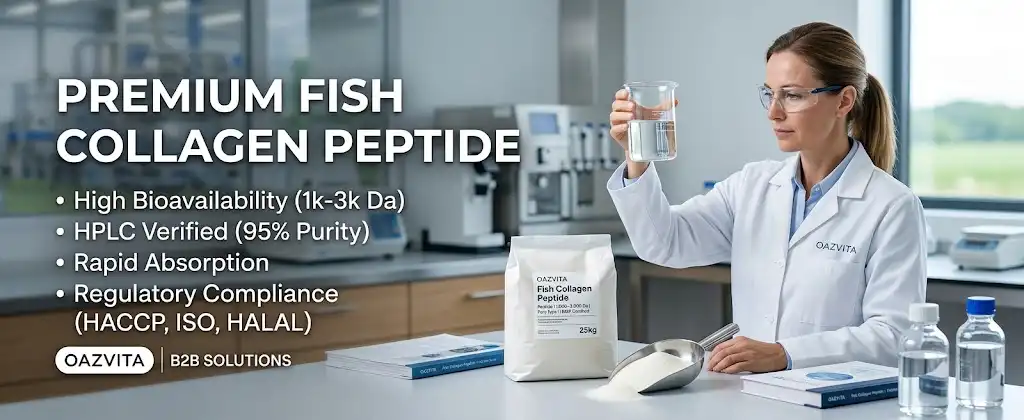
If you're sourcing collagen ingredients for supplement formulation, functional beverages, or nutricosmetic development, pure fish collagen peptide deserves serious attention. Derived from fresh fish scales and fish skin, this hydrolyzed Type I collagen hydrolysate carries a molecular weight of 1,000–3,000 Da, enabling rapid intestinal absorption via PepT1 transporters within 1–2 hours post-ingestion. With 95% purity (HPLC verified), it outperforms many conventional protein sources in bioavailability, solubility, and formulation versatility—making it a preferred raw material for brands operating across multiple global markets.
Understanding Pure Fish Collagen Peptide: Definition and Benefits
By using enzymes to break down fish scales and skin, pure fish collagen peptide, also known as hydrolyzed fish collagen powder (CAS No. 9007-34-5), is produced. It mostly comes from salmon, cod, and tilapia. Native collagen has a molecular weight of about 300,000 Da. The peptide form, on the other hand, is broken down to 1,000–3,000 Da, which means the body can take it more easily than native protein. It has a lot of glycine, proline, and hydroxyproline, which are three amino acids that help keep connective tissue stable in the body and get fibroblasts working in the skin matrix.
A peer-reviewed study shows that it's very good for your health. Research published in Nutrients and the Journal of Cosmetic Dermatology shows that daily intake of 5–10g of collagen peptides can make skin more elastic, keep it moist, and lessen the look of signs of aging. Marine-derived collagen peptides help build bone mineral density and also cushion joints and speed up recovery after exercise.
The element has a good track record when it comes to safety. It has a protein level of at least 90% (often over 96% when dry), a moisture level of about 7%, and an ash level of about 2%. There are very tight microbiological limits: the Total Plate Count must be less than 1,000 CFU/g, and Salmonella, E. coli, and Staphylococcus aureus must not be present. These specs have a direct effect on how safe people feel and how ready businesses are to follow the rules set by the government.
Pure Fish Collagen Peptide vs. Other Collagen Types: A Comparative Analysis
There are three types of collagen: marine collagen, bovine collagen, and hydrolyzed collagen. Business buyers often use these terms that mean the same thing. Because of business, the differences are important. This is how pure fish collagen peptide measures up:
- Bioavailability advantage: Cow collagen molecules are bigger than fish collagen molecules, and studies show that fish sources are about 1.5 times more accessible than cow sources. It might be more efficient to dose goods made from cows at 5g instead of the standard 10g. This would lower the cost-per-serving for customers.
- Source safety and regulatory alignment: Unlike collagen from cows or pigs, fish collagen does not pose a risk of BSE or TSE spread. The fact that it is Halal, Kosher, and pescatarian means that it can reach more people without having to pay more to be reformulated.
- Skin-specific efficacy: Most of the collagen in fish is type I. Most of the building proteins in human skin are type I collagen. You can use cow collagen for muscle-related tasks better because it has both Type I and Type III. Because it is more focused, the Type I profile that comes from fish is better for nutricosmetics and beauty products.
This makes it easy for OEM makers and private label buyers to pick the best collagen type for their product goals and customers. Putting the wrong type of collagen in the wrong product group is a simple but common mistake that is made when formulating.
Procurement Essentials: Bulk and Wholesale Buying Guide
To find large amounts of pure fish collagen peptide, you need to go through a well-planned review process. The buying teams should make sure that a service meets a number of strict requirements before they decide to work with them.
Here are some of the most important things that make a collagen peptide seller trustworthy:
- Certification stack: This list of certifications says that suppliers must have at least HACCP, ISO 22000, NSF, HALAL, EU Organic, and USDA Organic certifications. Every batch should always come with COA, MSDS, and TDS paperwork.
- Analytical verification: To meet EU and FDA standards for importing, molecules must be weighed out using GPC/HPLC, heavy metals must be checked using ICP-MS (Pb <1.0 ppm, Hg <0.1 ppm, As <1.0 ppm, Cd <0.5 ppm), and drug leftovers must be checked using LC-MS/MS for peptides from aquaculture.
- Hydroxyproline content: You can make sure it's real. A real collagen sample should have hydroxyproline levels of 8.0%. If the glycine and proline/hydroxyproline ratios are different, it could mean that the collagen has been messed with or that gelatin has been used instead.
These rules make sure that Products are always honest and protect your business from problems that come from rules. People who want to buy something should make sure that the seller meets their standards before placing an order. It's easy to use OAZVITA for market tests because the minimum order size is 1 kg and it can be packed in any way the customer wants. You can ship by air, sea, DHL, FedEx, UPS, or airmail post with a lead time of 1–5 business days. It will last 24 months if you keep it somewhere cool and dry.
Top Pure Fish Collagen Peptide Manufacturers: Trusted Partners for B2B Buyers
To choose the best fish collagen powder manufacturer, you need to look at more than just price. For long-term dependability, it's important to know where the parts come from, how much can be made, and how to get help after the sale. A trustworthy supplier keeps detailed records of every step that is taken, from the raw fish to the finished powder. They also offer free samples and batch-level COAs, and they let OEM/ODM customers change the ingredients in any dosage form, like capsules, powders, sachets, or gummies.
This is what OAZVITA does. Because it is so big and consistent, OAZVITA helps both new names and well-known wholesalers. It sends more than USD 15 million abroad every year, makes deliveries on time more than 99% of the time, and takes part in global trade shows such as Vitafoods and SupplySide West. Private label buyers can get "turnkey" services that include making the formula, designing the packaging, and getting the necessary paperwork from the government. This speeds up the process of getting the goods to market without lowering their quality.
Application Use Cases: Maximizing the Value of Fish Collagen Peptide Powder
There are many types of market forms that work well with pure fish collagen peptide powder. You can use it in many ways because it doesn't stick together easily (5–10 mPa·s at 10% solution), it melts quickly in cold water, and it stays stable at pH levels between 3.0 and 7.0.
- Functional beverages and RTD shots: The peptide keeps the fluid clear and stops it from settling over time for more than 12 months in places with a lot of acid (pH 3.0–3.8). You can use up to 10g per serve without making the texture too gel-like.
- Nutricosmetic powder blends: When mixed with vitamin C, hyaluronic acid, and biotin, the bulk density that was planned (0.3–0.4 g/ml) works best. In automatic filler lines, it keeps the ingredients from separating and makes sure that they are mixed properly. This is very important for making a lot of things.
- Clinical and medical nutrition: This peptide works well in liquid protein formulas because it is quickly absorbed and keeps its nitrogen. Its neutrality in terms of taste and smell helps with compliance in settings with sensitive consumers.
Brands in the US, Europe, and Asia have been able to add OAZVITA's hydrolyzed fish collagen to their lines of products without any problems. They have always liked how neutral it tastes, how clean it breaks down, and how uniform it is from batch to batch. Because of these things, it's easier to change the recipe quickly and get it approved by the government more quickly.
Conclusion
Collagen protein from fish has been shown to be an important part of many vitamins, beauty foods, and sports foods. Because it can be mixed in many different ways and has a Type I collagen profile, it is a good choice for brands that need to compete in tough markets. Many different types of goods, from skin care to sports healing powders, can use this pure fish collagen peptide because it has the right physicochemical features. Buying teams need a collagen source that they can trust, is approved, and can be used in different ways. The first step to good buying is to find the right partner.
FAQ
1. Is pure fish collagen peptide safe for long-term supplementation?
Yes. Microbe and heavy metal limits that are controlled show that the ingredient is safe. 5–10g of pure fish collagen peptide per day for a long time is in line with study methods that have already been made public.
2. What is the difference between fish collagen and marine collagen?
"Marine collagen" refers to collagen that comes from fish, crabs, and other water animals. Fish-specific collagen peptide is made from fish skin and scales only. It has a Type I collagen structure and a clearer amino acid make-up.
3. What should I check before placing a bulk order?
Also, make sure that the heavy metal rules are followed, that the hydroxyproline content is at least 8.0%, that there are no drug residues, and that you get all the certification papers, such as the COA, MSDS, and TDS.
4. Can it withstand high-temperature processing?
Yes. Since it doesn't change when it's pasteurized or UHT-treated, it can be used to make commercial drinks without breaking down.
Partner with OAZVITA for Premium Fish Collagen Peptide Supply
Certified, high-purity pure fish collagen peptide can be bought from OAZVITA by manufacturers and supplement makers who want a stable long-term source. We can help you with your product from the time you have an idea to the time you launch your business. Our MOQs start at 1 kg and can be changed to fit your needs. We also offer full OEM/ODM customization and a full compliance paperwork package. Email us at info@oazvita.com to get a free sample and find out how you can buy in bulk.
References
1. Proksch, E., Segger, D., Degwert, J., Schunck, M., Zague, V., & Oesser, S. — Skin Pharmacology and Physiology, 2014.
2. Asserin, J., Lati, E., Shioya, T., & Prawitt, J. — Journal of Cosmetic Dermatology, 2015.
3. Shaw, G., Lee-Barthel, A., Ross, M. L., Boysen, G., & Baar, K. — American Journal of Clinical Nutrition, 2017.
4. Zague, V. — Journal of Cosmetic Dermatology, 2008.
5. León-López, A., Morales-Peñaloza, A., Martínez-Juárez, V. M., Vargas-Torres, A., Zeugolis, D. I., & Aguirre-Álvarez, G. — Molecules, 2019.
6. Dressler, P., Gehring, D., Zdzieblik, D., Oesser, S., Gollhofer, A., & König, D. — Nutrients, 2018.

Send Inquiry

Related Industry Knowledge
- What is better, ashwagandha or ginseng?
- Garcinia Cambogia Extract Powder: Usefulness and Safety
- Everything You Need to Know About TUDCA Powder: Uses, Benefits, and More
- Exploring Organic Cordyceps Sinensis Extract Powder
- Fish Collagen Peptide Quality Systems Meeting Australian Standards
- Top Nicotinamide Riboside Chloride Powder Uses in Healthcare You Should Know in 2026
- Ensuring Consistent NR Chloride Quality for Japanese Pharma Buyers
- Bovine Collagen Peptides for Medical Nutrition in France
- How the best creatine monohydrate powder supports cognitive and physical performance?
- High purity magnesium glycinate powder: absorption and bioavailability