
Safety, heavy-metal testing and purity in spirulina chlorella tablets
Jun 05, 2026
When evaluating Spirulina Chlorella Tablets, key assessment criteria include safety verification, heavy metal testing, and overall quality control. Due to the natural ability of algae to absorb substances from their environment, product quality depends on cultivation conditions and comprehensive testing for contaminants such as microbes, lead, arsenic, mercury, cadmium, algal toxins, and other potential residues. Verification is also required to confirm that finished tablets are free from unwanted fillers or additives. In the U.S. market, procurement standards typically emphasize documentation aligned with FDA-related quality practices, third-party testing, and batch-level accuracy. These safety and compliance indicators are commonly used by brands, distributors, and private-label buyers in purchasing decisions.
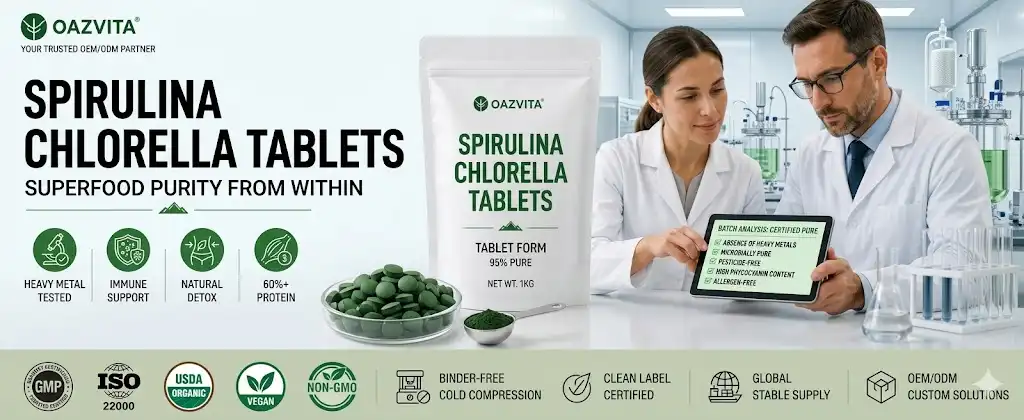
Understanding Safety Concerns in Spirulina Chlorella Tablets
This topic has a clear search intent: people want to know if Spirulina Chlorella Tablets are clean, tried, and trustworthy enough to sell or use for their own brand. Most of the time, the most popular SERP-style questions are about contamination, certificates, and how to check claims of cleanliness. In other words, good content should directly answer the questions “what,” “how,” and “what proof should I ask for.”
Why safety matters so much in algae tablets
Protein, algae, vitamins, and the fact that they are clean labels make spirulina and chlorella very popular. They are also biomass materials, which means that the place where they grow is very important. If the water used for growing, the cooling systems, or the conditions of handling are not well managed, the risk of contamination rises quickly.
The main things buyers look at are:
- heavy metals like arsenic, lead, cadmium, and mercury
- algal toxins, including microcystins
- microbiological contamination such as Salmonella or E. coli
- purity issues caused by fillers, binders, or excipients that aren't listed
That is why #N/A is important when talking about buying. People aren't just picking out tablets. In this case, they are picking a risk profile, a compliance burden, and a result for the brand's image.
What U.S. buyers usually expect
Buyers in the US who are smart want more than just a general certificate. A lot of the time, they want Certificates of Analysis that are special to the lot, records of the manufacturing process, and proof of GMP-style controls. A lot of people also compare the standards used to make supplements that are controlled by the FDA to foreign standards like EFSA guidance and ISO systems.
Featured-snippet style answer: Safe Spirulina Chlorella Tablets come from controlled farming, are tested for heavy metals, toxins, and microbes in each batch, and are shown to be pure through clean-label formulation and paperwork that has been checked by a third party.
Heavy-Metal Testing Protocols and Quality Assurance
Heavy-metal testing is often the best way to tell if something is safe in this group. Testing is not a nice extra because algae can bioaccumulate things that are not needed. It is important for making sure quality.
Which heavy metals should be tested?
The list of priorities is the same for both serious customers and manufacturers:
- Lead (Pb): closely watched because of worries about long-term exposure in supplements
- Arsenic (As): needs to be carefully understood, especially the difference between total arsenic and artificial arsenic
- Mercury (Hg): High-quality algae pills should keep the amount of mercury (Hg) very low
- Cadmium (Cd): This element is closely watched because plants can take it in from the environment
Many high-end specs set limits, like lead below 1 ppm, arsenic below 1 ppm, mercury below 0.1 ppm, and cadmium below 1 ppm. However, the final acceptance should always meet the standards of the destination market and internal risk.
How reliable suppliers test and document results
ICP-MS and AAS are the two most well-known ways to analyze things. For sensitivity and multi-element screening, ICP-MS is often the best choice, especially in programs for high-value exports. A good testing method also includes clear test frequency for both raw materials and produced pills, well-defined sampling plans, and samples that are kept.
The following should be in a good source file, and this is where many questions go from being interesting to being seriously considered:
- Method transparency: I want to know if the seller uses ICP-MS or another approved method, who does the research, and if the lab follows proper quality standards. This helps me figure out if the numbers mean something or if they're just fancy marketing words wrapped in technical terms.
- Batch-level traceability: A reliable partner can connect each group of tablets to records of their growth, gathering, drying, compression, and release testing. If a customer, retailer, or government agency later asks for proof, that amount of traceability will protect my business.
- Trend consistency: One passing report is not enough, as the trend shows. I look for results that can be repeated across multiple lots. This is because stable low-metal results are usually a sign of careful buying and process control, not luck. This level of stability helps with long-term purchases and lessens the shocks that come with market growth.
Purity Specifications and Nutritional Integrity of Spirulina Chlorella Tablets
It's not enough to say, “I have nothing bad inside me.” It also means that the product still has the right amount of nutrients after being processed, compressed, packed, and shipped.
What purity really means in tablet form
When a product says to be pure, premium buyers generally mean that it contains only algae and no fillers, artificial colors, or synthetic binders that aren't needed. Binder-free cold-compression technology is a big selling point in many high-end private-label goods because it allows for a more natural placement.
As part of checking for cleanliness, buyers may also look at the amount of wetness and ash. Microbial growth is less likely when the moisture level is below about 7%. Depending on the product, ash levels below about 8% can help meet better mineral balance standards.
Nutritional integrity buyers should verify
Even a clean computer needs to work. Protein levels above 60%, chlorophyll levels that make sense, and a well-preserved nutrient makeup are often used to judge the quality of pills. When buying mixed Spirulina Chlorella Tablets goods, people may also want to know if the chlorella cell wall has been broken down manually through pressure-release or milling technology to make it easier to use without using harsh chemicals.
Tablets are often easier to carry, less likely to be dusty, and more stable than powders when it comes to dose. That's important for private-label brands and distributors who need the same experience for customers across all platforms.
Selecting Trusted Suppliers and Ensuring Product Authenticity
This part of the buying process is about building trust. At this point, interest turns into source screening. Labels make it easy to print claims. To be real, you need proof.
Certifications and sourcing transparency
Supplier evaluation extends beyond product brochures to include verification of certifications and production transparency. Claims such as organic certification, GMP compliance, ISO-aligned systems, or vegan and non-GMO status are only considered reliable when supported by current documentation and traceable manufacturing records. Equally important is source transparency. Cultivation in controlled environments, such as alkaline water systems or regulated production facilities, can reduce the risk of contamination compared to sources with unclear or unverified origins.
Claims of origin like “Made in USA” should also be checked out carefully. Even if a supplier uses foreign raw materials and local tableting, the language still needs to meet legal and business standards. Label claims and the buyer's image are protected by clear origin communication.
Supplier support that matters for B2B buyers
A good relationship with a seller is useful in more ways than one. Buyers often need help with private labeling, stable bulk prices, reliable lead times, and quick contact after the sale. These details are just as important as the lab report when it comes to profits, start dates, and keeping customers.
Procurement Best Practices: Securing Safe, Pure Spirulina Chlorella Tablets
When a seller looks good, buying discipline is the only thing that can protect you. Good buying methods lower risk and make sure there is a steady supply over the long run.
A practical quality-control framework
Before you agree to buy something, suggest making a simple but strict review model:
- Define product specifications for heavy metals, microbiology, toxins, moisture, ash, and excipients in the product
- Require COAs that are unique to each lot and prove test methods
- Review tablet hardness and disintegration if dosage performance matters
- Audit packaging suitability for moisture and transport conditions
- Keep approved-supplier records and review performance regularly
Smaller private-label projects and bigger marketing programs can both use this system.
Logistics and storage also protect purity
If you don't store and ship tablets well, even clean ones can lose quality. Food-grade packing, moisture barriers, steady warehouse conditions, and careful pallet handling all help keep the purity of tablets. When buyers have to choose between tablet and powder forms, Spirulina Chlorella Tablets are often chosen because they are easier to transport, dose more accurately, and look better on the shelf.
Conclusion
To get safe Spirulina Chlorella Tablets, you need proof like controlled growth, confirmed heavy-metal testing, clean labels that say the tablets are pure, and suppliers who are open about what they do. I would always look for paperwork that is relevant to each batch, analytical methods that I could trust, and requirements that protect both brand value and compliance. In the U.S. market, which is very competitive, buyers who check early on for safety and purity make better buying choices, build trust with customers, and lower the risk of surprises in the supply chain.
FAQ
1. How do I verify heavy-metal safety in Spirulina Chlorella Tablets?
Procurement best practices include requesting a recent, lot-specific Certificate of Analysis (COA) that clearly reports levels of lead, arsenic, mercury, and cadmium. Ideally, these results should be generated using ICP-MS testing conducted by an accredited laboratory. In addition, evaluating multi-lot trend data rather than relying on a single report provides a more reliable assessment of consistency and quality over time.
2. Are tablets usually purer than powders?
Not always, but most of the time, pills are easier to handle, dose, and carry. It is also possible to make high-quality Spirulina Chlorella Tablets without using manufactured binders, which helps with clean-label placement. More than just structure, purity rests on where the ingredients come from, how they are tested, and how they are made.
3. What other safety tests should a buyer request?
Beyond heavy metal analysis, standard evaluation criteria also include microbiological testing, screening for algal toxins such as microcystins, and verification that moisture control and packaging processes support product stability throughout shelf life. Third-party verification further enhances credibility, particularly for Products positioned in premium market segments.
4. Why does supplier authenticity matter so much?
Because product claims become your brand claims. If there isn't enough or clear information about where the goods came from or how they were certified, the buyer takes the risk. Using real sources makes following the rules simple and helps with planning for long-term purchases.
Partner with Factop for Superior Pharmaceutical Capsule Filling Solutions
Need a reliable company to make, supply, or buy Spirulina Chlorella Tablets in bulk? OAZVITA can help you look at choices for private label and bulk programs that are safe, pure, and of good quality. Email info@oazvita.com to talk about requirements, test papers, and finding help. If you want to buy Spirulina Chlorella Tablets that you can be sure are of high quality, please contact OAZVITA right away.
References
1. U.S. Food and Drug Administration. Dietary Supplements.
2. European Food Safety Authority. Scientific Opinion on risks for public health related to the presence of arsenic in food.
3. World Health Organization. Cyanobacterial toxins: Microcystin-LR in Drinking-water.
4. United States Pharmacopeia. General Chapters on Elemental Impurities and Microbiological Examination.
5. AOAC International. Official Methods of Analysis for heavy metals in food and dietary supplements.
6. National Institutes of Health, Office of Dietary Supplements. Dietary Supplements Fact Sheets and Supplement Quality Resources.

Send Inquiry


Related Industry Knowledge
- Is it okay to take Super Greens Powder Packets every day?
- How to Choose the Best Pure NAD+ Powder Supplier in 2026?
- MCT Powder Processing Technologies Adopted in Singapore
- Germany Market Insights: Standardized Withanolides in Pure Ashwagandha Capsules
- Brazil Consumer Trends Driving Premium Black Seed Oil Softgels
- TUDCA Powder Manufacturing Excellence Serving South Korea’s Pharma Sector
- What are the stability and storage requirements of pure NMN powder?
- Spirulina chlorella tablets: nutrient profile and bioavailability
- Best Pure Fish Collagen Peptide for Health and Beauty
- Exploring the Uses of Pure Bovine Collagen Peptides in Cosmetics—From Manufacturing to Distribution