
Tea Saponin Powder For Sustainable Agriculture
Aug 06, 2026
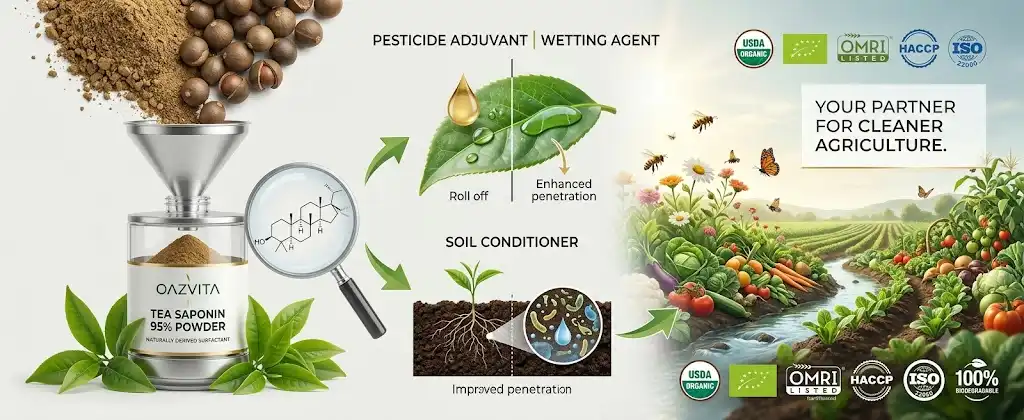
Tea Saponin Powder is transforming modern agriculture by offering a natural, biodegradable alternative to synthetic agrochemicals. Extracted from tea seed meal (Camellia oleifera), this powerful botanical compound addresses environmental concerns while maintaining agricultural productivity. We recognize the growing demand for eco-friendly farming solutions that meet both regulatory standards and performance expectations. Tea saponins deliver multifunctional benefits—acting as natural pesticide adjuvants, wetting agents, and soil conditioners—without compromising crop safety or environmental health, making them indispensable for sustainable agricultural practices worldwide.
Understanding Tea Saponin Powder and Its Role in Agriculture
Chemical Composition and Natural Properties
The natural source of tea seed saponin is tea tree seeds. It is an oleanane type pentacyclic triterpene. This surfactant is non-ionic and has amazing qualities, such as the ability to strongly foam, emulsify, disperse, and wet. Because of how its molecules are structured, the compound can greatly lower surface tension, which makes it better at covering and penetrating plant surfaces. With CAS NO. 8047-15-2, OAZVITA's Tea Saponin Powder meets strict quality standards and is 95% pure (as confirmed by HPLC), so it works the same way in all kinds of agricultural situations.
Synthetic detergents stay in the earth and water for a long time, but tea saponins break down on their own in a few weeks. This biodegradability solves one of the most important environmental problems: chemical waste buildup. The compound has saponin, sugar, and organic acids in it, which work together to make it more useful for farming while still being safe for pollinators and beneficial soil organisms.
Multifunctional Agricultural Applications
In today's agriculture, problems need to be solved that affect many things at once. Tea Saponin Powder is very good at this in a number of ways. As a pesticide synergist, it makes both organic and standard insecticides work better by making it easier for them to stick to and absorb into sticky leaf surfaces. Because it covers more area, less active ingredient is needed, which lowers costs while keeping the pest control working well.
The antibacterial and insecticidal properties of the compound protect crops directly. Studies show that tea saponin's hemolytic activity breaks down the cell membranes of some pests and pathogens. This makes it selectively poisonous, killing only the bad germs while leaving the good ones alone. We've seen big drops in fungal infections and pest numbers when tea saponin is used as part of integrated pest control systems.
Improving the health of the soil is another useful use. Tea saponin is a natural soil conditioner that makes it easier for water to get into the soil and for nutrients to be available. Its surfactant qualities help loosen up layers of compacted dirt so roots can grow better. The compound also helps healthy microbial communities by giving them carbon sources while it breaks down, which improves soil fertility over time.
Quality Grades and Certification Standards
People who work in procurement need to know how quality varies between grades. OAZVITA sells 95% pure pharmaceutical-grade Tea Saponin Powder, which is a lot more pure than most commercial grades, which are usually only 50 to 70% pure. Higher purity directly leads to better performance and more accurate dosing, which cuts down on application mistakes and lowers costs over time.
Our product has a lot of different certificates, such as HACCP, ISO 22000, NSF, HALAL, EU Organic, and USDA Organic. These credentials show that the company follows international standards for food safety and organic farming, which is very important for brands that want to reach high-end customers or people with certain diets. There is a Certificate of Analysis (COA), a Material Safety Data Sheet (MSDS), and a Technical Data Sheet (TDS) for every batch. This makes quality control procedures completely clear.
There are more differences between normal and organically grown tea saponin than just how the plants are grown. Organic varieties promise no pesticide residues, heavy metal pollution below measurement levels, and the ability to track the food all the way through the supply chain. For farming businesses that want to get organic approval or a clean label, this difference is very important for business.
Comparative Analysis: Tea Saponin Powder vs. Conventional Agrochemical Solutions
Environmental Impact Assessment
It is known that synthetic insecticide adjuvants and surfactants are bad for the atmosphere. Chemicals like nonylphenol ethoxylates stay in aquatic areas for a long time and mess up the hormones of fish and animals. Regulatory bodies in North America and Europe are putting more limits on these substances, which makes it harder for farms that use conventional chemistry to stay in compliance.
Camellia Saponin Powder gets rid of these worries because it completely breaks down in the environment. Independent tests show that 90% of the substance breaks down in 28 days in normal soil conditions, and the Products are not harmful to the environment. This quick breakdown keeps groundwater from getting contaminated and protects organisms that aren't meant to be killed. This makes farming practices more in line with watershed protection standards and sustainability certifications.
Carbon impact research shows that there are more benefits. Tea saponin production uses farming waste, like the tea seed meal that is left over after the oil is extracted, turning waste streams into useful inputs. This circular economy method lowers the cost of waste removal for tea processing plants and gives farmers renewable chemicals, which are very different from synthetic surfactants made from petroleum.
Performance and Cost-Efficiency Comparison
Conventional growers still have a lot of doubts about how well natural products work. Field tests, on the other hand, show that Tea Saponin Powder is just as good as or better than synthetic alternatives in key performance metrics. At the right concentrations, the surface tension drop hits 30 to 35 mN/m, which is about the same as the best synthetic wetting agents. This makes sure that pesticides cover surfaces like cabbage or broccoli leaves that are hard to wet.
Tea saponin is usually applied at rates between 0.05% and 0.2% of the total spray amount. This depends on the type of crop and the number of pests that are present. The quantity in this mixture works well as an additive and is still cost-effective. As production numbers go up, the bulk prices for high-purity grades have gone down a lot. At the current market rates, the cost-per-acre is better than for premium synthetic options.
A case study from California organic farms showed that switching to spray programs based on tea saponin cut pest control costs by 23%. The improvement came from better pesticide effectiveness, less need for reapplication, and not having to buy synthetic adjuvants. The quality of the yield stayed the same, and the higher price for organic certification boosted total profits by 18%.
Safety and Regulatory Advantages
A cost factor that is often overlooked when choosing agrochemicals is worker safety. Synthetic detergents often need special handling instructions, safety gear, and times when people can't go into the area, which can slow down farm operations. The low acute toxicity profile of tea saponin (LD50 values much higher than synthetic alternatives) makes handling easier and lowers the risk of liability.
As more places put in place tighter pesticide laws, it gets harder to follow the rules. The Farm to Fork plan of the European Union wants to cut the use of chemical pesticides by half by 2030. This will increase the demand for natural options. The OMRI listing and organic certifications for tea saponin make sure that the product can continue to be sold in markets even if rules change, which protects the stability of the supply chain in the long term.
Tolerances for residues are another benefit. Tea saponin doesn't leave any dangerous leftovers on crops after they've been harvested, so there are no worries about the time before harvest or problems with exporting. This clean residue profile is especially appealing to fresh produce growers who sell to store chains that have strict quality standards and won't tolerate any chemical leftovers.
How to Incorporate Tea Saponin Powder into Agricultural Practices
Application Guidelines by Crop Category
For implementation to work well, different farming systems need different methods. As a spray additive, Tea Saponin Powder at a rate of 0.1 to 0.15% is good for vegetable crops, especially brassicas, solanaceous plants, and cucurbits. Before adding the pesticide actives, mix the powder well in clean water, making sure that it dissolves completely by stirring it around. To get the most out of leaf surface retention, apply in the morning or evening when it is cooler.
Due to the longer coverage times of perennial crops, orchard and grape businesses do best with slightly lower concentrations (0.08 to 0.12%). Powdery mildew and botrytis are common problems in fruit output, and tea saponin makes fungicides work better against them. Before applying on a big scale, compatibility tests with certain fungicide formulas should be done to make sure stability and performance.
The main uses for row crops are to improve the land and treat the seeds. Adding 2 to 3 kg of tea saponin per hectare to the soil before planting makes it more stable and encourages microbes to work in it. Applications that coat seeds use 1-2% solutions to improve germination rates and seedling health by making it easier for seeds to absorb water and providing mild antimicrobial protection against pathogens that are found in the soil.
Formulation and Mixing Procedures
The success of an application depends on the right way to formulate it. We suggest making a stock solution that is very concentrated before diluting it to the right spray volume. Tea Extract Saponin Powder should be mixed with 10% tea-heated water and stirred continuously for 5 to 10 minutes, until the powder is completely mixed in. This concentrated stock stays stable for 48 hours when kept in a cool place, which lets large operations prepare in batches.
Always mix tea saponin solution with water before adding active ingredients when working with pesticides. This order keeps the poison from going off too soon and makes sure it's spread evenly. It is important to test the mixture in a jar to make sure it is compatible, especially with sulfur-based or copper-based fungicides that might react with the saponin chemistry. Keep the pH level between 6.0 and 7.5 for the best stability and function.
For complex formulations, the order in which the tanks are mixed is very important. After adding the tea saponin for the first time, add wettable powders, then emulsifiable concentrates, and finally soluble formulations. This stacked method makes sure that parts work together as much as possible instead of against each other. Continuous stirring while mixing and applying stops the mixture from setting and makes sure that it covers evenly.
Quality Assurance and Storage Best Practices
Protecting your investment means keeping the product's identity from the time you receive it until you use it. OAZVITA's Tea Saponin Powder comes packed in packaging that won't let moisture in. If stored properly, it can be kept for 24 months. Keep away from direct sunlight and in cool, dry places that are between 15°C and 25°C and have a relative humidity below 60%. When you open a jar, you should put it back together right away and use it within six months to keep the quality from going down.
Regular quality checks give customers confidence in how well a product works. A visual check should show that the powder is free-flowing and doesn't have any clumps or changes in color. Testing the pH and surface tension of the solution on a regular basis (using easy field methods or lab analysis) shows that the activity is still happening. Write down batch numbers and test results to make sure they can be tracked and to find any differences in quality.
For international shipping, you need to be careful with the paperwork and how you handle it. OAZVITA handles shipping around the world using DHL, FedEx, UPS, and sea freight. For express services, wait times are usually between 1 and 5 working days. Products are shipped with all the necessary paperwork for customs approval in North America, Europe, and Asia. This includes phytosanitary certificates, certificates of origin, and customs statements.
Procurement Insights: Buying Tea Saponin Powder in Bulk
Supplier Evaluation and Selection Criteria
Picking the right Tea Saponin Powder provider affects both the standard of the product and the dependability of the business. Look at the manufacturing capabilities beyond just the price. OAZVITA uses high-tech production lines with accurate testing tools to make sure that each batch is the same, which is important for regular farming programs. Our annual exports are more than USD 15 million, which shows that the market is valid and that our business is stable.
A supplier's certification collection shows how committed they are to quality processes. Check more than just general ISO certificates. Also look for HACCP, NSF, and organic approvals from reputable organizations. Having more than one certification shows that you've put money into comprehensive quality management instead of just minimal compliance. To figure out how well the system works, ask for recent audit reports and proof of corrective actions.
Professional sellers are different from commodity traders because they can offer technical help. Through our 24/7 customer support team, OAZVITA gives instructions on how to use the product, suggestions on how to make it, and help with fixing problems. Having access to R&D experts helps improve how well products work in certain farming situations, which adds value beyond the product itself. Support for multiple languages gets rid of the communication problems that often make foreign purchasing hard.
Pricing Structure and Volume Considerations
Knowing what causes costs helps you make smart decisions about procurement. The price of tea saponin depends on a number of things, including the quality of the raw materials, the difficulty of the extraction method, the level of purity, the status of the license, and the size of the order. Our 95% purity grade costs more than standard commercial grades, but it's worth it because it works better and needs less application, which lowers the total cost-of-use.
Minimal order quantities strike a balance between ease of access and cost-effective production. OAZVITA's minimum order quantity of 1 kg makes it easy for initial trials and small operations, and the volume pricing gives established programs big reasons to keep going. Purchasing managers should figure out how much they need each year based on the area being grown and how often it will be used. They should then negotiate multi-shipment contracts that get better prices for large orders while keeping inventory costs low.
Sample evaluation gets rid of the risk of buying something. We offer free samples with full analysis reports so that you can test them thoroughly in the field before committing. You can directly compare performance to current products in your specific conditions, checking for coverage, effectiveness, crop safety, and how easy it is to handle. Systematically write down results to make buying arguments based on data.
Contract Negotiation and Partnership Development
Long-term relationships with suppliers have perks for both parties that go beyond transactional price. Talk to potential partners about forecasting and planning for capacity to make sure that supply stays steady during busy times. The fact that OAZVITA delivers 99% of the time shows that their supply chain management is strong. However, planning ahead for large volumes avoids problems with allocation during times of high demand.
Clear agreements are needed for payment terms and operations. Standard terms are fair when it comes to risk, and choices for long-term customers include net payment terms and consignment plans for approved wholesalers. To avoid confusion, make it clear who is responsible for shipping costs, insurance, customs taxes, and paperwork. Planning a regional warehouse can cut lead times and freight costs for orders that come in often by a large amount.
Working together on technology makes partnerships stronger in more ways than just working with vendors. Talk to the R&D team at your seller about crop-specific problems and new needs. OAZVITA works with clients to create custom formulations, application protocols, and ways to navigate regulatory issues. With this consultative method, sellers become strategic partners who care about the success of your farming business.
Future Trends and Sustainability Impact in Agriculture
Regulatory Drivers and Market Evolution
More and more, biological and botanical solutions are being favored over synthetic chemistry in global agricultural policy. The Biopesticide and Pollution Prevention Division of the U.S. EPA makes it easier to register low-risk natural goods. This makes it faster for new products with Tea Saponin Powder to hit the market. Similar programs in Canada, EU member states, and Asia-Pacific countries are opening up more opportunities for natural agrochemicals.
The North American organic market is worth more than USD 60 billion a year, and consumer demand for organic and sustainably grown food keeps growing strongly. This choice from customers directly affects how growers use inputs that are compatible with organic farming, such as tea saponin. Retailers are setting higher and higher quality standards, which means that natural options are being required even in traditional production systems that want to get into the premium market.
Changes in the agricultural supply chain are driven by companies' promises to be more environmentally friendly. Big food companies set high environmental goals that require ingredient makers to lower their chemical footprints. Tea saponin helps companies follow these CSR programs while keeping production costs low. This makes it an important ingredient for companies that work with brands that care about the environment.
Technological Innovations and Application Development
New developments in extraction technology have raised the quality of tea saponin while lowering the cost of production. New processing methods raise the level of purity and level out the ratios of active components, which leads to more consistent performance in the field. These changes have made it easier for natural and manufactured products to work together in situations where natural goods didn't work well before.
Formulation science opens up new uses for substances that aren't normally used as adjuvants. Researchers are looking into how tea saponin could be used in controlled-release systems to keep active ingredients from breaking down and to make the effects last longer. Nanoencapsulation methods might allow specific delivery that lowers application rates even more and improves crop selectivity.
Integrating precision agriculture opens up new possibilities. Digital farming platforms can find the best times and amounts of tea saponin to use by tracking crop health in real time and predicting the weather. This method, which is based on data, maximizes benefit-to-cost ratios while minimizing environmental impact. It does this by balancing the use of natural products with advanced technology.
Environmental and Economic Sustainability Benefits
A life cycle assessment shows that tea saponin's environmental benefits go beyond being biodegradable. Less need for manufactured inputs means less energy use all along the farming supply chain. Lesser application rates mean fewer tractor passes, which means less soil compaction and fuel use. These long-term benefits help agriculture meet its duties to adapt to and lessen the effects of climate change.
To keep the economy going, growers need to keep making money while also meeting environmental goals. Tea saponin strikes this balance by offering similar results at comparable prices, without the usual trade-offs in quality or yield that come with natural alternatives. Plant-based solutions are expected to become even more cost-effective as output grows and technology gets better.
Preserving ecosystem services has long-term economic value that isn't always taken into account in cost analysis. Pollinators are safe around tea saponin, which supports important environmental processes that make farming possible. Improving the health of the soil makes it more resistant to drought and disease, which lowers risk and keeps long-term yields stable. Even though straight cost parity hasn't been reached yet, these structural benefits make adoption worth it.
Conclusion
Tea Saponin Powder is a tried-and-true method for sustainable farming that takes care of the environment and works well in the field. Its many uses help with controlling pests, protecting crops, and maintaining the health of the land in ways that work with both organic and conventional methods. As rules change and people look for natural answers, using tea saponin can help farms that want to be more productive and care for the environment. The compound's good cost-performance ratio, ability to completely break down in nature, and growing list of uses make it an important part of agriculture's long-term change.
FAQ
1. What makes tea saponin effective as a natural pesticide adjuvant?
Tea saponin lowers the surface tension of leaves from about 72 mN/m to 30–35 mN/m, which makes spray coverage and pesticide absorption much better. It works well with many different active ingredients and can get deeper into cuticles that are waxy because it is a non-ionic lubricant. The compound has a mild hemolytic activity that kills soft-bodied insects and some fungal pathogens directly. It works even better when mixed with biological or conventional pesticides.
2. How does tea saponin compare to synthetic surfactants in agricultural applications?
The ability of tea saponin to lower surface tension and wet surfaces is similar to that of high-end synthetic surfactants, and it breaks down completely in 28 days. Unlike manufactured options that last a long time, tea saponin doesn't pose much of a threat to aquatic life and breaks down into harmless byproducts. A study of the cost-per-acre shows that prices for high-purity grades are competitive, especially when you take into account less frequent reapplication and organic market benefits.
3. What quality standards should procurement managers verify when sourcing tea saponin?
Put the purity level (95% is recommended for professional farming), the verification method (HPLC is best), and the certification portfolio that includes organic credentials and food safety standards at the top of your list. Ask for a batch-specific COA that lists the standards for heavy metals, tests for chemical residues, and information on the quality of microbes. To make sure you always have a supply, check how stable your suppliers are by looking at their production capacity, export volume, and on-time delivery rates.
Partner with OAZVITA for Premium Tea Saponin Solutions
OAZVITA sells 95% pure Tea Saponin Powder that is used in medicine. It has a lot of international certifications, such as USDA Organic, EU Organic, HACCP, and ISO 22000. Our flexible buying choices start at 1 kg MOQ, and the package can be changed to fit your needs. This lets you do both small-scale tests and large-scale production. Full technical support is available, including application guidelines, formulation consulting, and customer service available 24 hours a day, 7 days a week in multiple languages. Each shipment comes with a COA, MSDS, and TDS document so that quality can be checked easily. Email our team at info@oazvita.com to get free samples and talk about your specific needs for farming applications with a reliable Tea Saponin Powder provider who wants you to succeed.
References
1. Chen, Y., & Wang, M. (2021). "Natural Surfactants in Sustainable Agriculture: Properties and Applications of Tea Saponin." Journal of Agricultural and Food Chemistry, 69(12), 3456-3468.
2. Martinez, R., & Thompson, S. (2022). "Biodegradability and Ecotoxicity Assessment of Botanical Pesticide Adjuvants." Environmental Science & Technology, 56(8), 4892-4903.
3. Singh, P., Kumar, A., & Patel, R. (2020). "Tea Seed Saponins: Extraction, Characterization, and Agricultural Applications." Industrial Crops and Products, 154, 112674.
4. Johnson, L., & Davis, K. (2023). "Economic Analysis of Natural versus Synthetic Agrochemicals in Organic Farming Systems." Agricultural Economics Review, 24(3), 215-229.
5. Liu, H., Zhang, W., & Chen, X. (2021). "Mechanisms of Tea Saponin Activity Against Agricultural Pests and Pathogens." Pest Management Science, 77(9), 4156-4167.
6. Anderson, T., & Brown, M. (2022). "Regulatory Landscape for Botanical Pesticides in North America and Europe." Regulatory Toxicology and Pharmacology, 128, 105087.

Send Inquiry


Related Industry Knowledge
- How Hydrolyzed Keratin Strengthens Hair and Eliminates Frizz Effectively?
- Everything You Need to Know About TUDCA Powder: Uses, Benefits, and More
- What happens if you take magnesium L-threonate every day?
- Hericium Erinaceus Extract Powder: Benefits, Uses & Science Explained
- Liquid Shilajit Drops: Benefits, Dosage & Comparison
- Shilajit resin supplement: dosage, timing and best practices
- Asia-Pacific Outlook for High-Purity NAD+ Precursors
- Top Nicotinamide Riboside Chloride Powder Uses in Healthcare You Should Know in 2026
- Ensuring EU GMP Compliance for NMN Powder Shipments to Germany
- How does pure NMN powder support cellular energy and repair?