What Is Kava Extract Powder and How Is It Actually Made?
Sep 20, 2026
Kava extract powder is a standardized botanical concentrate derived from the dried rhizomes and roots of Piper methysticum, a plant native to the Pacific Islands. Unlike raw root powder, which delivers inconsistent potency and poor solubility, kava extract powder undergoes precision processing to isolate and concentrate kavalactones — the active compounds responsible for its well-documented calming and relaxation properties. For supplement brands, functional beverage producers, and OEM buyers, this concentrated form offers formulation reliability, measurable bioactivity, and a cleaner ingredient profile that raw plant material simply cannot replicate.
Understanding Kava Extract Powder: Definition and Benefits
What Makes This Botanical Extract Different?
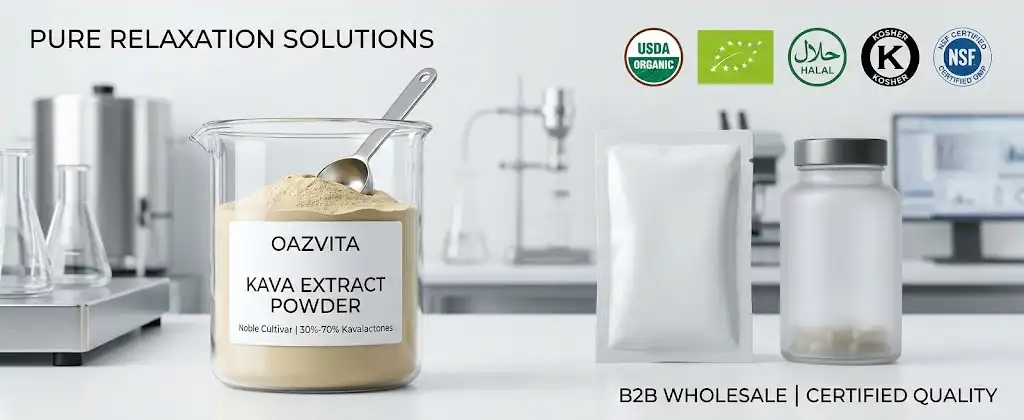
Kava extract powder, which is sometimes called Awa extract in some Pacific cultures, is not just kava root that has been broken up. It is a processed ingredient with a known amount of kavalactone, usually between 30% and 70%, which has been confirmed by HPLC research. Noble cultivars from Vanuatu, Fiji, and Tonga are given top priority in premium grades because root quality and chemotype consistency are most reliably controlled there.
This ingredient is different from tinctures or whole-root capsules because it can be used in different ways and is always the same. People who are making functional drinks, wellness capsules, or gummies for relaxation need an ingredient that acts the same way in all batches. That can't come from raw root powder.
The global market for Botanical Extracts has been slowly growing. In the U.S. market, stress-relieving and sleep-supporting supplements are two of the supplement groups that are growing the fastest. Kavalactones, especially kavain and dihydrokavain, have been studied in published pharmaceutical studies for their ability to help people who are anxious. This is what makes kava different from herbs that make you sleepy, like valerian root or kratom. Kava makes you feel calm and relaxed without making you lose your mind, as many other plants that make you sleepy do.
Regulatory compliance is an important step for buying teams that can't be skipped. The most important safety difference in the business is variety choice: When compared to Tudei cultivars, Noble types have much lower amounts of Flavokawain B. Reliable suppliers keep records of the cultivars they sell and offer third-party purity tests to prove this.
How Is Kava Extract Powder Made? The Production Process Explained
From Pacific Root to Standardized Powder
There are several planned steps that go into turning gathered kava root into kava powder for supplement use that can be sold. Traditional Pacific preparation involved soaking in water that had to be done by hand. This worked well for ceremonies but wasn't practical for making nutraceuticals on a large scale. Today, controlled, repeatable extraction protocols have taken the place of that variability in manufacturing.
In industry, ethanol extraction and supercritical CO₂ extraction are the two most common ways to do things. The full kavalactone profile can be extracted easily with ethanol, and it works well for making both normal and water-dispersible grades. Supercritical CO2 extraction doesn't leave behind any leftover solvent and preserves thermolabile chemicals, which is why it's the best method for high-end or clean-label product lines.
The concentrate is filtered and spray-dried after it has been extracted. Spray-drying with carriers like maltodextrin or cyclodextrin changes the naturally lipophilic resin into a free-flowing powder that mixes better with water, which is an important trait for use in drinks and functional foods.
At every step, quality checking takes place. Here are the basic quality standards that all responsible makers must meet during production:
- Kavalactone potency verification using HPLC to confirm concentration within specification, typically 30%–70% total kavalactones per batch.
- Flavokawain B monitoring with recommended limits below 0.1%, ensuring Noble-cultivar compliance and mitigating potential safety concerns.
- Moisture and ash content are maintained below 5% each to protect stability and shelf integrity.
- Microbiological and heavy metal screening is conducted on every production lot to meet international food-grade safety standards.
For B2B buyers, these standards are a must. When brands make goods for the U.S. market, they have to show proof that their ingredients are safe and effective. It is a procurement liability to work with suppliers who can't give a full COA, MSDS, and TDS for every batch.
Another procurement decision point is whether to buy from organic or non-organic sources. Kava root that is verified organic by the USDA and the EU costs more, but it helps clean-label brands get a better place in the market. Along with these two certifications, OAZVITA's kava extract powder also has HACCP, ISO 22000, NSF, and HALAL accreditations. This collection of certifications meets the documentation needs of most major retail and private-label channels.
Kava Extract Powder Comparison: Choosing the Best Form for Your Business Needs
Matching the Ingredient Format to Your Formulation Goals
Choosing the right botanical style relies on how the product will be used, who it is meant for, and how the supply chain works. Here's how the main types of delivery compare:
Tinctures work quickly and are easy for people to get used to, but they need to be handled with alcohol, have a longer shelf life, and can't be used for solid dose forms. Capsules make dosing easy, but they only let the manufacturer make potency increases that are already set. Kava extract powder is the most flexible form because it can easily be added to capsules, tablets, gummies, drink mixes, and functional foods. Its strength can also be changed during the formulation process.
When compared to valerian root, kava affects the brain in a different way. Valerian mostly works on GABA receptors through valerenic acid, which makes the effect more calming. The kavalactone profile of kava, especially kavain-dominant chemotypes, helps you relax while keeping your mind clear, which makes it better for daytime wellness positioning.
The birthplace and cultivar certifications are the most important things to look at when judging a seller. Pacific Island sourcing from well-known growth areas gives you a better level of cultivar purity. Teams in charge of buying things should also look at the supplier's GMP production environment, response time, and track record of following export regulations.
Procurement Insights: How to Buy Kava Extract Powder in Bulk
Key Factors for B2B Sourcing Decisions
Buying uniform plant extracts in bulk is more complicated than buying common ingredients. The price of kava extract powder depends on how much kavalactone it has, how it was extracted, and what cultivar it comes from. Extracts with a higher percentage (60%–70% kavalactones) cost more than lower-level grades, and organic material adds another level of cost.
When brands are testing the market, MOQ arrangements are important. OAZVITA has low MOQs starting at 1 kg, and packaging can be tailored to meet specific needs. This is a useful setup for brands that are releasing new formulations or testing how well ingredients work before going big. Lead times are between one and five business days, and based on the location and amount, items can be shipped by DHL, FedEx, UPS, sea freight, or airmail.
Reliability of a supplier goes beyond price. A reliable kava extract powder provider keeps track of batches, makes sure that chemotype profiles are the same from order to order, and lets customers know ahead of time when supplies are available. These things keep costly delays from happening during reformulation and help with long-term planning for production.
Procurement teams can check the quality of ingredients before placing large orders by sending free samples with full COA paperwork. This is a common practice that OAZVITA fully supports.
Conclusion
Kava extract powder fits a clear role in the world of botanical ingredients: it is a consistent, flexible, and scientifically proven ingredient that can help with nervousness, sleep, and nerve stress. Choosing the right extract grade and supplier partner is important for supplement brands, functional beverage makers, and private-label buyers because it affects both the performance of the product and its compliance with regulations. This ingredient has a shelf life of 24 months, multiple certifications, and variable supply terms, making it a good choice for long-term formulation projects.
FAQ
1. Is kava extract powder safe for regular use in supplement formulations?
How safe kava Products are depends a lot on which variety is used. Noble cultivar extracts with Flavokawain B levels that are controlled (below 0.1%) are fine to use on a regular basis in regulated markets. Suppliers should show written proof of the cultivar's birthplace and let a third party analyze the batch. Formulation brands should also follow the daily kavalactone intake guidelines that are set out in documents from regulatory agencies.
2. What kavalactone concentration is recommended for bulk supplement applications?
30% to 50% of total kavalactone extracts are often used for pill and tablet uses. For solubility and flavor integration, functional beverage and gummy forms often do better with grades that dissolve in water at 30% to 40%. The best specification relies on the dose that is wanted per serve and the rules that apply in the market that the product is meant for.
3. How does kava extract powder compare to whole kava root powder?
Whole root powder has less kavalactone, and its strength changes a lot from batch to batch.
4. What certifications should I require from a kava extract powder supplier?
You should at least require GMP production records, HACCP records, ISO 22000 records, a full COA, and cultivar tracking records. Certifications from the USDA, EU, HALAL, and NSF give products a lot more respect when they have a clean name or are sold in other countries.
Source Your Kava Extract Powder with OAZVITA
People in North America, Europe, and Asia trust OAZVITA to provide high-quality kava extract powder to private-label buyers, functional food companies, and companies that make Dietary Supplements. Our kava extract comes only from Noble kava roots and rhizomes. It has been tested to make sure it has the right amount of kavalactone and has been certified by HACCP, ISO 22000, NSF, HALAL, the USDA, and the EU as organic. You can start a chat for free since there is no minimum order quantity (MOQ) and the lead time is between 1 and 5 days. Send us a message at info@oazvita.com.
References
1. Pittler, M. H., & Ernst, E. (2003). Kava extract versus placebo for treating anxiety. Cochrane Database of Systematic Reviews.
2. Cairney, S., Maruff, P., & Clough, A. R. (2002). The neurobehavioural effects of kava. Australian and New Zealand Journal of Psychiatry.
3. Lebot, V., Merlin, M., & Lindstrom, L. (1992). Kava: The Pacific Elixir. Healing Arts Press.
4. Sarris, J., Stough, C., Bousman, C. A., et al. (2013). Kava in the treatment of generalized anxiety disorder. Journal of Clinical Psychopharmacology.
5. Teschke, R., Wolff, A., Frenzel, C., & Schulze, J. (2012). Herbal hepatotoxicity: A tabular compilation of reported cases. Liver International.
6. U.S. Pharmacopeia (USP). (2021). Dietary Supplement Compendium: Botanical Ingredient Standards. USP Convention.

Send Inquiry



Related Industry Knowledge
- Glutathione Powder: The Ultimate Guide for Skincare Enthusiasts
- What are the benefits of berberine HCl?
- How to use pearl powder: Complete 2026 Benefits Guide
- Chewable Collagen Gummies for Skin Health: Are They Really Worth It?
- 2026 Best OEM/ODM Pure Fish Collagen Peptide Suppliers for Skincare Industry
- Chicken Collagen Peptides: The Ultimate Guide for Health Enthusiasts
- Avoiding Batch Variability in Fish Collagen Peptides for EU Buyers
- Germany Market Insights: Standardized Withanolides in Pure Ashwagandha Capsules
- Top 10 Pure NMN Powder Manufacturers in China For 2026
- Nicotinamide Riboside Chloride Powder vs Nicotinamide: Key Differences Explained