What Is Sodium Copper Chlorophyllin Powder?
Aug 04, 2026
Sodium Copper Chlorophyllin Powder is a semi-synthetic, water-soluble derivative of natural chlorophyll, extracted predominantly from mulberry leaves and similar botanical sources. Through a specialized saponification process, the magnesium ion in natural chlorophyll is replaced with copper, dramatically enhancing stability, solubility, and antioxidant capacity. This copper-substituted compound (CAS No. 11006-34-1), often referred to as Chlorophyllin Copper Sodium Salt Powder, addresses critical industry challenges—namely, the degradation of natural chlorophyll when exposed to light, heat, and oxidative stress. Its vibrant green pigmentation and functional bioactivity make it indispensable for B2B manufacturers seeking reliable, high-performance ingredients for nutraceuticals, functional foods, and cosmetic formulations.
Understanding Sodium Copper Chlorophyllin Powder
Chemical Structure and Stability Advantages
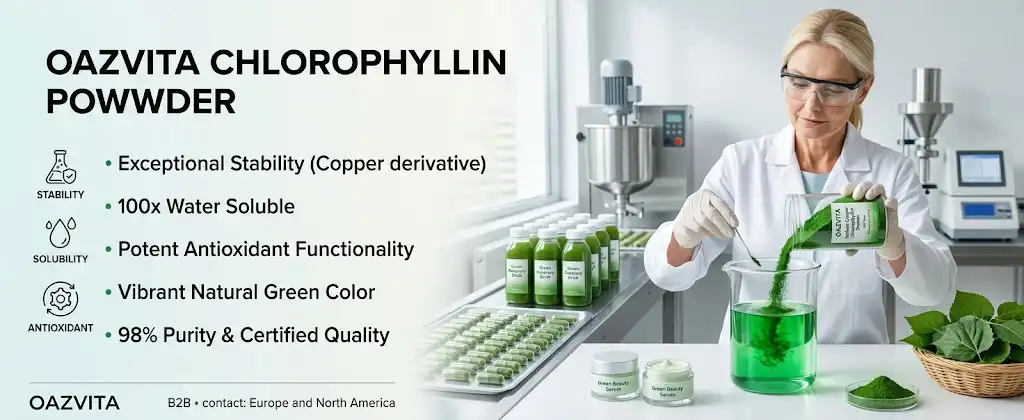
When natural chlorophyll changes into its copper-sodium derivative, performance characteristics are fundamentally changed. The magnesium core of natural chlorophyll is extremely fragile. It breaks down into brownish pheophytin when it's made in the usual way, like when it's pasteurized or put into tablets. When magnesium is switched out for copper, a very stable porphyrin complex is made that keeps its emerald hue during processing and storage. Supplement and food makers used to have a lot of trouble with color fading and differences in quality from batch to batch, but this structural change fixes that problem. The sodium salts that are made during saponification make natural chlorophyll 100 times more water-soluble than lipophilic chlorophyll. This makes it possible for it to be easily added to water-based drinks, pill fillers, and topical formulas. Through HPLC testing, OAZVITA's product is 98% pure, making sure that it is consistent enough to meet strict international standards like HACCP, ISO 22000, and NSF certifications.
Antioxidant and Functional Properties
Researchers have found that Sodium Copper Chlorophyllin Powder is a powerful antioxidant. This is because it can neutralize free radicals and lower markers of oxidative stress. The chemical speeds up the body's metabolism by helping cells make energy, and it also keeps the gut healthy by having prebiotic-like effects on the bacteria there. Unlike synthetic antioxidants, it comes from plants and is a clean-label solution. This meets customer desire for clear, plant-based ingredients. Studies show that it can help the body absorb nutrients, especially vitamins that dissolve in fat, by keeping gut enzyme activity stable. For business-to-business clients in the sports nutrition industry, this means formulas that help with healing and support antioxidant defense after exercise without adding any artificial ingredients. The compound's ability to chelate heavy metals makes it an even more valuable ingredient in detox Products. However, manufacturers should be aware that this mechanism needs careful dosing protocols.
Advantages Over Natural Chlorophyll Extracts
Natural chlorophyll is hard to work with and breaks down quickly, which can cause problems for procurement teams. Within weeks of being made, raw plant extracts separate in emulsions and water-based solutions, and the color gets less intense. This technical problem is solved by the copper-sodium derivative, which keeps the biological essence of chlorophyll. Because it is very stable, manufacturers can store it for 24 months in cool, dry conditions, while natural alternatives only last 3 to 6 months. The steady tinctorial strength—about 5 to 10 times more chromatic potency per gram—lowers the cost of ingredients and makes formula calculations easier. Brands that want to be seen as "natural" can benefit from having the E141ii designation in EU markets and the GRAS designation in North America. This meets both legal standards and marketing stories. OAZVITA only gets its ingredients from mulberry leaves, which makes it a good choice for brands that care about the ethical and sustainable sourcing of their ingredients.
Applications and Usage Guidelines
Nutraceutical and Dietary Supplement Formulations
This green pigment can be used in a lot of different supplement forms. Capsules and tablets usually have 50-100 mg per dose, which is used for both coloring and protective functions. Its benefits for gut health are used by companies that make digestive wellness products at amounts of 100-300 mg per day, spread out over several doses. 0.5-2% Sodium Copper Chlorophyllin Powder is added to powder mixes for sports nutrition and meal replacements to give them bright green colors and help boost antioxidant levels generally. The ingredient's high dissolvability makes sure that it is evenly distributed in protein powders and recovery solutions, which is an issue with real chlorophyll. Manufacturers of gummies like that it stays stable when heated and works well with gelatin and pectin materials. It is used by brands that want to stand out in crowded markets because it has two functions: it makes the product look good and supports claims about its health benefits, all while keeping the formulation simple and the list of ingredients shorter.
Functional Food and Beverage Integration
Finding the right balance between color stability and flavor profiles is hard for people who make drinks. Sodium Copper Chlorophyllin Powder is great for adding to fortified waters, energy drinks, and healthy teas because it has a bland taste and is stable from pH 5 to 10. When used at normal levels (10 to 50 ppm), it gives a bright green color without the shiny notes that come from having too much copper in it. The compound is heat-stable enough to withstand standard pasteurization procedures (72°C for 15 seconds), so the color stays the same throughout the distribution chain. Protein bar and snack makers add 0.1% to 0.5% to get natural green marbling in brown or beige matrices, which makes the food look better without using artificial dyes. The compound's freeze-thaw stability makes it useful for frozen desserts because it stops color bleeding that makes the product look bad. OAZVITA's food-grade specifications, along with full MSDS and COA documentation, make regulatory approval easier in many foreign markets, such as the EU, the US, and the Asia-Pacific region, where clean-label efforts drive projects to change the way products are made.
Cosmetic and Nutricosmetic Applications
Sodium Copper Chlorophyllin Powder is being used more and more in both topical and ingestible beauty products. Serums and creams with 0.1 to 1% show soothing properties that are good for skin barriers that have been damaged, but manufacturers should focus on cosmetic positioning instead of therapeutic positioning. The compound's antioxidant activity backs up claims of anti-aging by dealing with the effects of external stressors. Nutraceutical pills for skin health usually contain 100-200 mg per day, and they are often mixed with collagen peptides, hyaluronic acid, or vitamin C to make the benefits stronger. The ingredient comes from mulberry leaves, which is a clean source that meets the needs of the beauty industry for botanical, non-GMO ingredients that can be proven through clear supply chains. OAZVITA's EU and USDA organic credentials help brands that want to get COSMOS or EcoCert certifications keep the integrity of their certifications. The natural green color of the compound makes it stand out in the market for health supplements, so it doesn't need any extra colorants. It also has useful benefits.
Quality and Comparison Insights for Procurement
Evaluating Purity and Grade Specifications
To do sophisticated buying, you need to know the quality factors that set commodity-grade Sodium Copper Chlorophyllin Powder apart from premium material. Purity levels below 90% usually mean that there is still plant matter, salts, or breakdown products that make the color less intense and the product less useful. The 98% HPLC-verified purity of OAZVITA represents pharmaceutical-grade material that can be used in situations where absolute consistency is needed. Copper content should be between 4-6% by weight to keep things stable while still being safe enough to not go over regulatory limits. For the best tinctorial strength, the chlorophyll content, shown as E1 1% 1cm absorbance at 405 nm, should be higher than 400. Microbial requirements must be in line with those used in the supplement business. For example, the total plate count must be less than 1,000 CFU/g, yeast and mold must be less than 100 CFU/g, and absence of pathogens like Salmonella and E. coli. Lead levels should not be higher than 2 ppm, arsenic levels should be less than 1 ppm, and cadmium levels should be less than 1 ppm. Brands that want to sell in the EU must make sure they follow Regulation (EC) No. 1333/2008. For US-focused goods, they need to make sure they are GRAS and have FDA color additive approval for the color ingredient E141ii.
Comparative Analysis with Alternative Ingredients
People who make decisions often compare Sodium Copper Chlorophyllin Powder to spirulina powder, natural chlorophyll extracts, and synthetic green dyes. Natural chlorophyll comes from real plants, but it is very unstable and fades quickly in store lights and forms crystals in water. Spirulina gives food a green color and contains protein and vitamins. However, it has strong oceanic tastes and allergen worries that make it less useful in some situations. Synthetic dyes, such as brilliant blue FCF mixed with tartrazine, make colors green, but more and more people don't like them, and some countries, like Norway, Austria, and California, have laws that make it illegal to sell them. The copper derivative is in a special place because it comes from natural sources, is very stable, has useful bioactivity, and is approved by regulators in all big markets. Due to its 5–10 times stronger tinctorial strength, it often has lower per-unit costs, even though the raw materials are more expensive than natural products. Bioavailability studies show that the copper complex is better at absorbing nutrients than pure chlorophyll, but there isn't a lot of direct data to compare the two.
Criteria for Evaluating Suppliers
When looking for trusted partners, you have to look at more than just the product specs. Manufacturing certifications like GMP, HACCP, and ISO 22000 show that quality control is done in a planned way, and NSF and Informed-Sport verification meet the needs of the sports nutrition sector. Organic certifications from the USDA and EU officials prove that farming methods are correct and that products can be tracked, which is very important for brands that want to talk about ecology. Suppliers should give batch-specific paperwork, like a COA with full analytical panels, an MSDS with handling instructions, and Technical Data Sheets (TDS) with suggested use levels. A production capacity assessment makes sure that suppliers can keep up with rising demand. Facilities that process 500 tons or more per year show that the infrastructure is stable. When OAZVITA offers lead times of less than 5 working days, it means that their processes are prompt and they have enough inventory on hand. Geographic factors include being close to major shipping places to make operations easier and finding suppliers in areas with established botanical ingredient industries. Ask current clients with similar applications for references, preferably those that serve the US and EU markets with strict regulatory requirements.
Procurement Guide: Where and How to Buy
Identifying Trusted Manufacturers and Distributors
The world Sodium Copper Chlorophyllin Powder supply network is mostly based in places that already have well-established businesses for extracting plants, like China, India, and some European countries. When it comes to quality control and tracking, manufacturers who do everything themselves, from growing the raw materials to finishing the products, usually do a better job than traders who buy from a lot of different places. This integration is shown by OAZVITA's direct buying from mulberry leaf growers, which guarantees stable quality in the raw materials and fair farming practices. Check out the research and development (R&D) capabilities of manufacturers. Companies that publish research, attend international trade shows like Vitafoods and SupplySide West, and offer formulation support show technical depth that is useful for complex applications. Regulatory compliance can be confirmed online through the FDA's GRAS Notice Inventory, the EU's Food Additives Database, and third-party certification registries. Request virtual walks of the building to get a feel for the work areas, the level of sophistication of the equipment, and the procedures for keeping the environment clean. Being a member of an industry group like the United Natural Products Alliance (UNPA) or the Natural Products Association (NPA) shows that you are committed to ethical and high-quality business practices.
Minimum Order Quantities and Pricing Structures
Knowing the MOQ standards helps you avoid surprises during the buying process and make accurate budget plans. The 1 kg minimum order size for OAZVITA makes it easier to test new formulations and make small batches. This is especially helpful for private label buyers who are testing new markets. Standard commercial quantities start at 25 kg, and prices drop significantly at 100 kg, 500 kg, and 1,000+ kg or more. Prices per kilogram vary a lot depending on how pure it is (85% vs. 98%), what type of approval it has (standard vs. organic), and how it is packed (fiber drums vs. food-grade poly bags with aluminum foil). Prices on the market for 98% HPLC-verified material range from $45-85/kg for orders of 100 kg or more. Organic-certified types command 20–30% higher prices. Annual contract arrangements that guarantee a supply for 3 to 12 months often offer 8 to 15 percent savings compared to buying on the spot and protect against changes in the price of raw materials. New customers usually have to put down 30 to 50 percent of the total amount they want to pay as a deposit. After a while, they can switch to net-30 or net-45 terms. Before committing to business quantities, ask for samples. Reliable providers like OAZVITA offer free samples with a certificate of authenticity (COA) to make sure that the specs meet the needs of the application.
Documentation and Regulatory Compliance
When functional ingredients are traded internationally, they need to be accompanied by a lot of paperwork to help with customs processing and government approval. The COA should list all the factors that were tested, such as heavy metals, bacteria, purity, copper content, chlorophyll content, and microbiology. It should be signed by quality assurance staff and match the batch numbers on the shipping containers. MSDS gives warehouse workers and formulators important safety information, like how to handle chemicals safely, give first aid, and properly get rid of them. TDS gives advice on how to use the product, its solubility, and the best ways to incorporate it. For locations in the EU, providers must show proof that they follow Regulation (EC) No. 1333/2008 for food additives. GRAS affirmation notes and proof of the right FDA color status are helpful for shipments going to the US. For organic certifications, each package must have transaction certificates (TCs) that links it to a certified business. For Halal and Kosher certifications, production facilities and specific product codes must be covered by valid certificates from recognized authorities. Some countries, like Australia, Canada, and Japan, have their own rules about what can be imported. Talk to customs brokers and regulatory experts to make sure you have all the paperwork you need so your shipment doesn't get held up.
Why OAZVITA Stands Out as Your Sodium Copper Chlorophyllin Powder Supplier
Our dedication to excellence starts with sourcing methods that put sustainability and traceability first. OAZVITA keeps in touch with people who grow mulberry leaves to make sure that their farming methods are in line with organic standards and rules for fair labor. This vertical integration gets rid of the lack of transparency in the supply chain that is common in markets for commodity ingredients. It also gives clients paperwork that can stand up to review from both certification bodies and careful customers. This makes Sodium Copper Chlorophyllin Powder from OAZVITA a reliable choice.
Our manufacturing skills set our business apart from rivals. Multiple advanced production lines with HPLC, UV-Vis spectrophotometry, and ICP-MS equipment allow quality checks to be done in real time as the products are being processed. Our research and development team, which is made up of biochemists and food technologists with decades of experience between them, works with clients to solve formulation problems by customizing particle size, testing stability under conditions specific to the client, and fixing problems with applications. This technical partnership goes beyond simple supply ties, making OAZVITA a strategic ingredient partner that cares about the success of its clients.
With strict testing schedules, quality assurance methods go above and beyond what is expected in the business. Before being released, each production batch goes through 23-point analytical screening. Samples are kept for 36 months so that they can be looked at again if there are any questions. Having certifications from HACCP, ISO 22000, NSF, HALAL, EU Organic, and USDA Organic shows that you are dedicated to following a wide range of legal and moral standards. Our on-time delivery rate of more than 99% shows that we are very disciplined in our operations and respect our clients' production plans. This is very important when delays in ingredients cause costly manufacturing disruptions.
Different clients' wants can be met by flexible business plans that are flexible. OEM and ODM services help brands that don't have their own production facilities by providing complete solutions that include formulation, encapsulation, and main packing. Our 1 kg minimum orders let startups and private label operators try ideas without having to spend a lot of money on inventory. For annual supply agreements over 10 tons, you get dedicated account management and better prices. Respondent customer service works across time zones, and support staff who speak multiple languages answer technical questions, questions about regulations, and help with planning. Giving samples with full documentation shortens the time it takes to evaluate them, which shows confidence in the quality of the product and helps people make smart buying decisions.
Conclusion
Sodium Copper Chlorophyllin Powder is a sophisticated answer to long-standing problems in natural ingredient formulation. It combines the authenticity of plants with the dependability of industrial processes. Because it is more stable, has strong antioxidant properties, and can be used in a wide range of nutraceuticals, functional foods, and products, brands that care about quality and performance can't do without it. Choosing suppliers who offer verified purity, full certifications, and helpful technical support is important for successful procurement. Our all-around approach, which includes environmentally friendly buying, cutting-edge production, and flexible business terms, makes OAZVITA your ideal partner for creating high-quality goods that also appeal to health-conscious customers.
Frequently Asked Questions
1. Is copper chlorophyllin safe during pregnancy?
At this point in time, studies have not definitively established safety ratings for Sodium Copper Chlorophyllin Powder during pregnancy. Because pregnancy changes how nutrients are used and how sensitive you are to food components, the compound's copper content and bioactive properties should be taken with care. Most doctors will tell you to stay away from vitamins that aren't necessary while you're pregnant, unless you have specific weaknesses. If a business is making prenatal or postnatal products, they shouldn't include it. Instead, they should clearly label general supplements with standard pregnancy warnings. Regulatory advice in the EU and US markets generally says that women who are pregnant should talk to a doctor before using this drug.
2. What is the recommended dosage for supplement formulations?
Depending on the purpose, most supplements run from 50-300 mg per day, spread out over one to three doses. Digestive health products usually have 100 to 200 mg per dose, while antioxidant-focused products might have 50 to 100 mg. 100–150 mg is added to post-workout sports nutrition products that are meant to help with recovery. These ranges find a good mix between functional effectiveness and safety margins below values that are linked to bad effects. Manufacturers should do stability tests to make sure that amount stays the same throughout the product's shelf life, since degradation could lower the product's effectiveness below goal levels.
3. How does antioxidant activity compare to natural chlorophyll?
Compared to natural chlorophyll that is based on magnesium, the copper substitution makes it a stronger antioxidant. The porphyrin ring's natural antioxidant structure is strengthened by copper's redox chemistry, which adds to its ability to remove electrons. Testing in the lab using DPPH and ORAC methods shows that copper chlorophyllin neutralizes 30–50% more free radicals per gram than natural extracts of the same amount. But differences in bioavailability make direct comparisons harder. The water-soluble derivative may have stronger effects in living things, even though the differences in per-molecule potency are small.
Partner with OAZVITA for Premium Chlorophyllin Copper Sodium Salt Powder
OAZVITA's pharmaceutical-grade ingredient solutions can change the way your products are made. Our technical team is ready to talk about your specific application needs, send you free samples with full analytical documentation, and make custom proposals that meet your volume and quality requirements. OAZVITA gives your business the consistency and support it needs, whether you're launching new supplement lines, changing the formulas of current goods to use clean labels, or looking for a reliable bulk provider for Wholesale Copper Chlorophyllin Powder. Email our purchasing agents at info@oazvita.com to ask for Certificates of Analysis, talk about reasonable prices for bulk orders, and look into OEM/ODM partnership possibilities. We make sure your supply chain works well in global markets by letting you ship via DHL, FedEx, and ocean freight. Experience the OAZVITA difference—where knowledge of plants meets skill in making products.
References
1. Ferruzzi, M.G. & Blakeslee, J. "Digestion, Absorption, and Bioavailability of Chlorophylls and Related Compounds." Journal of Agricultural and Food Chemistry, Vol. 55, 2007, pp. 4015-4021.
2. Kephart, J.C. "Chlorophyll Derivatives—Their Chemistry, Commercial Preparation and Uses." Economic Botany, Vol. 9, 1955, pp. 3-38.
3. Tumolo, T. & Lanfer-Marquez, U.M. "Copper Chlorophyllin: A Food Colorant with Bioactive Properties?" Food Research International, Vol. 46, 2012, pp. 451-459.
4. Simonich, M.T. et al. "Natural Chlorophyll Inhibits Aflatoxin B1-Induced Multi-Organ Carcinogenesis in the Rat." Carcinogenesis, Vol. 28, 2007, pp. 1294-1302.
5. Egner, P.A. et al. "Chlorophyllin Intervention Reduces Aflatoxin-DNA Adducts in Individuals at High Risk for Liver Cancer." Proceedings of the National Academy of Sciences, Vol. 98, 2001, pp. 14601-14606.
6. Jubert, C. & Bailey, G. "Isolation of Chlorophylls a and b from Spinach by Column Chromatography." Journal of Chemical Education, Vol. 84, 2007, pp. 1740-1742.

Send Inquiry

Related Industry Knowledge
- The Truth About Blue Copper Peptide Powder No One Really Talks About
- How is the quality of pure curcumin powder tested?
- What is the benefit of vitamin D3 powder?
- Biotin Powder: The Secret Behind Naturally Thick and Healthy Hair
- What Is Pure Fish Collagen Peptide Used For in the Beauty Industry?
- What Is Pure NAD+ Powder and How Does It Work in Anti-Aging
- Fish Collagen Peptide Solutions for Functional Food Leaders in Australia
- Benefits of shilajit resin supplement for cognitive performance
- MCT Powder Processing Technologies Adopted in Singapore
- Why Germany Chooses Our GMP-Grade NMN Powder for R&D Programs?