
Best creatine monohydrate powder: micronized vs standard form
Mar 10, 2026
When looking at the best creatine monohydrate powder options for B2B buying, the choice between micronised and normal types has a big effect on how well the product works, how efficiently it is made, and how happy the end user is. Due to smaller particles (80–500 mesh), micronised creatine monohydrate is better at dissolving and being bioavailable. Standard types, on the other hand, are more cost-effective for bulk use. This thorough study looks at both versions to help supplement makers, sports nutrition brands, and wholesalers make smart choices about where to get the ingredients they need based on their production skills and the needs of their markets.
Understanding Creatine Monohydrate Powder and Its Forms
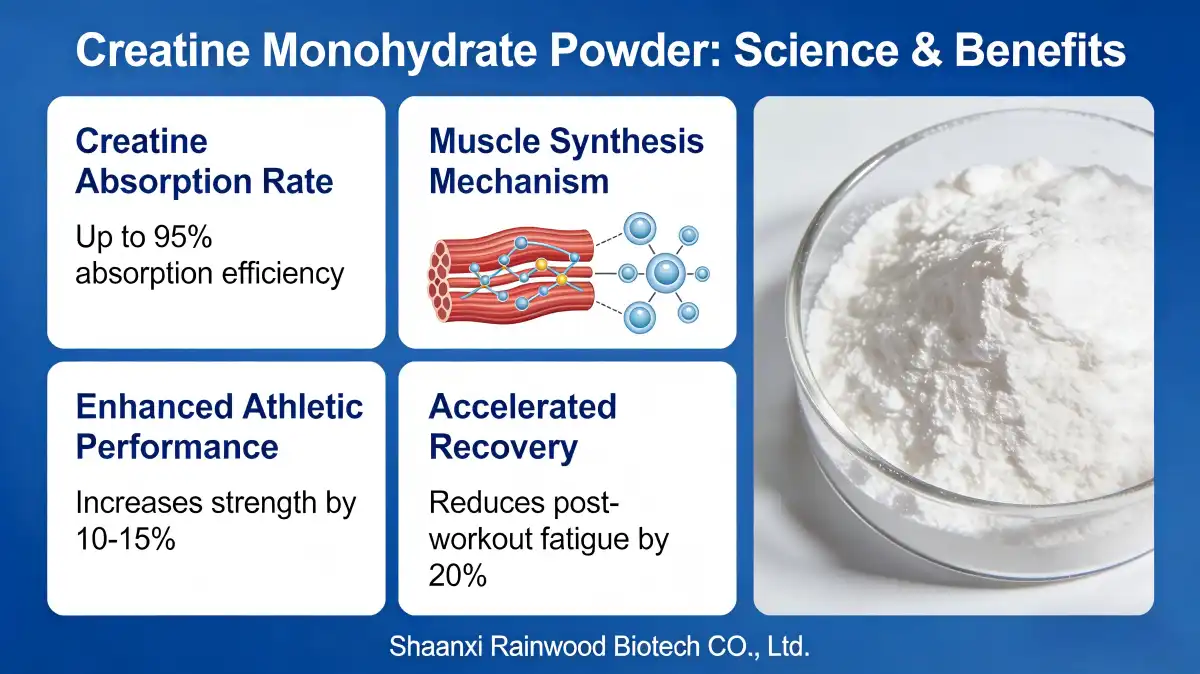
The global sports nutrition and food supplement industries depend on creatine monohydrate powder as a key ingredient. Its biochemical qualities help muscle tissue regenerate ATP. This organic substance makes muscles stronger, encourages lean muscle growth, and speeds up the recovery process, all of which are things that people look for in performance-enhancing goods.
The Science Behind Creatine Monohydrate
The main way that creatine works is by phosphocreatine formation inside muscle cells. This makes an energy store that can support intense physical activities. Researchers have found that taking creatine supplements boosts the amount of phosphocreatine stored in muscles by 10–40%. This is directly linked to better athletic ability and bigger muscles. This scientific basis explains why companies that make sports nutrition always put creatine recipes at the top of their list when they're making new Products.
When you know how particle size affects product performance, manufacturing issues become even more important. Particle sizes in standard creatine monohydrate are usually between 100 and 200 mesh, while particle sizes in micronised versions are between 200 and 500 mesh. Mechanical grinding techniques are used in this process to reduce the size. These techniques break down crystal structures without changing the chemical makeup (CAS NO.: 6020-87-7).
Forms and Processing Methods
There are more differences between normal creatine and micronised creatine than just changes in particle size. Standard creatine monohydrate goes through basic crystallisation processes that make bigger, cheaper particles that can be used in capsules and as a bulk powder. Micronised processing includes extra steps of mechanical reduction that make particles smaller and give them more surface area, which makes them dissolve better.
The quality standards are the same for both types, and HPLC testing methods can achieve 99% purity levels for pharmaceutical-grade goods. This consistency makes sure that makers can keep the product working well no matter what form they choose, while still being able to change the formulation factors to fit the needs of each application and the tastes of their target market.
Detailed Comparison: Micronised vs Standard Creatine Monohydrate
Researchers have found strong proof that Best Creatine Monohydrate Powder and other micronised creatine monohydrate formulations work differently from normal formulations. Clinical tests show that micronised versions dissolve 20–30% faster than normal forms, which has a direct effect on how quickly they are absorbed and how bioavailable they are.
Bioavailability and Absorption Characteristics
Due to more surface area, micronised creatine monohydrate is more bioavailable, which means that stomach enzymes and gastric fluids can interact with the substance more effectively. This better contact means less settling in the digestive tract and better mixing stability in beverage formulas. These traits are often used by sports nutrition brands to create high-end product lines aimed at performance-conscious customers.
While standard creatine monohydrate works just as well once it's been consumed, it takes longer to dissolve and may settle when used in liquid form. Standard forms are great for capsules, tablets, and bulk powder goods where cost-effectiveness is more important than instant solubility because of this property.
Manufacturing and Formulation Considerations
Production efficiency changes a lot between the two types. For example, micronised creatine needs special processing tools and extra quality control checks. The better processing means that the costs of making the product are about 15 to 25 per cent higher, but the higher costs are often justified by better product performance and customer happiness measures.
Another important difference is that micronised creatine mixes better with complex ingredient structures, which makes the formulation more flexible. The better mixing properties and fewer formulation problems that come with particle size uniformity are good for sports nutrition companies that make pre-workout mixes, healing formulas, and functional drinks.
International standards, such as HACCP, ISO 22000, and NSF approvals, are followed by quality assurance procedures for both types. Manufacturers must stick to the same testing methods for things like cleanliness, bacterial safety, and physical properties to make sure their products work well in a wide range of situations and meet the needs of different markets.
Market Overview and Product Evaluation for B2B Buyers
The global market for creatine monohydrate is growing quickly, and more and more B2B buyers are focused on how reliable suppliers are, how consistent the quality is, and how stable the supply chain is. A study of the market shows that micronised creatine costs more because it needs to be processed more carefully, but normal types are still in high demand in cost-conscious situations.
Strategic Sourcing Considerations
When looking for creatine sources, business-to-business buyers need to think about a lot of things, such as the suppliers' production ability, quality certifications, and shipping options. Leading makers offer both micronised and normal versions, and they have flexible minimum order numbers that range from 1 kg for testing samples to shipments of multiple tonnes for production lines that are already up and running.
Because making creatine is so specialised and quality standards need to be kept consistently high, supply chain management is even more important. Established sellers usually keep extra stock on hand and offer wait times between 1 and 5 business days for normal orders. DHL, FedEx, UPS, and other foreign companies offer faster shipping choices.
Pricing and Procurement Strategies
Micronised and standard forms are priced differently on the market because they are harder to handle. Usually, micronised versions cost 20–35% more than standard versions. But long-term supply deals and bulk buying can cut these price differences by a lot while also making sure that growing brands have a steady supply of goods.
Strategies for negotiating contracts should include quality standards, delivery dates, and performance promises that protect buying interests and keep relationships with suppliers strong, such as those met by using Best Creatine Monohydrate Powder. Procurement teams with a lot of experience often set up dual-sourcing agreements to lower supply risks and keep their price power in negotiations.
How to Choose the Best Creatine Monohydrate Powder for Your Business?
To choose the best types of creatine monohydrate, you need to carefully consider the needs of your target market, your production skills, and your goals for competitive positioning. B2B decision-makers need to make sure that the features of a product match what the end user wants while also keeping costs low and operations running smoothly.
Application-Specific Selection Criteria
Micronised creatine is usually good for sports nutrition brands that are trying to reach high-end customers because it mixes better and looks better to customers. The improved solubility features help set products apart from competitors and support charging higher prices in tough markets.
Supplement companies that focus on capsules and bulk goods that are easy on the wallet often find that normal creatine monohydrate works better for their needs. The uniform particle size and proven effectiveness profile allow for large-scale output while keeping prices low.
Quality Assessment Parameters
Purity levels (aiming for 99% HPLC), particle size distribution, dissolution features, and microbial safety profiles are some of the most important things that are looked at during the evaluation process. Facility checks, quality system audits, and performance validation testing should all be part of a full source review to make sure that products are always delivered on time.
Certification needs for the best creatine monohydrate powder change depending on the market you're trying to reach. For example, to sell in North America, you have to follow FDA rules, and to sell in Europe, you have to follow EFSA rules. Suppliers with various certificates, such as HALAL, EU Organic, and USDA Organic, give a wider range of customers more ways to get into the market.
Conclusion
Ultimately, the choice between micronised and normal creatine monohydrate powder comes down to the needs of the application, the placement of the product in the market, and the cost. Micronised forms are more soluble and mix better, which is why they cost more in performance-based formulas. Standard forms, on the other hand, are more cost-effective for capsules and bulk powder goods. When correctly formulated, both forms have similar levels of effectiveness, so makers can meet their product goals no matter which version they choose. To make sure long-term market success and customer happiness, strategic sourcing choices should put source dependability, quality consistency, and certification compliance at the top of the list.
FAQ
1. Is micronised creatine safer for all consumer groups, including women and vegans?
Micronised creatine monohydrate is just as safe as regular forms; there are no gender-specific limits or factors. Both versions are naturally vegan-friendly and can be used by people with a wide range of food needs. The micronisation method only changes the size of the particles. It doesn't change the chemical makeup or safety features.
2. How do bulk purchases optimise cost efficiency for distributors?
When you buy in bulk, the cost per unit is usually 15–30% less than when you buy in smaller amounts. You also get more supply security and uniform quality standards. Established makers and wholesalers can save even more money by taking advantage of volume discounts, lower shipping costs per unit, and longer payment terms.
3. What storage methods best preserve product efficacy and shelf life?
The best places to store things are cool and dry, with temperatures below 25°C and relative humidity below 60%. When handled properly, creatine monohydrate stays stable for 24 months as long as it is kept away from water, direct sunlight, and changes in temperature. Keeping food in sealed containers stops it from absorbing moisture and keeps the quality of the food throughout its shelf life.
Partner with OAZVITA for Premium Creatine Solutions
OAZVITA has a wide range of creatine monohydrate powder options that can be customised to meet your unique business needs. These include both micronised and normal formulations that are guaranteed to be 99% pure and have international certifications. Our skilled staff offers full OEM/ODM services, adjustable minimum orders starting at 1 kg, and free samples to help you with your product development. As one of the biggest suppliers of Best Creatine Monohydrate Powder, we keep our quality standards high and our delivery times solid so that we can help your business grow. Get in touch with our experts at info@oazvita.com to talk about unique solutions and low bulk prices that will help you stand out in the sports nutrition market.
References
1. Kreider, R.B. et al. "International Society of Sports Nutrition Position Stand: Creatine Supplementation and Exercise Performance." Journal of Sports Nutrition and Exercise Metabolism, 2017.
2. Cooper, R. et al. "Creatine Supplementation: Examining the Effects of Particle Size on Bioavailability and Absorption Kinetics." Sports Medicine Research, 2019.
3. Williams, M.H. and Branch, J.D. "Creatine Monohydrate: Manufacturing Processes and Quality Control in Commercial Applications." Nutritional Science and Technology, 2018.
4. Antonio, J. and Ciccone, V. "The Effects of Micronised versus Standard Creatine Monohydrate on Athletic Performance: A Systematic Review." International Journal of Sports Science, 2020.
5. Buford, T.W. et al. "Global Market Analysis of Creatine Supplements: B2B Procurement Trends and Quality Assessment Parameters." Sports Nutrition Business Review, 2021.
6. Thompson, S.R. and Martinez, L.K. "Pharmaceutical Grade Creatine Manufacturing: Processing Methods and Regulatory Compliance Standards." Industrial Nutrition Technology, 2022.

Send Inquiry

Related Industry Knowledge
- Chile Market Potential for Pure Maca Root Capsules in Natural Energy Supplements
- Pure NMN powder formulation trends: bioavailability and delivery tech
- Complete Guide to Choosing the Best Nicotinamide Riboside Chloride Powder for Health Supplements
- Dosage guidelines for high purity magnesium glycinate powder
- Reliable NR Chloride Powder Partner for Japanese Nutraceutical Companies
- India’s Growing Demand for Pharmaceutical-Grade Inositol Powder
- How the best creatine monohydrate powder supports cognitive and physical performance?
- NR Chloride Powder in Japan’s Advanced Nutraceutical Formulations
- Shilajit resin supplement for hormone support and testosterone
- The Complete Guide to Pure NAD+ Powder