
Chicken Collagen Peptides vs Bovine Collagen: Key Differences Explained
Sep 03, 2026
When sourcing raw materials for supplement lines, beverage formulations, or nutricosmetic Products, brand owners face a critical decision: chicken collagen peptides or bovine collagen? Chicken Collagen Peptides are predominantly Type II collagen, extracted through controlled enzymatic hydrolysis of chicken cartilage and bone tissue. This bioactive protein delivers targeted joint and cartilage support, making it a preferred choice for orthopedic health applications. Bovine collagen, enriched with Type I and III, focuses primarily on skin elasticity and structural wellness. Understanding these differences allows B2B buyers to align ingredient selection with product positioning, regulatory requirements, and consumer expectations in competitive markets.
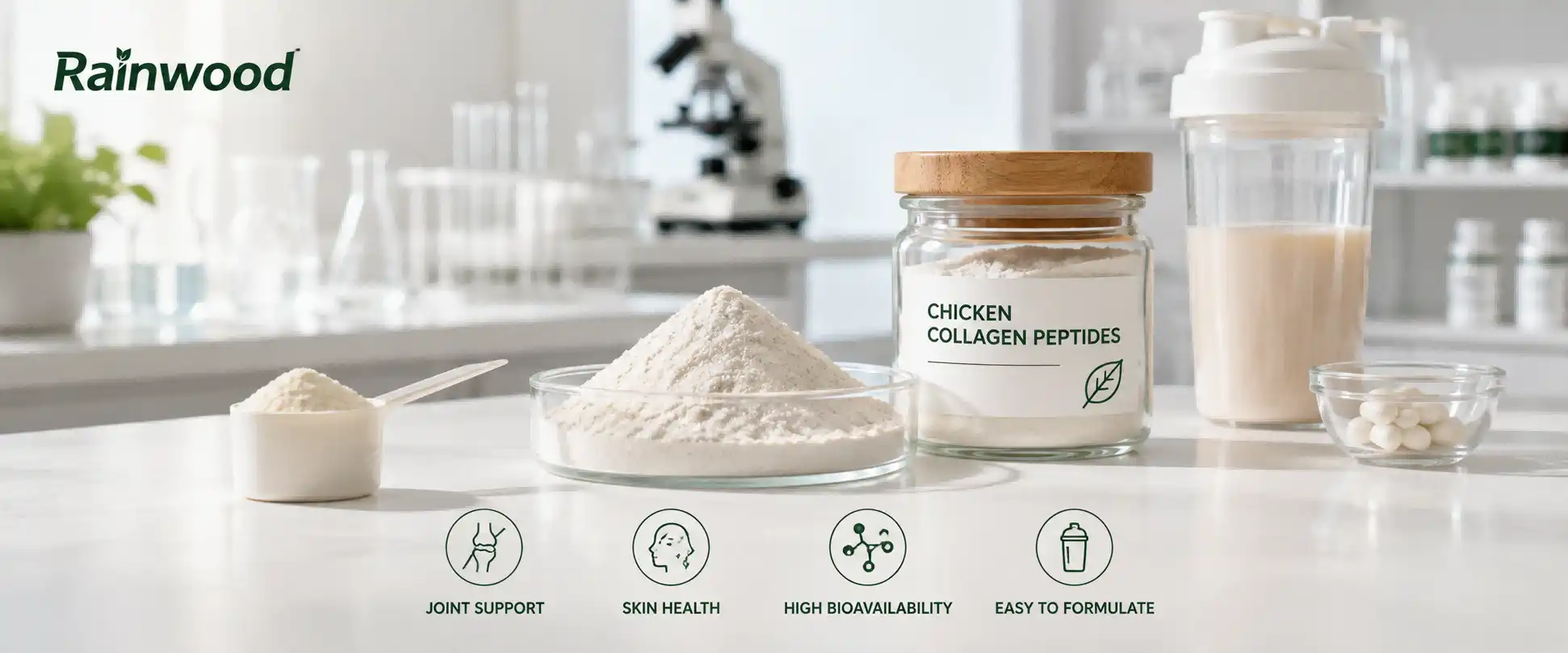
Understanding Collagen Peptides: Chicken vs. Bovine
Source and Extraction Methods
Each collagen peptide comes from a different type of animal tissue and has its own biological features. Skin and sternal cartilage are the main sources of Chicken Collagen Peptides. Proteins called enzymes cut long chains of collagen into shorter chains that are less than 3,000 Daltons long. This process improves the rate of absorption and makes sure that the substance dissolves in cold liquids, which is very important for companies that make drinks. Bovine collagen comes from the hides and bones of cattle. It is made using similar hydrolysis methods, but the collagen types that are made are different. How the amino acids are extracted changes the molecular weight distribution, amino acid profile, and how well the finished goods work.
Collagen Type Composition
Type II collagen makes up most of the peptides that come from chicken, which shows that it is the main structural part of human cartilage tissue. This type of collagen makes chondrocytes work harder, which helps cartilage grow back and joints move more freely. Large amounts of type I and III collagen are found in cattle collagen. These types of collagen are what give skin, bones, and soft parts their shape. About 90% of the body's collagen is type I, which means that sources from cows can be used to make a wide range of health goods. If you're making supplements for joint health, B2B buyers usually choose chicken sources first. If you're making beauty products, they usually choose cow sources first.
Molecular Weight and Bioavailability
Protein powder made from hydrolyzed chicken usually has molecular weights between 500 and 3,000. This lets the body absorb it better without having to use enzymes to break it down. Because they have a low molecular weight, peptides can quickly get through the gut walls and reach their target organs. Peptides that are less than 2,000 Daltons are better for living things than molecules that are bigger, according to research. When they are properly hydrolyzed, bovine collagen peptides have similar molecular weights that are similar. However, the amino acid sequences vary depending on the source tissue. The Chicken Collagen Peptides from OAZVITA are 95% pure, as shown by HPLC. This holds true to the promise of stable product performance and makes sure that bioactivity stays the same from one production batch to the next.
Functional Benefits and Application in B2B Products
Joint Health and Mobility Support
Chicken Collagen Peptides are great for formulas that are meant to keep cartilage healthy and make joints feel better. GAGs and chondroitin sulfate are naturally found in type II collagen. These are chemicals that make joint fluid thick and cartilage flexible. Companies that make sports nutrition use these peptides in vitamins and healing powders that you can take after a run to help with inflammation and bone repair. Studies have shown that taking 40 mg of undenatured Type II collagen every day for 90 days can make joints more flexible. The specific way that chicken collagen works helps B2B clients, which makes orthopedic health goods stand out in the supplement market.
Skin Elasticity and Beauty Applications
Most nutricosmetics use bovine collagen peptides because they have a lot of Type I collagen in them. This kind of collagen helps the structure of the dermis and keeps the skin moist. Proteins from cows are used in collagen shots and beauty drinks because people know they are good for their skin. Chicken skin peptides can also be used for beauty reasons, especially if they come from cells that are high in collagen. The body's natural process for making collagen in the face works better when these peptides help fibroblasts grow. Beauty brands can use either source, depending on how they show off their goods. If a specialty market wants an alternative to regular bovine sources that doesn't involve animals, chicken peptides are a good choice.
Functional Food and Beverage Integration
Firms that make protein bars, healthy snacks, and drinks with extra nutrients need collagen peptides that don't break down or crystallize when hot. Chicken Collagen Peptides that have been broken down by water stay solid at high temperatures and don't change shape when it is baked or heated. With its bland taste, it goes well with a lot of different flavor systems, from chocolate protein drinks to lemon-flavored drinks. Bovine collagen can also be used in high-temperature situations, tho some producers say that the small changes in taste need extra masking agents. Cold water breaks down both kinds of collagen completely. This makes sure that the doses stay the same for all batch sizes and that they don't clump together during fast production runs.
Procurement Considerations for B2B Buyers
Quality Assurance and Testing Protocols
Professionals must use several analytical techniques to assess raw material quality. HPLC proves molecular weight distribution. Top-notch peptides have peak quantities below 2,000 Daltons, accounting for over 80% of the total. ICP-MS measures heavy metal levels. This ensures lead, arsenic, and mercury levels remain below 0.5, 0.5, and 0.1 ppm, per USP and EP pharmacy guidelines. Total Plate Count, E. coli, and Salmonella testing check for bacterial safety, with global food safety regulations. Every OAZVITA package includes a comprehensive COA, MSDS, and TDS. This allows company purchasers to verify legality before selling to the public.
Certification and Regulatory Compliance
There are many certification methods you need to follow in order to get into world markets. These include rules about food safety, healthy farming, and religious food laws. The HACCP and ISO 22000 certifications show that risks are controlled in a planned way during production. The NSF certification, on the other hand, proves that ingredients used in Dietary Supplements are pure. Labels that say "USDA Organic" or "EU Organic" help make things look more expensive and help them reach more people in the Middle East and Southeast Asia. Chicken Collagen Peptides that come from antibiotic- and hormone-free poultry are in line with clean-label trends and meet customer demands for clear ingredient sources. Buyers should ask for audit records from a third party that show the production site is in line with regulations. This lowers the regulatory risk when a product is sold in more than one place.
Supply Chain Logistics and Flexibility
Minimum order quantities (MOQ) let you purchase without managing inventory or cash flow. OAZVITA's 1-kilogram MOQ lets new manufacturers test recipes without investing much. Lead times of one to five working days allow for speedy product development and market response. Different packaging options are available, from powder to grains. Whether brands desire enormous cases or ready-to-use packets, the product may be customised. When it comes to speed and cost, you may send them using DHL, FedEx, UPS, or normal air and sea freight. Peptides may last 24 months in cold, dry locations. This reduces product loss.
These considerations can help you develop long-term seller connections while buying. Buyers of Chicken Collagen Peptides should check that the firms are open, have all the documentation, and respond to technical queries immediately. This makes it easy to ensure vendors meet timelines and quality requirements.
Choosing Between Chicken Collagen Peptides and Bovine Collagen: Decision Criteria
Target Application and Health Claims
Product positioning decides which collagen source to use based on marketing claims and the health benefits that are wanted. Research based on Type II collagen backs up the claims that Chicken Collagen Peptides help with joint health, ligament health, or living a busy life. Bovine collagen Type I is good for skin health supplements, anti-aging formulas, and other health products in general. Lots of people already believe that collagen can help with looks. The proof needed for claims depends on the rules that are in place. For instance, some places need facts from clinical trials for claims about structure-function. Because chicken collagen has a special Type II structure, it is easier to show that health claims about joints are true. This could make it easier for regulators to approve health claims.
Consumer Demographics and Market Preferences
When you know what your people want, you can choose items that will go over well with them. People who are into fitness and sports like joint support products with Chicken Collagen Peptides because they believe that Type II collagen helps them recover after a performance. Lots of ads for cow collagen say it's good for your face, which makes people who care about their looks want to buy it, especially in Asian markets. People choose what to buy based on their diets. Chicken Collagen Peptides gives people who can't eat beef for religious or personal reasons other choices. People who support clean labels are paying more attention to where their food comes from and prefer suppliers who can show proof that their chicken comes from sources that are raised without antibiotics and in a way that doesn't harm the environment.
Cost Analysis and Pricing Strategy
The costs of raw materials have a big impact on the profits of finished goods. Because of this, pricing methods must be carefully examined in light of quality standards. When compared to collagen from cows, Chicken Collagen Peptides typically cost more money. They are removed in a certain way and put in a certain place as a Type II collagen product. You can get better deals and be sure of a steady supply for bigger production runs if you buy in bulk from well-known companies like OAZVITA. Private label manufacturers have to find a balance between the prices they charge for their goods and the costs of the ingredients they use so that they can keep their prices low and their profit margins high. It's easier to budget and plan for money during the whole process of making a product when the costs of raw materials, testing, and customization are split up in a clear way.
Future Trends and Innovations in Collagen Peptides for B2B Markets
Personalized Nutrition and Targeted Formulations
With more personalized health care, there is a bigger need for collagen peptide formulas that are made just for certain groups of people and their health problems. For example, skin care products for youth and products for seniors need different amino acid profiles and sets of ingredients that work well together. Genetic tests and biomarker analysis make it possible to get the right nutrition for each person. Collagen peptides are picked out for each person based on their metabolism and collagen production. When B2B companies work with testing companies, they can give customers unique collagen mixes based on the results of their tests. This gives them an edge over their competitors. This trend is good for providers who can offer quick prototyping and adjustable formulation. This cuts down on the time it takes for new product ideas to reach the market.
Sustainability and Ethical Sourcing Initiatives
It changes how people buy things when they care about the environment, and brands look for suppliers that can back up what they say about being environmentally friendly. Things that were thrown away are used to make collagen from chicken tissue waste. This cuts down on farming waste and makes better use of resources. When blockchain technology is used for traceability, the supply line is clear, from the farm to the finished product. This takes care of the land and makes sure that animals are treated well. Brands that care about the environment use green energy in factories and make transportation better to lower their carbon footprint. Because OAZVITA wants to be environmentally friendly, it only works with certified organic farms and finds ways to cut down on waste all the way through the production process. This helps clients reach their CSR objectives.
Advanced Processing Technologies
By processing peptides in new ways, new extraction methods make them purer and better at what they're supposed to do. Some techniques for membrane filtration separate molecular weight fractions, which lets you make targeted peptide profiles that work best for certain tasks. Peptides become more stable, dissolve better, and have different release qualities that make them soluble for longer when they are changed by enzymes. When delicate peptides are microencapsulated, they don't break down while being kept or going through the stomach. This makes them more useful in harsh industrial environments. These changes in technology have made it possible for high-end goods to stand out. Their higher prices are fair because they clearly work better, as shown by clinical studies and measures of customer satisfaction.
Conclusion
To choose between Chicken Collagen Peptides and bovine collagen, you should carefully think about the product goals, the people you want to sell it to, and how you can get it. Chicken Collagen Peptides contain Type II collagen, which is good for joint health. Collagen peptides from cows contain Type I and III collagen, which offer more general health benefits. Important parts of successful business-to-business procurement include making sure quality through strict testing protocols, following the rules in all target markets, and having a reliable supply chain that keeps production capacity steady. Businesses that focus on sustainability, custom formulas, and technological progress will do well in the collagen market as it changes. Strategic relationships with suppliers are now possible, which help a business stand out from others in the same field.
FAQ
1. What distinguishes chicken collagen peptides from bovine collagen at the molecular level?
Chicken Collagen Peptides have a unique set of amino acids that are high in hydroxylysine and glycosaminoglycans and are primarily composed of Type II collagen. They are made to specifically target tissue in the joints. Types I and III collagen in bovine collagen have different peptide sequences that make them better at supporting bone and skin structure. Molecular weight bands from different sources overlap when the process is done right. But the amounts of some amino acids change, which impacts their cellular function and ability to bind to target tissues.
2. How do I verify supplier authenticity and product purity?
Ask for full test records, like molecular weight checking by HPLC, proof of amino acid makeup, heavy metal checking by ICP-MS, and reports on microbiological safety. Lab certificates from a third party, facility audit reports, and Certificates of Analysis that are unique to each batch are what real providers give out. PCR tests confirm the species' identity, which means that protein from other sources can't be added to change it. OAZVITA keeps track of everything it makes, from the raw materials it uses to the finished goods it sells. This ensures quality and openness.
3. Can chicken collagen peptides integrate into existing formulations without reformulation?
Chicken Collagen Peptides mix well with most supplement bases and disappear totally in cold water, so it doesn't change the taste or texture. No nutrients are lost when it is added to baked goods or drinks that have been sterilized because it is heat-stable. Neutral flavors mean that the recipe doesn't have to be changed as much, but depending on the format and processing conditions of the finished product, small changes may be needed to balance the moisture content or binding properties.
Partner with OAZVITA for Premium Chicken Collagen Peptide Supply
OAZVITA makes hydrolyzed Chicken Collagen Peptides powder that is safe for use in medicines. It is made from fine chicken tissue and skin. It meets the high-quality standards that buyers in the business world expect. The HPLC test results show that our Chicken Collagen Peptides are 95% pure. The molecular weights have been changed to make them more bioavailable and effective. We keep a lot of certificates, such as HACCP, ISO 22000, NSF, HALAL, EU Organic, and USDA Organic, to make sure that selling your products is legal everywhere in the world. We are a well-known company that makes Chicken Collagen Peptides. To support quick product development cycles, we offer flexible MOQs starting at 1 kg, free samples with full COA documentation, and lead times of 1 to 5 days. Our customer service team is here for you 24 hours a day, seven days a week, to help you make unique goods that your target market will like and improve your recipe. Send us an email at info@oazvita.com to talk about your needs and find out how our OEM/ODM options, private label options, and stable bulk supply can help you grow your business and make more sales.
References
1. Crowley, D.C., Lau, F.C., Sharma, P., Evans, M., Guthrie, N., Bagchi, M., Bagchi, D., Dey, D.K., & Raychaudhuri, S.P. (2009). Safety and efficacy of undenatured type II collagen in the management of osteoarthritis. International Journal of Medical Sciences, 6(6), 312-321.
2. Moskowitz, R.W. (2000). Role of collagen hydrolysate in bone and joint health. Seminars in Arthritis and Rheumatism, 30(2), 87-99.
3. Oesser, S., Adam, M., Babel, W., & Seifert, J. (1999). Oral administration of 14C labeled gelatin hydrolysate leads to an accumulation of radioactivity in cartilage of mice. Journal of Nutrition, 129(10), 1891-1895.
4. Zague, V., de Freitas, V., da Costa Rosa, M., de Castro, G.A., Jaeger, R.G., & Machado-Santelli, G.M. (2011). Collagen hydrolysate intake increases skin collagen expression and suppresses matrix metalloproteinase 2 activity. Journal of Medicinal Food, 14(6), 618-624.
5. Schunck, M., Zague, V., Oesser, S., & Proksch, E. (2015). Dietary supplementation with specific collagen peptides has a body mass index-dependent beneficial effect on cellulite morphology. Journal of Medicinal Food, 18(12), 1340-1348.
6. Lugo, J.P., Saiyed, Z.M., Lane, N.E., & Efficacy and tolerability of an undenatured type II collagen supplement in modulating knee osteoarthritis symptoms: A multicenter randomized, double-blind, placebo-controlled study. Nutrition Journal, 15, 14.

Send Inquiry
Related Industry Knowledge
- Including Inulin in Your Everyday Diet
- 6 Health Benefits of Hericium Erinaceus Extract Powder
- Cordyceps Sinensis Extract Powder: A Guide to Its Benefits
- Chewable Collagen Gummies vs Powder: A Side-by-Side Comparison
- Pure NAD+ Powder vs NAD+ Capsules: Key Differences & Applications
- Dosage guidelines for best spirulina chlorella tablets
- Best TUDCA Powder Uses for Liver Support in the Medical Industry
- Pure NMN powder: ingredient quality and purity standards
- What makes the best creatine monohydrate powder effective?
- Shilajit resin supplement for hormone support and testosterone