
Cistanche Tubulosa Extract Powder Benefits: Overview, Uses, and More
Sep 20, 2026
There are a number of fascinating botanical actives that are now finding their way into the global nutraceutical business. One of them is cistanche tubulosa extract powder, which is also frequently referred to as Desert Ginseng Extract Powder. In this powder that has been standardised, the Phenylethanoid Glycosides (PhGs), which comprise Echinacoside and Acteoside, have been condensed into a form that is both easily accessible and water-soluble. Cistanche tubulosa (Schrenk) Wight's dried succulent stems are the source of the powder that is used in manufacturing the product. As a result of the fact that it has been demonstrated to have the capacity to regulate immunological function, in addition to delaying the ageing process of the body and protecting the nervous system, it is regarded as a high-value ingredient by supplement brands, functional food producers, and OEM/ODM product developers all over the world.
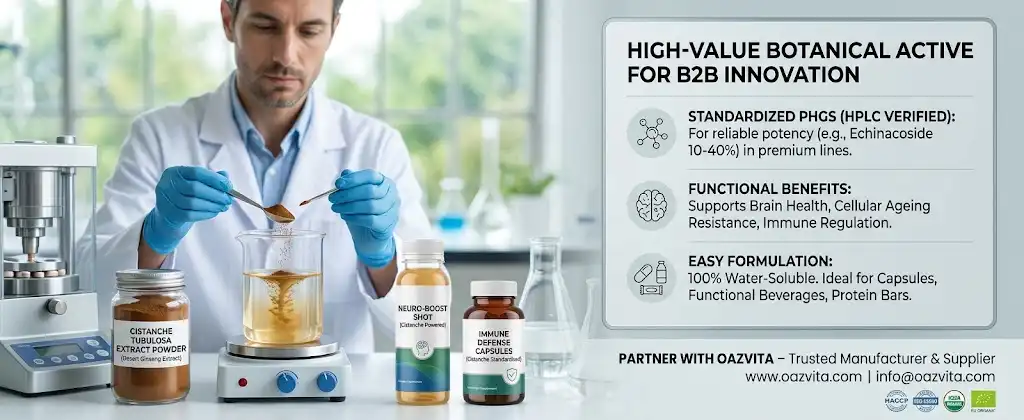
Understanding Cistanche Tubulosa Extract Powder: Key Benefits and Properties
In Traditional Chinese Medicine, Cistanche tubulosa is known as "Rou Cong Rong," and it has been documented for many years as being one of the top 50 vital herbs in TCM. This has been the case for many generations. The modern extract version improves its effectiveness by condensing it into a standardised and measured form that can be utilised by industrial manufacturers with confidence. This allows the extract to be used more effectively.
Core Bioactive Profile
The standardised PhGs content of this chemical is the essential component that provides support for its technical basis. According to HPLC, high-quality standards typically produce Total PhGs that range from forty percent to eighty percent, with echinacoside falling anywhere between ten and forty percent and acteoside falling somewhere between two and ten percent. Cistanche tubulosa is known to generate a higher proportion of echinacosides in comparison to Cistanche deserticola. This is a distinctive characteristic of the species. It is the species of choice for modern formulations that are meant to support the brain in creating successful outcomes and battle weariness. As a consequence of this, it is the species of choice.
Evidence-Backed Functional Benefits
Several functional features of this extract have been supported by research that has been evaluated by peers as well as clinical observations. Listed below are the primary areas of advantage that are pertinent to the creation of B2B Products:
- Active PhGs are responsible for immunological regulation because they encourage the proliferation of T-cells and natural killer cells, which in turn supports immune surveillance at the cellular level. Because of this, the substance is positioned in a strong position within wellness capsule formulations and supplement lines that concentrate on the immune system.
- Echinacoside and acteoside have the ability to neutralise reactive oxygen species, which in turn reduces oxidative stress indicators that are linked with accelerated cellular ageing. Therefore, they have antioxidant and anti-aging properties. There has been published research that has pointed out their collagen-protective characteristics, which make them important for applications in the fields of nutricosmetics and skin health.
- PhGs have been found to enhance neuronal survival and decrease neuroinflammatory pathways using preclinical models, which demonstrates their neuroprotective properties. Formulators working in the cognitive health sector now have access to a natural, non-stimulant active pharmaceutical product that has mechanistic credibility.
Cistanche tubulosa extract powder is a multipurpose ingredient that may be easily included in a wide variety of product categories, ranging from energy capsules to beauty supplements, thanks to these three processes that have been identified and documented.
How to Use Cistanche Tubulosa Extract Powder Effectively
Typical usage levels for high-potency desert cistanche extract range from 200 mg to 600 mg per serving, depending on the standardization level of total PhGs and the target product category. The cistanche tubulosa extract powder presents as a fine, brown to dark brown powder with mild sweet-bitter notes and high hygroscopicity, which means encapsulation or moisture-controlled blending is recommended.
Its water-solubility profile opens doors to functional beverages, liquid shots, protein bar coatings, and fortified teas — product categories where raw herbal powders would fail due to poor dispersibility. For capsule and tablet applications, the spray-dried form integrates cleanly without binding complications.
Successful B2B deployments include OEM brands that have combined this extract with adaptogens like ashwagandha or rhodiola in energy and recovery blends, and nutricosmetic brands that have paired it with collagen peptides and vitamin C in skin health capsules. The formulation versatility is genuine and commercially proven.
Comparing Cistanche Tubulosa Extract Powder with Alternatives
Cistanche tubulosa vs. Cistanche deserticola
These two species belong to the same botanical family, yet their phytochemical compositions are significantly different from one another. There is a method by which it can be determined that Cistanche tubulosa provides a measurable increase in the concentration of echinacoside, which is the marker that is most closely associated with the neuroprotective and anti-fatigue effects of the plant. However, Cistanche deserticola continues to be readily accessible, although it requires less accuracy when it comes to standardisation. Since Cistanche tubulosa extract powder is the most robust technical option, it is recommended for companies who are developing premium-tier goods that are backed by proof.
Desert Cistanche vs. Ginseng Extracts
Ginseng, and more specifically Panax ginseng, is a well-established adaptogen that has garnered significant consumer awareness all over the world. Cistanche extract fills a complementary role in the market since it provides kidney yang tonification and neural-protecting characteristics, both of which ginseng does not cover as directly. Cistanche may be used in synergistic blends by companies that want to target male wellness, longevity formulations, or cognitive health. Additionally, these companies can promote cistanche as a distinctive ingredient for customers who are looking for options that go beyond the mainstream.
Extract Ratios: 10:1 vs. 20:1 and Standardized PhGs
Despite the fact that ratio labelling (10:1, 20:1) shows the concentration of the raw material, it does not ensure the presence of the active ingredient. Utilising standardised PhGs labelling that has been confirmed by HPLC is the most dependable measure for making judgements about buying. When compared to a well-specified 40% PhGs extract, a 20:1 ratio extract that does not have PhGs standardisation may provide a lower level of effectiveness. Before committing to bulk purchases, purchasers should always be sure to seek a certificate of assurance validating the presence of HPLC-verified markers.
How to Source and Purchase Cistanche Tubulosa Extract Powder for B2B
Procurement decisions for Botanical Extracts carry regulatory and quality implications across every market these products enter. Selecting a cistanche tubulosa extract powder supplier requires scrutiny across several dimensions. Here are the non-negotiable criteria:
- Certifications: HACCP, ISO 22000, NSF, HALAL, EU Organic, and USDA Organic certifications that have been confirmed show that the product is in accordance with production standards and is ready for export to both North American and European markets, as well as Middle Eastern markets.
- For each batch, documentation includes a complete COA, MSDS, and TDS. The existence of traceable sourcing from certified harvest places (the Taklamakan Desert belt) is not a marketing promise but rather a sign of the integrity of the supply chain.
- M.O.Q. and the flexibility of lead time: Before scaling up their bulk procurement, companies are able to evaluate the feasibility of the market with a minimum order of one kilogramme and a lead time of one to five working days. This is of utmost significance for private label enterprising companies as well as OEM/ODM developers that are venturing into new sectors.
When evaluating a supplier, it is essential to take into consideration not just their certificates and papers, but also their technical response. If you collaborate with a manufacturer that provides formulation assistance, sample assessments, and application instructions, you will be able to drastically speed up the schedule for the development of your product. Having the capability to ship by air, sea, DHL, FedEx, and UPS, in addition to having a track record of delivery that is more than 99% on time, is an additional factor that helps to lessen the risk that is associated with procurement operations.
If an ingredient has a storage shelf life of twenty-four months and is stored in an atmosphere that is both cold and dry, then it is guaranteed that the ingredient will stay stable during the normal inventory cycles. Consideration should be given to these logistics and stability factors when it comes to the planning of yearly purchase quantities that are more than several hundred kg.
Conclusion
Cistanche tubulosa extract powder has earned its place as a high-value botanical ingredient in the global supplement and functional nutrition market. Its standardized PhGs content, multi-mechanism benefits, and broad formulation compatibility make it a strategic addition to immune support, anti-aging, neuroprotection, and male wellness product lines. When sourced from a certified, technically capable manufacturer — one that provides HPLC-verified batches, transparent documentation, and flexible supply terms — this ingredient can anchor differentiated, market-competitive products across multiple categories.
Frequently Asked Questions
1. What is the standard active content in high-quality cistanche tubulosa extract?
The total Phenylethanoid Glycosides (PhGs) are standardised by reputable vendors to be between 40% and 80%, with Echinacoside being validated by HPLC tests to be between 10% and 40%. Before making any purchases, you should always get a batch-specific COA.
2. Is this extract suitable for organic-certified product formulations?
Indeed. The ability to offer compatible material for clean-label and organic-certified product lines is available to suppliers that possess both EU Organic and USDA Organic certifications. You should make sure that the organic scope encompasses the particular lot that you are acquiring.
3. What dosage range is recommended for supplement formulations?
The doses of standard formulations range from 200 mg to 600 mg per serving, with adjustments made according to the PhGs standardisation level and the health claim category that the product is intended to provide coverage for.
4. Can this extract be used in functional beverages?
The spray-dried, water-soluble version performs very well when included in functional beverages, liquid shots, and teas that have been fortified. At some point throughout the product development process, it is advised to conduct stability testing under the parameters of the final beverage's pH and temperature.
Partner with OAZVITA — Trusted Cistanche Tubulosa Extract Powder Manufacturer
OAZVITA delivers pharmaceutical-grade cistanche tubulosa extract powder with full certification compliance (HACCP, ISO 22000, USDA Organic, EU Organic), HPLC-verified PhGs standardization, and 1–5 working-day lead times. Free samples are available upon request. Whether you need bulk supply, OEM/ODM formulation, or private label development, our team provides end-to-end support. Contact Us today at info@oazvita.com to request your sample and sourcing consultation.
References
1. He, Z. D., Lau, K. M., Xu, H. X., Li, P. C., & Pui-Hay But, P. (2001). Antioxidant activity of phenylethanoid glycosides from Cistanche tubulosa. Journal of Ethnopharmacology, 78(2–3), 153–159.
2. Morikawa, T., Xie, Y., Ninomiya, K., Nishi, M., Okamoto, M., & Yoshikawa, M. (2014). Phenylethanoid glycosides and other constituents of the desert plant Cistanche tubulosa. Phytochemistry, 107, 138–150.
3. Jiang, Y., & Tu, P. F. (2009). Analysis of chemical constituents in Cistanche species. Phytochemistry, 70(3), 394–404.
4. Li, Z., Lin, H., Gu, L., Gao, J., & Tzeng, C. M. (2016). Herba Cistanche (Rou Cong-Rong): One of the best pharmaceutical gifts from traditional Chinese medicine. Frontiers in Pharmacology, 7, 41.
5. Xiong, Q., Kadota, S., Tani, T., & Namba, T. (1996). Antioxidative effects of phenylethanoids from Cistanche deserticola. Biological & Pharmaceutical Bulletin, 19(12), 1580–1585.
6. Chen, L., Liu, J., & Zhang, Y. (2018). Neuroprotective effects of Echinacoside in neurodegenerative disease models: A review. Journal of Neurochemistry, 144(1), 22–35.

Send Inquiry
Related Industry Knowledge
- Buyer’s Guide: How to Choose the Best TUDCA Powder
- Bulk Tea Saponin Powder: Supply for Fertilizers
- Tea Saponin Powder: What It Is and What It Does
- Natural Astaxanthin Powderr: The Ultimate Guide to Nature’s Most Potent Antioxidant
- Top 7 Benefits of Using Pure Fish Collagen Peptide in Skincare
- Hericium Erinaceus Extract Powder: Beginner's Guide & Benefits
- How to Take Shilajit Drops: A Comprehensive Guide for Wellness Enthusiasts
- Best Glutathione Powder Uses for Skincare in the Beauty Industry
- Ensuring Consistent NR Chloride Quality for Japanese Pharma Buyers
- Bovine Collagen Peptides Trusted by Medical Nutrition Firms in France