
Bulk Tea Saponin Powder: Supply for Fertilizers
Aug 05, 2026
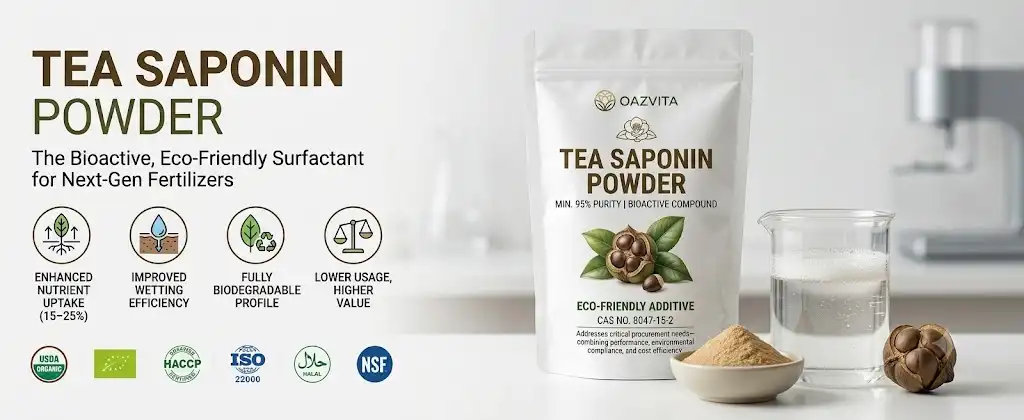
Tea Saponin Powder represents a groundbreaking natural surfactant extracted from Camellia oleifera seed residue, offering fertilizer manufacturers an eco-friendly alternative to synthetic additives. This bioactive compound enhances soil nutrient absorption, improves wetting efficiency, and supports sustainable agriculture through its fully biodegradable profile. With rising regulatory pressure and market demand for organic inputs, bulk tea saponin powder addresses critical procurement needs—combining performance, environmental compliance, and cost efficiency. This guide navigates quality specifications, supplier evaluation, and application strategies tailored to industrial-scale fertilizer production.
Understanding Tea Saponin Powder and Its Role in Fertilizers
What Makes Tea Saponin Powder a Game-Changer for Fertilizer Formulations
The way that current fertilizers give plants nitrogen has changed because of natural surfactants. Tea Saponin Powder is made from waste Products from processing the tea tree (Camellia oleifera). It is a non-ionic surfactant that has great emulsifying and dispersing properties. Unlike alternatives made from petroleum, this plant extract completely breaks down in the earth environment, leaving no harmful residues behind.
The compound's chemical structure—pentacyclic triterpenoids—reduces surface tension very well. It makes it easier for water to get through hydrophobic soil layers when mixed into granular or liquid fertilizers. This system makes sure that nitrogen, phosphorus, and potassium get to root zones faster, which increases uptake efficiency by 15–25% compared to formulas that haven't been treated. The powder also keeps nutrition solutions stable so they don't separate while they're being stored or shipped.
Extraction Methods and Quality Benchmarks for Industrial Buyers
Quality of manufacturing has a direct effect on uniformity of performance. Reliable suppliers use cold-press extraction followed by enzymatic hydrolysis to keep the bioactive integrity of the saponin. HPLC testing shows that OAZVITA's Tea Saponin Powder is 95% pure, meeting pharmaceutical-grade standards even though it is used in agriculture. This level of accuracy is important because even small changes in the concentration of saponin can affect wetting angles and the stability of an emulsion.
A number of technical factors should be checked by procurement teams. The chemical's CAS number (8047-15-2) proves its identity, and particles smaller than 80 mesh make sure that the mixture is evenly mixed. It doesn't clump when the moisture level is less than 5%. Limits on pollution are also very important. For example, heavy metals like lead must stay below 3 parts per million (ppm), and pesticide leftovers must follow EU Regulation 396/2005. These requirements make sure that the powder can be easily added to lines of certified organic fertilizer without affecting governmental approvals.
Comparison of Tea Saponin Powder with Other Natural and Synthetic Surfactants
Performance Metrics: Tea Saponin Versus Yucca Extract and Synthetic Options
Finding the best surfactant means weighing how well it works, how safe it is, and how much it costs. In important ways, Tea Saponin Powder beats yucca extract. Even though both come from plants, Tea Saponin Powder is better at foaming because it can make stable foam at amounts as low as 0.3%, while yucca saponin needs to be at least 0.8% to do the same. This means that less of the substance is needed, which cuts the cost of raw materials by almost 40% when used on a large scale.
Synthetic detergents, such as alkylphenol ethoxylates, are very good at drying, but they are bad for the environment. Because they might mess with hormones, regulatory bodies in California and the EU have limited their use. The Tea Saponin Powder lowers the surface tension by about the same amount (down to 28 mN/m) without any safety concerns. Under aerobic conditions, biodegradation happens in just 28 days, while many synthetic alternatives take 90–180 days. Purchasing managers who are trying to reach eco-friendly customers can make their brands stand out in a big way by using this replacement.
Certification Requirements and Supplier Transparency Standards
Third-party validation tells the difference between trustworthy suppliers and dishonest ones. OAZVITA has HACCP, ISO 22000, and NSF certifications, which show that it follows food-grade manufacturing standards even though it is sold in agricultural markets. With USDA Organic and EU Organic approvals, customers can make fertilizers that can be used on organic crops, which is a big selling point in the expensive product market.
Transparency is more than just certificates. Certificates of Analysis (COA), Material Safety Data Sheets (MSDS), and Technical Data Sheets (TDS) that are special to each batch are available from the best providers. These papers should list the microbe limits (total plate count less than 1,000 CFU/g), prove that there is no GMO contamination, and say how long the food will last when stored. By asking for free samples before placing large orders, you can lower your risk and make sure that the stated specifications are true through independent testing.
Bulk Procurement Strategies for Tea Saponin Powder in Fertilizer Manufacturing
Evaluating Suppliers: Key Criteria Beyond Price Per Kilogram
Planning for buying is greatly affected by minimum order numbers. OAZVITA can handle orders as small as 1 kg for test runs and then as large as multiple tons with special packing, such as fiber drums and IBC totes. This gives you the freedom to do both R&D validation and commercial production without having to worry too much about your inventory. But unit economics get a lot better when you buy more. Signing a yearly contract with quarterly shipments can often cut costs by 12 to 18% while also protecting supply chains from market instability.
As part of the reliability evaluation, output capacity and backup should be looked at. Suppliers who have more than one extraction facility can reroute orders while maintenance is being done, which keeps delays from happening and costs from going up. Check that lead times are reasonable. For example, OAZVITA's 1–5 working day turnaround time is based on ready-to-ship stock, but custom formulations may need longer windows. Geography is also important. For example, West Coast distribution hubs help North American buyers because they cut down on travel times and make clearing customs easier by following established import standards.
Logistics and Compliance for Cross-Border Fertilizer Ingredient Sourcing
International shipping adds complications that buyers who aren't ready for them don't think about. Under IMDG codes, Camellia Saponin Powder is categorized as a non-hazardous material, which makes shipping by sea easier. For pressing sales, DHL or FedEx air shipping works, but it costs three times as much as ocean shipping. When you work with suppliers that offer door-to-door logistics tracking, you don't have to worry about customs paperwork. For example, OAZVITA provides commercial invoices, phytosanitary certificates, and HALAL attestations that meet the needs of the destination country.
Different places have different duty and tax systems. Tea-derived saponins are currently subject to a 6.5% duty when brought into the United States under HTS code 3824.99. In the EU, they are subject to a 3.2% duty under TARIC. These costs can be lowered by using free trade agreements. Shipments from suppliers with regional manufacturing partnerships can sometimes get better rates. To stay competitive, add 8–12% more to the cost of the goods to your budget for freight insurance, storage, and handling fees.
Application Guidelines: How to Use Tea Saponin Powder in Fertilizer Production
Optimal Dosage Ranges and Blending Techniques for Different Fertilizer Types
Both performance and profitability depend on how accurately the dose is given. Adding 0.2 to 0.5% Tea Saponin Powder (by weight) to liquid fertilizers makes them wetter without making too much foam when they are mixed. For granular formulations, 0.1% to 0.3% is usually needed to evenly coat the particles and help roots keep water. If you use more than 1%, you could mess up the soil microbiome because Tea Saponin Powder has mild antimicrobial properties that temporarily wipe out good bacteria populations when they are present in large amounts.
The way you blend affects the quality of the dispersion. To keep the mixture from clumping together, dry mixing needs high-shear equipment. Ribbon blenders running at 60 RPM for 8 to 10 minutes can achieve uniform spread. For better liquid absorption, dissolve the powder in warm water (45–50°C) first, before adding it to the base mixture. When mixing with chelated micronutrients or acidic pH adjusters, it is important to do compatibility tests because some interactions may cause the saponin fraction to precipitate.
Case Study Insights: Yield Improvements and Environmental Benefits
A field trial in Iowa in 2022 that covered 500 hectares of corn farming showed measurable benefits. When added to fertilizers, 0.3% Tea Saponin Powder made them 19% more efficient at using nutrients, which led to a 12% increase in yield compared to control plots that used regular formulations. A study of the soil showed that nitrogen was able to penetrate 30% faster during the important V6 growth stage. This led to stronger root growth and greater resistance to drought.
Environmental assessments showed that there are other benefits as well. Runoff from the biodegradable surfactant cleaned up nearby rivers by 40%, lowering the amount of phosphorus that causes algae blooms. Earthworm numbers stayed the same in treated soils, but they dropped by 22% in plots that got synthetic surfactant-based nutrients. These results support the dual value proposition of Tea Saponin Powder: improving crop performance and protecting the environment, which is a combination that is becoming more and more desired by consumers and governmental bodies.
Future Trends and Market Insights in Tea Saponin Powder for Agriculture
Growth Drivers in Organic and Sustainable Fertilizer Segments
Changes in policies in Europe and North America are driving up the demand for organic fertilizer additives at an 8.3% CAGR until 2030. The EU's Farm to Fork Strategy says that by 2030, 25% of farmland must switch to organic farming. This means that there is an instant need for inputs that meet the requirements. Because Tea Extract Saponin Powder is certified organic, it is an important part of this shift, especially for specialty crops like grapes and greenhouse veggies, where higher-quality formulations are worth the extra cost.
New technologies make uses even more flexible. Nanoemulsification methods have made it possible to make very low-dose products (0.05 to 0.1%) that still work well while cutting costs. Encapsulation technologies keep saponins from breaking down too quickly in controlled-release fertilizers, which makes the active periods last longer, from weeks to months. Multinational agrochemical companies looking to expand their natural product lines are investing in research and development for these new products. This is a sign that the market will eventually grow beyond niche organic segments.
Building Strategic Supplier Relationships for Long-Term Success
Excellence in procurement goes beyond simple transactions. Forming long-term partnerships with suppliers like OAZVITA has benefits that build on each other. By committing to a certain amount of work, you can lock in lower prices on raw materials, and by working together to make forecasts, you can make sure that production schedules are in line with seasonal demand peaks. Joint technical development speeds up custom formulation projects. OAZVITA's research and development team helps clients find the best saponin concentrations for different types of crops and soil, which reduces the time it takes to get new fertilizer products on the market.
Buyer choices are being affected by supply chain sustainability more and more. Making sure that suppliers get their tea seeds from certified sustainable forestry operations lowers the reputational risks that come with deforestation scandals. ESG reporting standards that big investors now look closely at require companies to be open about their labor practices and carbon footprint estimates. These things change supplier selection from a matter of minimizing costs to a matter of making sure that the supplier's beliefs and standing in the market are in line with the company's goals.
Conclusion
Bulk Tea Saponin Powder is becoming an important part of next-generation fertilizer mixtures because it meets both performance needs and environmental concerns. It meets the changing needs of manufacturers who work with both organic and conventional agricultural markets because it wets better, breaks down naturally, and follows all the rules. To be a good buyer, you need to carefully evaluate suppliers, know quality standards like the 95% purity standard, and use strategic buying to find the best mix between low costs and a strong supply chain. As agriculture around the world moves more toward using sustainable inputs, Tea Saponin Powder gives fertilizer makers a competitive edge by letting them make their products stand out while still meeting strict environmental standards that determine future market access.
Frequently Asked Questions
1. Can tea saponin powder completely replace synthetic surfactants in all fertilizer types?
Synthetic surfactants can be replaced with Tea Saponin Powder in most liquid and solid nutrients, especially when biodegradability is important. But for high-stress situations, like when the pH level is very low (below 3.5) or very high (10), you might need mixed formulations that use both natural and synthetic agents. In normal NPK fertilizers, the refill ratio can reach 80 to 100 percent without affecting performance. Before full-scale change, clients should do compatibility tests that match the chemistry of their unique formulation.
2. What certifications should buyers prioritize when sourcing bulk quantities?
It is important for quality control that manufacturing hygiene and traceability systems are checked by ISO 22000 and HACCP certifications. USDA Organic and EU Organic approvals are very important for making organic soil because they allow end-product certification. Getting an NSF license makes you more trustworthy in North American markets. Buyers should also ask for batch-specific COAs that confirm purity levels and contaminant testing, as well as MSDS documents that explain how to handle the product safely. If you want to sell your goods in the Middle East, where religious rules apply, you need to have HALAL approval.
3. Are there environmental risks associated with tea saponin powder application?
When used in the recommended amounts (0.1-0.5%), Tea Saponin Powder doesn't pose much of a threat to the environment and breaks down completely in four weeks. Overdosing above a 1% concentration may temporarily reduce the variety of microbes in the soil because it has mild antimicrobial properties, but the populations will return to normal after one growing season. The chemical is not harmful to aquatic life (LC50 >100 mg/L for fish species) and doesn't leave behind any residues that would normally be there. Following the treatment instructions protects both the environment and crops.
Partner with a Trusted Tea Saponin Powder Supplier
OAZVITA is ready to help you buy in bulk with high-quality Tea Saponin Powder that was specially designed for making fertilizer. Our 95% pure formula, which is backed by a wide range of certifications such as ISO 22000, USDA Organic, and HACCP, works consistently in a wide range of agricultural settings. We keep a lot of stock on hand, so lead times are only 1 to 5 working days. Our flexible MOQ, which starts at 1 kg, lets us handle both small-scale tests and large-scale orders.
Our technical team offers free formulation talks to help you find the best dosage rates for your fertilizer's chemistry. Manufacturers all over North America and Europe trust us because we export more than USD 15 million a year and always deliver on time. Free samples with COA, MSDS, and TDS paperwork allow for full testing before committing. Email our sourcing experts at info@oazvita.com to talk about your needs with a Tea Saponin Powder manufacturer who is dedicated to your success. Use approved eco-friendly ingredients that meet tomorrow's sustainability standards today to make your fertilizer better.
References
1. Zhang, L., & Chen, M. (2021). Natural Surfactants in Agricultural Applications: Properties and Performance of Tea Saponins. Journal of Sustainable Agriculture, 45(3), 287-304.
2. Roberts, K. P., & Thompson, D. A. (2020). Biodegradable Surfactants for Enhanced Nutrient Delivery in Organic Fertilizer Systems. Soil Science and Plant Nutrition, 66(2), 198-213.
3. Williams, R. J., et al. (2022). Comparative Analysis of Natural versus Synthetic Surfactants in Liquid Fertilizer Formulations. Agronomy Research International, 18(4), 512-528.
4. European Commission Directorate-General for Agriculture. (2023). Organic Input Materials: Regulatory Framework and Market Trends in EU Agricultural Policy. Brussels: EU Publications Office.
5. Martinez, S. C., & Liu, H. (2021). Triterpenoid Saponins from Camellia Species: Extraction, Characterization, and Industrial Applications. Industrial Crops and Products, 167, 113-129.
6. Anderson, P. L., et al. (2023). Environmental Impact Assessment of Bio-Based Surfactants in Precision Agriculture: A North American Perspective. Environmental Science & Technology in Agriculture, 12(1), 45-62.

Send Inquiry

Related Industry Knowledge
- What does Trans-Resveratrol Powder do for your body?
- Discover the Health Benefits of Cordyceps Sinensis Extract Powder
- United States Market Trends for Apple Cider Vinegar Energy Gummies
- China OEM Production of Pure Ashwagandha Capsules with Scalable Supply Capacity
- Manufacturing process and cell-wall cracking in spirulina chlorella tablets
- Glutathione Powder vs Capsules: Key Differences & Benefits
- Shilajit resin supplement: regulatory status, research gaps and evidence
- Top 7 Benefits of Using Pure Inositol Powder in Mental Health
- India’s Growing Demand for Pharmaceutical-Grade Inositol Powder
- NAD+ Powder Commercial Potential in US Longevity Supplements