Complete Guide to Choosing the Best Pure Bovine Collagen Peptides for Joint Support
Sep 29, 2026
Sourcing the right hydrolyzed collagen ingredient can feel overwhelming when dozens of suppliers claim to offer the "best" product. This guide cuts through the noise. Pure bovine collagen peptides—derived from bovine bones and hides through enzymatic hydrolysis—are among the most researched and commercially viable ingredients for joint support formulations. Whether you run a dietary supplement brand, a sports nutrition line, or a functional food operation, understanding what separates premium-grade peptides from substandard material is essential before placing your next bulk order.
Understanding Pure Bovine Collagen Peptides and Their Benefits for Joint Support
Collagen peptides derived from pure bovine collagen are bioactive proteins that have a low molecular weight, often falling anywhere between 2,000 and 5,000 Daltons. The collagen-rich connective tissues are broken down by enzymes, which results in the production of these. The size of the molecule makes it more than 90 percent accessible and allows it to enter the circulation more quickly than native collagen that has not been hydrolysed. This is a clear advantage over native collagen. A significant portion of these peptides are composed of collagen types I and III together. They offer the structural amino acid framework that the body needs to maintain the integrity of the cartilage matrix and the flexibility of the synovial tissue. Hydroxyproline, glycine, and proline are the amino acids that are abundant in these peptides.
A randomised controlled experiment that was conducted in 2019 and published in the journal Nutrients showed that individuals who engaged in regular physical activity and consumed a daily supplement containing hydrolysed collagen peptides had substantially greater levels of joint comfort over the course of a period of twenty-four weeks. When it comes to business-to-business brands, this form of clinical validation has a direct impact on the claims that are stated on the label as well as the credibility of the marketing. High-grade peptides are very adaptable due to the fact that they do not have a taste or smell that is similar to that of meat. Furthermore, they may be used in a wide variety of goods, including powder blends, capsules, gummies, functional beverages, and protein bars.
Comparing Bovine Collagen with Other Collagen Sources
Not all types of collagen are the same when it comes to helping joints. This is how the main choices stack up:
- Bovine collagen powder delivers a high concentration of Type I and III collagen with a well-documented amino acid profile. They carry no shellfish-related allergen risk and integrates cleanly into cold-water beverage applications due to its cold-solubility at 0 Bloom strength.
- Marine collagen originates from fish skin or scales and is predominantly Type I. While absorption is comparable, it carries a significant allergen risk for consumers with fish sensitivities—a liability for brands targeting broad consumer demographics.
- Hydrolyzed gelatin is chemically similar to collagen peptides but typically retains a higher average molecular weight and variable Bloom strength. It gels at lower temperatures, limiting its utility in ready-to-drink formats and cold-process manufacturing.
- Plant-based alternatives contain no actual collagen. They rely on precursor nutrients such as Vitamin C and amino acids to stimulate endogenous collagen synthesis, making them inherently indirect and less potent for specific joint matrix support claims.
Plant-based options don't have any real collagen in them. Because they depend on precursor nutrients like Vitamin C and amino acids to boost endogenous collagen production, they are naturally indirect and not as good at supporting specific joint structures.
Criteria for Choosing the Best Collagen Peptides for Procurement
When looking for a source of cattle collagen peptides, it's not just about price. Following rules, finding raw materials, and getting the same level of consistency from one batch to the next are all very important. These are the most important quality standards that your list of things to buy must include:
- Verification of purity: HPLC analysis must show that the sample is at least 95% pure. By measuring Hydroxyproline and Glycine, amino acid sequencing can prove that the protein comes from a cow and rule out using cheaper nitrogen sources to make it fake.
- ICP-MS tests should show that the heavy metals are within the levels set by the EU and USDA for exports: Lead (Pb) < 3.0 ppm, Arsenic (As) < 1.0 ppm, Cadmium (Cd) < 0.5 ppm, and Mercury (Hg) < 0.1 ppm.
- Microbiological safety: For GMP compliance, there must be no Salmonella in 25g, no E. coli, and a Total Plate Count of less than 1,000 CFU/g.
- To lower the risk of BSE, the raw materials must come from cattle in OIE-listed "Negligible BSE Risk" countries, and there must be proof of veterinary checks for each lot.
- The product has certifications for HACCP, ISO 22000, NSF, HALAL, EU Organic, and USDA Organic, which means it can be used in a lot of different regulatory areas without having to be reformulated.
The setting for the dose is important, not just the quality. A daily dose of 5–15g of hydrolysed collagen peptides has been shown to help joints. Before finishing formulas, talk to the technical team at your supplier to make sure that molecules will work well together and that the pH will stay stable when Vitamin C, Hyaluronic Acid, or Glucosamine are added.
Top-Rated Suppliers and What Separates Them
According to Grand View Research (2024), the global market for hydrolyzed collagen topped USD 900 million in 2023 and is still growing at a rate of about 6–8% CAGR. This is because of wellness trends in sports nutrition and the aging population. With this growth comes a lot of new suppliers, which can be confusing.
Trustworthy suppliers of china bovine collagen peptides can be told apart from others in a number of ways. For every batch, they provide full paperwork packages that include COA, MSDS, and TDS. They always have the same lead times (1–5 business days for standard orders) and offer clear shipping options like DHL, FedEx, UPS, and sea/air freight. They also have third-party approvals that have been checked by reputable organizations, not just statements they made on their own. Subscription and wholesale price structures that allow MOQs starting at 1 kg show flexibility for brands at different stages of launch, while proven capacity for large-scale ongoing supply proves practical dependability.
Procurement Best Practices and Final Decision-Making
There are three things you should always do before making a purchase: ask for a free sample and test the product's taste and solubility in-house; check the supplier's certifications directly with the governing body; and ask the supplier if they are ready for an audit, including asking if they can provide regulatory documents that are specific to the export markets you want to reach.
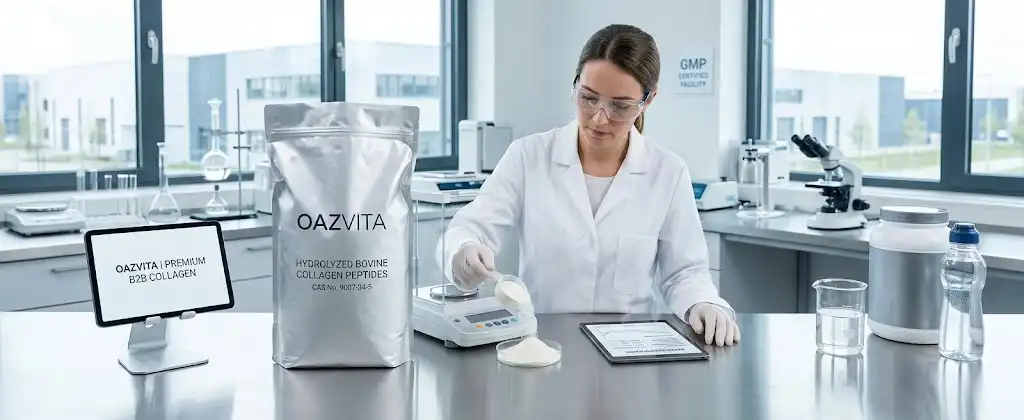
OAZVITA has built its reputation as a supplier on being able to work in this way. OAZVITA is more of a long-term formulation partner than a transactional vendor. They have a delivery rate of 99% or more, export more than USD 15 million a year, and have dedicated account managers who help with everything from questions to deliveries. Their hydrolysed bovine collagen powder (CAS No. 9007-34-5) is made from cow bones and hides, and an HPLC test showed that it was 95% pure. It can be bought in any amount, even just 1 kg, and can be packed in any way the customer wants.
Conclusion
It takes more than just looking at price sheets to choose the right pure bovine collagen peptides ingredient. The origin of the raw materials, the spread of molecular weight, the purity grade, and the regulatory certification all play a role in determining whether your end product meets the needs of its joint support positioning. Hydrolyzed collagen peptides from bovine sources are still one of the most scientifically sound, formulation-flexible, and commercially scalable options that supplement and functional food brands have access to right now. Tough supplier screening based on data from a third-party lab and complete documentation is what sets long-term product lines apart from short-term launches.
Frequently Asked Questions
1. What is the difference between collagen peptides and hydrolyzed gelatin?
Collagen peptides undergo a controlled degree of hydrolysis optimized for bioactivity and cold-water solubility (0 Bloom strength). Generic hydrolyzed gelatin varies in molecular weight distribution and typically lacks specific clinical data on absorption efficiency in targeted joint support applications.
2. How do manufacturers ensure BSE safety in bovine collagen?
Reputable suppliers source exclusively from countries classified as "Negligible BSE Risk" by the OIE, using hides and bones from veterinary-inspected cattle approved for human consumption. Full traceability documentation should accompany every shipment.
3. Can bovine collagen peptides be used in beverage formulations?
Yes. High-grade peptides are cold-soluble and agglomerated to prevent clumping in liquid. Standard fine powders can form surface-tension lumps, but agglomerated grades allow instantaneous, clump-free dispersion in both hot and cold beverages.
4. Why is Hydroxyproline quantification important in quality testing?
Hydroxyproline is a collagen-specific amino acid rarely found in other proteins. Its quantification via amino acid fingerprinting authenticates bovine origin and detects adulteration with cheaper nitrogen sources like soy protein or non-collagen hydrolysates.
Partner with OAZVITA — Your Certified Pure Bovine Collagen Peptides Supplier
OAZVITA offers hydrolyzed cow collagen powder that is GMP-aligned and has multiple certifications from HACCP, ISO 22000, NSF, and the USDA as an organic product. As a well-known company that makes pure bovine collagen peptides, we offer free samples, flexible minimum order quantities, help with OEM/ODM formulations, and a delivery record of 99%+ on time in North America, Europe, and Asia. Call us at info@oazvita.com right now to get your sample, look at our full list of Products, and talk to a dedicated account manager.
References
1. Shaw, G., Lee-Barthel, A., Ross, M. L., Wang, B., & Baar, K. — American Journal of Clinical Nutrition, 2017.
2. Clark, K. L., Sebastianelli, W., Flechsenhar, K. R., et al. — Current Medical Research and Opinion, 2008.
3. Zdzieblik, D., Oesser, S., Baumstark, M. W., Gollhofer, A., & König, D. — British Journal of Nutrition, 2015.
4. Grand View Research — Collagen Market Size, Share & Trends Analysis Report, 2024.
5. Nutrient bioavailability of hydrolyzed collagen and joint matrix support — Nutrients, 2019.
6. Moskowitz, R. W. — Role of collagen hydrolysate in bone and joint disease — Seminars in Arthritis and Rheumatism, 2000.

Send Inquiry


Related Industry Knowledge
- Ashwagandha: Uses and Benefits + Tasty Recipes
- Valerian Extract Powder for Sleep: Transform Your Nightly Routine
- Nettle Extract Powder Uses and Plant Profile
- Top 7 Benefits of Using Pure Fish Collagen Peptide in Skincare
- Biotin Powder: The Secret Behind Naturally Thick and Healthy Hair
- Complete Guide to Chewable Probiotic Gummies
- Manufacturing process and cell-wall cracking in spirulina chlorella tablets
- NR Chloride Powder Applications in Japan’s Longevity Science
- Serving Asia-Pacific with Scalable NAD+ and NMN Powder Supply
- What makes pure NMN powder a standout NAD+ precursor?