
The Ultimate Chewable Collagen Gummies Guide
Jun 09, 2026
Getting around in the world of collagen supplements doesn't have to be hard. Chewable Collagen Gummies have changed the way companies give bioactive peptides to health-conscious customers. This complete guide tells you everything that business-to-business buyers need to know, from the science behind formulations and manufacturing standards to how to place your product in the market and set quality standards. If you want your collagen candies to stand out in a busy market, whether you're starting a nutricosmetics line or adding to your sports nutrition line, you need to know about the technical and business side of them.
Why Collagen Gummies Are Dominating the Supplement Industry
It is because people want easy-to-use and tasty alternatives to traditional collagen shakes and pills that the global collagen market keeps growing. Teenagers and young adults in Gen Z are especially fond of beauty candies because they like skin care practices that are less scientific and more fun.
Collagen peptides that are given in the form of an edible tablet have clear benefits. When you chew, enzymes start to break down the food faster, which could lead to better absorption than with pills, which have to dissolve first in stomach fluid. Collagen that has been hydrolysed—that is, broken down into peptides that are usually between 2,000 and 5,000 Daltons—becomes more accessible. This means that amino acids like glycine, proline, and hydroxyproline can get to specific tissues more easily.
Brand owners know that following the rules leads to results. People who enjoy taking their vitamins are much more likely to keep up with their regular routines. This behaviour directly leads to return sales and good reviews, which are important for the long-term success of any supplement brand.
Understanding the Science Behind Collagen Supplement Gummies
Collagen is the most common structural protein in human connective tissue at the molecular level. After age 25, our body's natural collagen production drops by about 1% to 1.5% each year. This causes obvious signs of ageing, less flexible joints, and weaker hair and nails.
The way Collagen Peptides Chewable Gummies work is by giving the body the amino acids it needs to make collagen on its own. When taken with vitamin C—an important part of the hydroxylation process that keeps collagen structure stable—these nutrients help keep skin flexible, joints healthy, and tissues repaired generally.
The distribution grid is very important. Gelatin- or pectin-based methods are used to make good sweets. Gelatin has collagen in it, which works together to make it stronger, and pectin gives plant-based brands vegan-friendly choices. The hard part is getting the right texture—firm enough so that they don't stick while being packed, but soft enough so that they're enjoyable to chew.
Flavour-masking technologies have become more advanced to get rid of the "marine" or "bovine" notes that come from collagen sources. Products that people really look forward to taking every day are made with advanced microencapsulation methods and carefully balanced berry or citrus flavour profiles.
Key Manufacturing Considerations for B2B Buyers
When professionals look at Bulk Chewable Collagen Gummies, they have to look at a number of important manufacturing factors that have a direct effect on how well the product works and how long it lasts on the shelf.
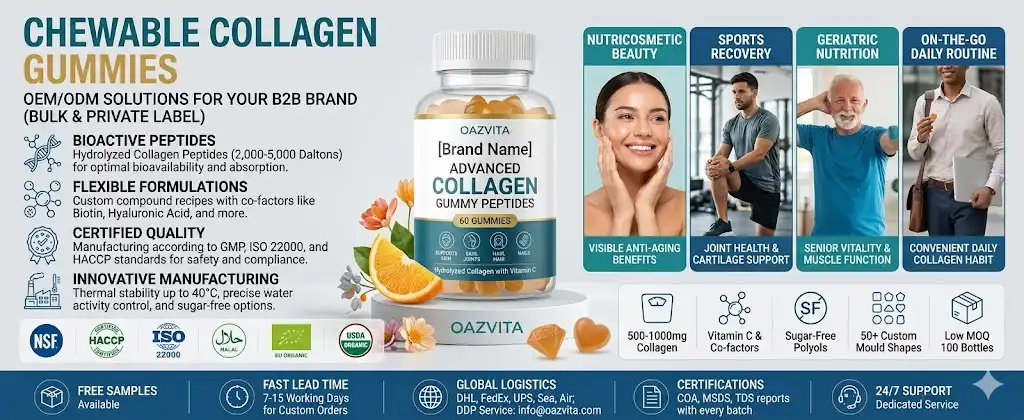
Collagen Load Capacity: Each premium recipe gummy bear has 500 mg to 1000 mg of hydrolysed collagen. Getting this concentration without changing the material takes exact knowledge of how to formulate. Manufacturers of lower quality often water down the active ingredients, so people have to take more than one piece to get the same effect.
Water Activity Control: This technical standard tells you how safe microbes are and how stable the texture is. Between 0.55 and 0.65 is the best range. If it's too high, germs could grow; if it's too low, the sweets will get too hard to eat. During production, OAZVITA follows strict rules for tracking to make sure that all batches are the same.
Thermal Stability: To get from one climate zone to another, you need sweets that don't melt. High-methoxyl pectin mixtures or mixed gelatin-pectin systems with high freezing points (above 40°C) keep food from deforming during long shipping routes that go through several countries.
Sugar-Free Innovations: People who care about their health are looking for goods with no extra carbs more and more. Polyol sugars, like maltitol or erythritol, keep the taste while helping with clean labelling. For these mixtures to keep from crystallising during the usual 24-month shelf life in the industry, the humectant amounts need to be changed.
Certification Standards That Build Market Trust
Following the rules is necessary for doing business internationally in the long term. Buyers in business who want to sell in North America, Europe, or the Middle East need to make sure that suppliers have full approval profiles.
GMP (Good Manufacturing Practice) approval shows that quality control is done in a planned way throughout the production process. This includes cleaning methods that have been tested and proven to work, written records of each batch, and strict training guidelines for staff that lower the risk of contamination.
With HACCP (Hazard Analysis Critical Control Points) approval, every step of the production process looks for biological, chemical, and physical risks. For collagen candies, important control points include checking the raw materials, the temperature settings, and testing the finished product for heavy metals. This is especially important for sea collagen sources.
ISO 22000 combines management of food safety with other quality systems. This gives foreign buyers confidence that factories meet standards that are known all over the world. Halal and USDA Organic approvals let you reach certain groups of customers who have specific food needs.
OAZVITA keeps all of these certifications up to date, along with its NSF registration and EU Organic compliance. This makes it easy for the company to enter new markets with different legal settings. There are full Certificates of Analysis (COA), Material Safety Data Sheets (MSDS), and Technical Data Sheets (TDS) for every output run.
Formulation Flexibility for Brand Differentiation
The most popular vitamin brands know that being different is what gets them more market share. In competitive groups, cookie-cutter formulas don't usually make a big difference.
OAZVITA provides full OEM/ODM customisation services that turn product ideas into recipes that are ready for the market. With more than 50 mould types to choose from, brands can pick unique forms that make their products stand out, like elegant diamonds or fun hearts, based on the people they want to sell to.
Compound Formulations: Smart brands mix collagen with active ingredients that work well together. Hyaluronic acid helps skin-care products keep more moisture in the face. Biotin and keratin work together to make products that help hair and nails in many ways. To keep joints healthy, glucosamine, chondroitin, and Type II collagen work together naturally.
Dosage Form Versatility: Gummies are the most popular choice according to customer studies, but some people still like pills or powders because they think they are more effective. When brands work with a company that can make more than one dosage type, they can test different market groups without having to switch providers.
Low MOQ Options: Minimum order numbers that are easy to change are good for new names and companies that are trying out new markets. The 100-bottle MOQ from OAZVITA lets you test the product without taking on too much inventory risk. This is especially helpful for private label buyers who are entering new markets.
Quality Control Protocols That Protect Your Brand
A brand's image depends on how well its products are made. One bad batch can ruin years of work on marketing and building trust with customers.
Professional manufacturing partners of Bulk Chewable Collagen Gummies use testing methods with multiple steps. Quantifying hydroxyproline using HPLC ensures that the substance is real collagen and not just useless fillers, which is a problem that many low-cost providers have. Because hydroxyproline is almost always found in collagen, this amino acid is a good way to tell if there is real collagen present.
Instrumental measurements are used in Texture Profile Analysis (TPA) to check for hardness, springiness, stiffness, and gumminess. Subjective sense panels are not nearly as good at ensuring stability from batch to batch as these objective measures.
Heavy metal screening keeps lead, arsenic, cadmium, and mercury from building up. This is especially important for marine-sourced collagen, which can bioaccumulate pollutants from the ocean. Products sold in the United States must go through extra strict testing to make sure they meet California Proposition 65.
Testing for microbes shows that there is no tolerance for pathogens like Salmonella, E. Staphylococcus aureus and E. coli. Total plate numbers must stay within certain levels to make sure the product is safe for as long as it says it will last.
Target Applications Across Market Segments
Understanding specific use cases helps business-to-business buyers put goods in the right place in their businesses.
Nutricosmetic Beauty Uses: Brands that are trying to appeal to the "beauty-from-within" trend stress the benefits that can be seen on the face. The marketing messages for collagen focus on its anti-ageing benefits, such as making skin more flexible, reducing fine lines, and keeping skin more hydrated. These goods usually have higher prices, which are ok because they have extra ingredients like vitamin E, biotin, and antioxidants from plants.
Sports Recovery Solutions: Collagen is an important part of joint health and connective tissue repair for athletes. Type II collagen helps cartilage grow back, which is why runners, weightlifters, and older athletes who still live busy lives like it. Some of these mixtures may have vitamin C to help make collagen and minerals like magnesium to help muscles heal.
Geriatric Nutrition: Older people have two problems: their bodies aren't making as much collagen, and it's hard for them to swallow regular pills. Chewable forms help people who have trouble swallowing and provide protein to fight sarcopenia, which is the loss of muscle with age. For this group, simple ingredients and mild flavours are more important than popular superfood adds.
Mass-market names that aim for a wide range of people stress that their products have many benefits and can help with skin, hair, nails, bones, and joints all at the same time. These goods are both effective and affordable, so people on a budget can take collagen supplements every day.
Navigating Source Selection: Marine vs. Bovine vs. Plant-Based
Choosing the source of collagen affects how the product is positioned, how allergens are handled, and how open the target market is to it.
Marine collagen, which comes from fish skin or scales, is Type I collagen with smaller peptide amounts that may be better for use on the face, according to some studies. Because it has a lower molecular weight, it may be easier for it to get into cells. Marine collagen is popular with people who want to eat seafood, but it needs to be clearly labelled for allergens because shellfish can get mixed in with it.
Bovine collagen comes from cow hides or bones and includes both Type I and Type III collagen. It helps keep skin healthy and also gut linings and muscle tissue strong. Most of the time, bovine sources are cheaper than sea sources and have better amino acid ratios. This choice is good for brands that want to prioritise value without sacrificing effectiveness.
Since real collagen can only be found in animal cells, plant-based alternatives come with their own set of problems. Instead of collagen peptides, most "vegan collagen" goods contain amino acid precursors and collagen-boosting nutrients like vitamin C, calcium, proline, and glycine that come from plants. These formulas are good for strict vegans, but the marketing copy needs to be very careful not to make false claims.
Supply Chain Reliability and Global Logistics
How well international business-to-business relationships work depends on how reliable the supply chain is. Stock-outs that make it hard for stores to sell their products or for consumers to buy Collagen Peptides Chewable Gummies online are not an option for distributors, dealers, or brand owners.
The fact that OAZVITA exports more than $15 million USD every year shows how stable its operations are and how big its factories are. With a delivery rate of more than 99% on time, procurement managers can safely predict how much material they will need without keeping too much on hand as a safety net.
Different levels of haste and price constraints can be met by a variety of shipping choices. DDP (Delivered Duty Paid) services make clearing customs easier for buyers who don't know much about import rules. Fast-moving SKUs can be quickly restocked by air freight through DHL, FedEx, or UPS. When wait times are flexible, sea freight is a cost-effective way to ship large amounts of goods.
Logistics tracking in real time lets buyers see the whole supply chain. Plans to expand regional warehouses will cut delivery times even more for customers in North America and Europe, making OAZVITA more competitive in these key markets.
Conclusion
The collagen supplement landscape continues evolving, with chewable gummies leading innovation in both consumer appeal and functional delivery. B2B buyers who understand the technical nuances—from peptide size and source selection to manufacturing standards and quality control protocols—position their brands for sustainable competitive advantage. Partnering with an experienced manufacturer offering comprehensive customisation, rigorous certification compliance, and reliable global logistics transforms product concepts into market leaders. The collagen gummies opportunity rewards brands that prioritise quality, authenticity, and consumer experience above all else.
Common Questions B2B Buyers Ask About Collagen Gummies
1. Can gummies deliver clinically effective collagen doses?
Absolutely. While volume constraints exist compared to powders, a typical serving of 2-3 gummies provides 2.5-3g of hydrolysed collagen peptides—the threshold demonstrated in multiple studies to trigger measurable improvements in skin hydration and elasticity after 8-12 weeks of consistent use.
2. How do you prevent melting during summer shipping?
Advanced formulation techniques using high-methoxyl pectin or hybrid gelling systems raise melting points above 40°C. Combined with pH buffering and controlled water activity, these gummies maintain structural integrity through temperature fluctuations encountered in global logistics networks.
3. What about sugar content concerns?
Sugar-free formulations using polyol sweeteners (maltitol, erythritol) maintain palatability while supporting clean-label positioning. Proper humectant balancing prevents the crystallisation or hardening sometimes associated with sugar-free confections.
4. Do certifications really matter to end consumers?
While consumers may not scrutinise certificates directly, trust signals like "GMP Certified" or "USDA Organic" on packaging significantly influence purchase decisions. More importantly, certifications are mandatory for retail partnerships with major chains and for international market access.
Why OAZVITA Stands Out as Your Collagen Gummies Partner
Selecting the right Chewable Collagen Gummies supplier determines your product's market success. OAZVITA brings together manufacturing excellence, regulatory compliance, and customer-focused flexibility that transforms procurement partnerships into competitive advantages.
Our comprehensive certification portfolio—including HACCP, ISO 22000, NSF, HALAL, EU Organic, and USDA Organic—eliminates market access barriers across North America, Europe, Asia, and the Middle East. Every batch ships with complete documentation: COA, MSDS, and TDS reports that satisfy the most demanding quality audits.
With 24/7 multilingual customer support, dedicated account managers provide one-on-one guidance throughout product development, from initial concept through commercial launch. Free samples allow thorough evaluation before commitment, while flexible MOQs starting at just 100 bottles make market testing financially feasible.
Ready to launch your collagen gummy line? Contact OAZVITA at info@oazvita.com to discuss your specific formulation requirements and receive personalised recommendations from our technical team.
References
1. Proksch, E., Schunck, M., Zague, V., Segger, D., Degwert, J., & Oesser, S. (2014). Oral Supplementation of Specific Collagen Peptides Has Beneficial Effects on Human Skin Physiology: A Double-Blind, Placebo-Controlled Study. Skin Pharmacology and Physiology, 27(1), 47-55.
2. Asserin, J., Lati, E., Shioya, T., & Prawitt, J. (2015). The Effect of Oral Collagen Peptide Supplementation on Skin Moisture and the Dermal Collagen Network: Evidence from an Ex Vivo Model and Randomized, Placebo-Controlled Clinical Trials. Journal of Cosmetic Dermatology, 14(4), 291-301.
3. Lugo, J. P., Saiyed, Z. M., Lau, F. C., Molina, J. P., Pakdaman, M. N., Shamie, A. N., & Udani, J. K. (2016). Undenatured Type II Collagen (UC-II) for Joint Support: A Randomized, Double-Blind, Placebo-Controlled Study in Healthy Volunteers. Journal of the International Society of Sports Nutrition, 13, 24.
4. Grand View Research. (2022). Collagen Market Size, Share & Trends Analysis Report By Source (Bovine, Porcine, Marine), By Product (Gelatin, Hydrolyzed Collagen), By Application (Food & Beverages, Healthcare), By Region, And Segment Forecasts, 2022-2030. Market Analysis Report.
5. Clark, K. L., Sebastianelli, W., Flechsenhar, K. R., Aukermann, D. F., Meza, F., Millard, R. L., & Albert, A. (2008). 24-Week Study on the Use of Collagen Hydrolysate as a Dietary Supplement in Athletes with Activity-Related Joint Pain. Current Medical Research and Opinion, 24(5), 1485-1496.
6. Hexsel, D., Zague, V., Schunck, M., Siega, C., Camozzato, F. O., & Oesser, S. (2017). Oral Supplementation with Specific Bioactive Collagen Peptides Improves Nail Growth and Reduces Symptoms of Brittle Nails. Journal of Cosmetic Dermatology, 16(4), 520-526.

Send Inquiry

Related Industry Knowledge
- Are Chewable Probiotic Gummies Better Than Capsules for Gut Health?
- Top 7 Benefits of Using Chicken Collagen Peptides in Health Supplements
- Germany Demand for Highly Bioavailable Pure Magnesium Glycinate Capsules
- 2026 Best OEM/ODM Pure Fish Collagen Peptide Suppliers for Skincare Industry
- NR Chloride Powder in Japan’s Advanced Nutraceutical Formulations
- Germany Market Focus on Beta-Glucan Standardized Lion’s Mane Extract Capsules
- Supplying GMP MCT Powder to Clinical Nutrition Brands in Singapore
- Pure NMN powder application: longevity, metabolism and fitness
- The Complete Guide to Pure NAD+ Powder
- Exploring the Uses of Pure Bovine Collagen Peptides in Cosmetics—From Manufacturing to Distribution