Inulin: What is it, what are the health benefits, and how does it work?
Oct 20, 2026
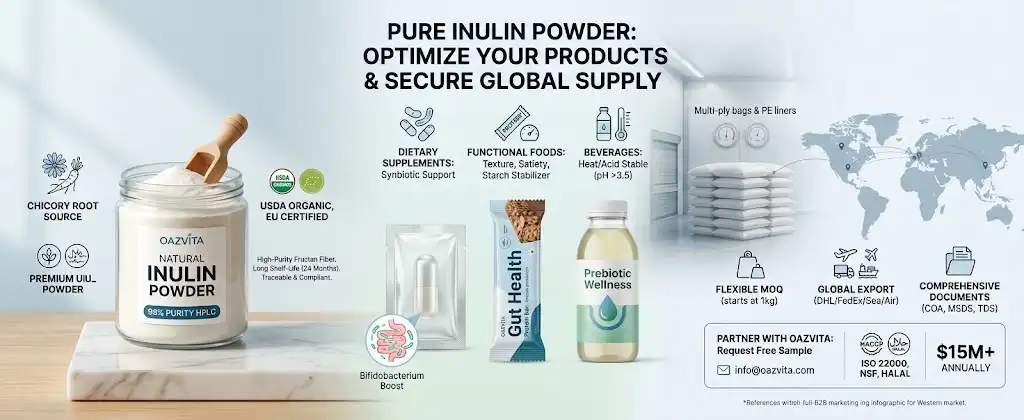
Inulin is a naturally occurring soluble dietary fiber and prebiotic classified within the fructan family. Pure inulin powder — extracted primarily from chicory root (Cichorium intybus) and Jerusalem artichoke — consists of fructose chains linked by β(2→1) glycosidic bonds. With a purity grade of 98% HPLC, it resists digestion in the small intestine and reaches the colon intact, where it feeds beneficial bacteria. For supplement brands, food manufacturers, and OEM buyers, it delivers proven gut health support, satiety management, and blood lipid regulation — making it one of the most formulation-friendly fibers available today.
What Is Pure Inulin Powder? Composition and Origins
Botanical Source and Extraction
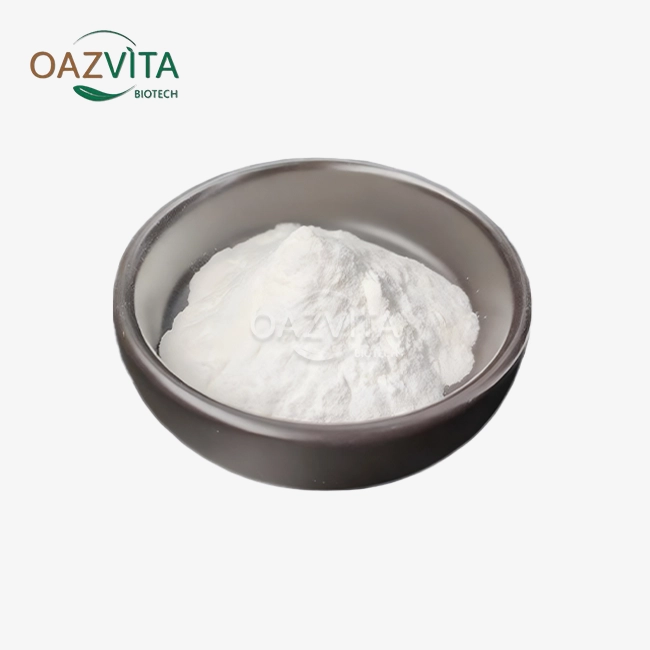
The main sources of OAZVITA's natural inulin powder (CAS No. 9005-80-5) are chicory root and Jerusalem artichoke. These are the main plants that are used to make it. Hot water diffusion is used in the industrial extraction process to get better results when taking fructan chains out of plant tissue. The material that is left over after the process is done is spray-dried to make a fine white powder that has 4.5% water and 0.2% ash. After reaching these levels of stability, the powder will stay stable for twenty-four months if it is kept somewhere dry and cool.
Chemical Composition and Degree of Polymerization
When inulin is made, different kinds of linear fructans are used. The degree of polymerisation (DP) of inulin can be anywhere from two to more than sixty. The DP of standard-grade material is usually between 10 and 12, which means it breaks and ferments in the same way. When high-performance (HP) models with a DP greater than 23 are mixed with water, a microcrystalline gel network is formed. It's possible that this gel network could be used to replace fat in dairy Products and low-calorie meals. The DP range being talked about here has a direct effect on how the ingredient works in many different products.
Inulin vs. FOS vs. Inulin Syrup
A lot of the time, procurement teams want to know how inulin stacks up against oligofructose (FOS) and inulin syrup. The DP of FOS, which is also called short-chain inulin, is less than 10 and it gives off about 30–50% of the sweetness that sugar does. Additionally, it breaks down faster than sugar, but it doesn't add as much texture as sugar does. Long-chain inulin powder, on the other hand, works better at gelling and making things look like fat. While inulin syrup can make it hard for water to flow when it's in powder form, it works pretty well when it's in liquid form. That way, formulators can pick the right material for every type of product on the market once they know these differences.
Health Benefits of Pure Inulin Powder: Science and Practical Applications
Prebiotic Activity and Gut Microbiota Support
Pure inulin powder feeds only certain types of bacteria in the gut, like Bifidobacterium and Lactobacillus. A study published in 2015 in the British Journal of Nutrition confirmed that healthy adults who eat chicory inulin every day have much higher levels of Bifidobacterium. Short-chain fatty acids (SCFAs), especially butyrate, are made during this selective fermentation. These SCFAs help colonocyte health and the stability of the gut barrier. This supports supplement and functional food brands' claims about gut health that are true and can stand up to review from regulators in both the US and EU markets.
Satiety, Weight Management, and Blood Lipid Regulation
Journal of Appetite (2011) published research that showed adults who were overweight and took 10–16 g of inulin daily felt fuller and ate fewer calories. The fiber slows down the emptying of the stomach, changes hormones that control hunger (GLP-1 and PYY), and lowers blood sugar spikes after a meal. Studies on both animals and people have also shown that regular inulin intake lowers LDL cholesterol and total triglycerides. This supports OAZVITA's claim that its product can control blood lipid levels.
Safety Profile and Recommended Dosage
In the United States, inulin is GRAS, which stands for "Generally Recognized As Safe." Most people can handle 5–10 g per day without any problems. People who are allergic to chicory or ragweed should be careful; this should be written on the labels of consumer-facing brands.
How Pure Inulin Powder Works: Mechanisms and B2B Applications
Fermentation Mechanism in the Colon
Inulin gets to the large gut without being broken down by human stomach enzymes because its β(2→1) glycosidic bonds are strong. Microbes in the colon process it for 12 to 24 hours, making SCFAs and lactate. This managed, slow fermentation is what makes inulin different from fibers that process quickly and cause severe gas. This mechanism also explains why it only attacks bifidogenic bacteria. Most pathogenic bacteria don't have the enzyme inulinase they need to break down long-chain fructans, which gives beneficial species an edge in the competition.
Application Across B2B Product Categories
On account of the fact that inulin may be used for a wide variety of purposes, it is beneficial to a wide variety of sectors. The following is a list of the primary use cases through which it demonstrates demonstrable results:
- Inulin, which may be found in capsules, sachets, or functional blends, is a dietary supplement and nutraceutical that supports prebiotic fibre claims and interacts well with probiotic strains for synbiotic formulations. Inulin is often found in dosages ranging from 5 to 10 grams per serving.
- It functions as a humectant in protein bars and fortified snacks, and it increases the shelf life of the product by retarding the retrogradation of starch. Functional foods and drinks include these applications. Through conventional pasteurisation at temperatures up to 140 degrees Celsius, it maintains its structural integrity in drinks with a pH greater than 3.5.
- Inulin is becoming an increasingly important component in beauty-from-within supplements as a result of recent research that establishes a connection between the balance of gut bacteria and the health of the skin.
As a result of these applications, inulin is consistently ranked among the top five ingredients that original equipment manufacturer (OEM) and private-label customers who are searching for functional fibre choices request.
Storage, Packaging, and Supply Chain Considerations
Inulin is hygroscopic, which means it easily takes in water from the air. OAZVITA, a China inulin fiber powder factory, ships the goods in multi-ply bags with a PE inner cushion, making sure the temperature stays below 25°C and the humidity stays at 60%. As soon as bags are opened, they need to be closed again right away to avoid caking. If you store it right, it will last for 24 months. For big orders, OAZVITA offers shipping by air, sea, DHL, FedEx, UPS, and airmail post. From the time an order is confirmed, the wait time is 1–5 working days.
How to Choose and Procure the Best Inulin Ingredient for Your Business
Certifications That Matter in the US Market
When searching for a store that sells genuine inulin powder, the first thing you should check for is certifications. The organic status of OAZVITA's inulin has been validated by HACCP, ISO 22000, NSF, HALAL, the European Union, and the United States Department of Agriculture. Additionally, a complete documentation package that includes a COA, MSDS, and TDS is included with each batch that is sent out. The standards for importing products into North America, Europe, and the Middle East are satisfied by these certificates. When working in regulated marketplaces, this makes it simpler for distributors and brand owners to adhere to the restrictions that are in place.
MOQ, Pricing Structure, and Packaging Flexibility
OAZVITA requires a minimum purchase quantity of one kilogram, and the buyer has the ability to customise the packaging to meet their specific requirements. Because of the low price, purchasers of private-label and original equipment manufacturers (OEM) are able to test out new markets without having to commit to a large quantity of inventory. The fact that the firm exports more than USD 15 million annually demonstrates that it has the manufacturing capacity to handle both small quantities and big orders. Bulk costs decrease when more are purchased, and the fact that the company exports makes it possible for it to do so. Before you make a purchase decision, you may acquire free samples to evaluate the product's quality.
Organic vs. Conventional and Powder vs. Syrup
Despite the fact that it is more expensive, chicory inulin that has been certified organic is able to fulfill the requirements for a clean label for natural food and health supplement businesses. In situations where organic certification is not a requirement for the brand, conventional grades are more cost-effective for producing large quantities of food. When it comes to pills, tablets, and dry mixes, powder is the most suitable option since it is simple to administer and does not dissolve in water. When it comes to liquid beverages, the syrup form is an excellent choice; nevertheless, it does make the process more difficult. When it comes to business-to-business transactions, the powder format that has an HPLC purity of 98% or more is the one that has the most applications.
Conclusion
Inulin is a well-studied polysaccharide that can be used in many different ways and is useful in supplements, food, drinks, and health products. Peer-reviewed research backs up its prebiotic activity, ability to help you feel full, and positive effects on blood lipids. Its technical versatility, ranging from adding fiber to foods to replacing fat, makes it a good choice for formulators in all areas. OAZVITA's pure inulin powder is 98% pure by HPLC, has been certified as organic by both the USDA and the EU, and can be stored for 24 months. It gives sourcing teams a traceable, compliant ingredient that can be added right away to any recipe process.
Frequently Asked Questions
1. Does inulin work in acidic beverages?
When heat and low pH come together, they can damage inulin. In drinks that can be kept for a long time below pH 3.5, it may break down over time into free fructose, which lowers the fiber content. If the cooking conditions allow it, add the ingredient after the drink has been pasteurized if it is acidic.
2. How does inulin differ from oligofructose (FOS)?
The main difference is the length of the chain. Long-chain inulin (DP 10–12+) can help things gel and look like fat. While short-chain FOS (DP <10) is sweeter and easier to dissolve, it can't change the texture of food. Which one you choose relies on the style and functionality claims you want to make for your product.
3. Can inulin be used in keto-labeled products?
Yes, as long as the specifications are met. For strict keto formulas, you should always ask for a COA that says the amount of free sugars is less than 2–5%. Low-quality ingredients with high amounts of free sugar and glucose could make keto claims less valid.
Partner With OAZVITA — Your Trusted Pure Inulin Powder Supplier
OAZVITA has pure inulin powder with 98% HPLC purity for sale, as well as full organic approval (USDA & EU) and a free sample program for people who qualify. Our lead time of 1–5 working days, variable MOQ starting at 1 kg, and dedicated account management make it easy to source. Our team is ready to help you develop your product, whether you need white-label solutions, custom formulations, or a steady supply over the long term. To get your free sample, email us at info@oazvita.com right now.
References
1. Kelly, G. (2009). Inulin-type prebiotics: A review. Alternative Medicine Review, 14(1), 36–55.
2. Niness, K. R. (1999). Inulin and oligofructose: What are they? Journal of Nutrition, 129(7), 1402S–1406S.
3. Roberfroid, M. B. (2005). Inulin-type fructans: Functional food ingredients. Journal of Nutrition, 135(11), 2493S–2497S.
4. Dahl, W. J., & Stewart, M. L. (2015). Position of the Academy of Nutrition and Dietetics: Health implications of dietary fiber. Journal of the Academy of Nutrition and Dietetics, 115(11), 1861–1870.
5. Delannoy-Bruno, O., et al. (2021). Evaluating microbiome-directed fibre snacks in gnotobiotic mice and humans. Nature, 595(7865), 91–95.
6. Brighenti, F., et al. (1999). Effect of consumption of a ready-to-eat breakfast cereal containing inulin on the intestinal milieu and blood lipids in healthy male volunteers. European Journal of Clinical Nutrition, 53(9), 726–733.

Send Inquiry
Related Industry Knowledge
- Does apigenin build muscle?
- Top Quercetin Health Benefits: From Antioxidant Action to Allergy Relief
- The Surprising Health Benefits of Nettle Extract Powder and the Various Forms that you Can Find it
- Pure Inositol Powder: The Ultimate Guide for Health Enthusiasts
- Tea Saponin Powder For Sustainable Agriculture
- Exploring Organic Cordyceps Sinensis Extract Powder
- Pure NMN powder vs other NAD+ supplements: key differences
- Best spirulina chlorella tablets for immunity and detox
- Supplying GMP MCT Powder to Clinical Nutrition Brands in Singapore
- What Are the Benefits of Chicken Collagen Peptides for Skin Care?