What are the benefits of Soybean Natto Powder?
Jul 31, 2026
Soybean Natto Powder delivers concentrated cardiovascular, digestive, and immune support through its rich composition of nattokinase enzymes, vitamin K2, soy isoflavones, and polyglutamic acid. This fermented soybean derivative assists in thrombus dissolution, improves blood circulation, regulates blood viscosity, and provides antioxidant protection—making it a high-value functional ingredient for Dietary Supplements, sports nutrition, functional foods, and nutricosmetics. Its shelf-stable format, standardised potency, and global compliance certifications address critical procurement needs for brands seeking reliable, science-backed ingredients.
Understanding Soybean Natto Powder: Composition and Health Benefits
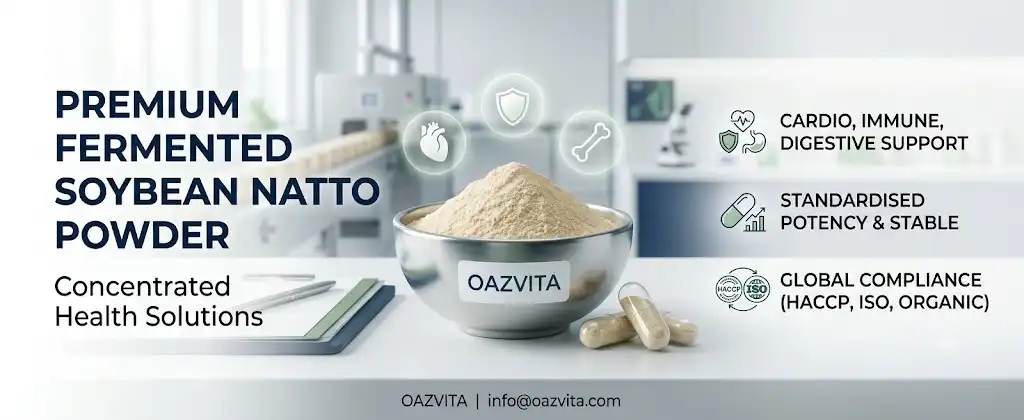
Fermented Soybean Natto Powder is a big step forward in the study of ingredients that are good for you. Traditional natto is hard to move around because it has a strong smell and sticky mucilage. The powdered form, on the other hand, is a standard way to send food that works well and stays fresh. Health and food supplement companies want high-quality Products that have been shown to work every time. This change makes that possible.
Origins and Production Differences
The old way to make natto is to ferment whole soybeans with Bacillus subtilis natto. Japan eats a lot of this sticky, spicy food. Extra steps, like lyophilization or low-temperature spray drying, are taken with the powdered form to get the moisture level down to less than 5%. This keeps the medical chemicals safe and gets rid of the ammonia smell. The enzyme activity of nattokinase is kept when this method is used, and a fine powder (usually 80–100 mesh) is made that is easy to pump into industrial setups.
OAZVITA's fermented Soybean Natto Powder has three grades with different amounts of enzyme activity. The 2,000 FU/g grade is for general food use, the 5,000 FU/g grade is for moderate supplementation, and the 20,000 FU/g grade is for pharmaceutical-grade formulations. This lets companies change how strong their products are to fit different market conditions and government rules.
Nutrient Profile and Bioactive Compounds
There is more to the powder than just nattokinase. Menaquinone-7 is a type of Vitamin K2 that can be found in nature in amounts greater than 100 parts per million. It works out calcium and keeps bones strong. Plant-based oestrogen regulators, such as genistein and daidzein, found in soy isoflavones, help keep hormones in check and protect the heart. The fact that polyglutamic acid keeps skin healthy and moist makes it a valuable ingredient for skin care brands.
Because it has so many nutrients, fermented soybean extract is a flexible ingredient that can be used in many different recipes. Companies that make beauty-from-within products, heart health pills, or vitamins for bones can all use this one ingredient to make more than one health claim. This makes it easier to understand formulations and makes supply lines easier to understand.
Scientifically Supported Health Benefits
Nattokinase has fibrinolytic action, which means it can break down fibrin, the protein that clots blood. Heart and circulatory journals have studies that show taking vitamins on a daily basis can help keep your blood flow healthy and may even help keep your blood pressure in the normal range. As long as the pH stays between 5.5 and 9.0, the enzyme works well in the digestive system and is more bioavailable than proteolytic enzymes that are less stable.
It helps your digestive system stay healthy because it has probiotics in it. Before they are processed, soy proteins are broken down. This gets rid of things that are bad for you and makes amino acids easier to get. This ingredient can be mixed with other digestive enzymes or prebiotics by brands that want to improve gut health. These ingredients will work well together and appeal to people who want all-around digestive support.
Changing the defence system is another benefit that has been shown to work. During fermentation, special chemicals and peptides are created that work with immune system communication pathways. In North America and Europe, where the law allows it, the powder is sold under the claim that it boosts the immune system. This does not treat any disease.
Safety, Dosage, and Allergen Considerations
To source in a safe way, you need to know the rules. To keep your health in good shape, most people take between 100 mg and 500 mg every day. Higher doses should only be used by doctors who know what they're doing for certain blood formulas. On their labels, brands should make it clear which products contain soy allergens. This is because people who are sensitive to soy may still have issues with the goods even after they have aged.
There are full Certificates of Analysis (COA), Material Safety Data Sheets (MSDS), and Technical Data Sheets (TDS) that come with every batch of Soybean Natto Powder from OAZVITA. These make sure you can see the levels of purity (95% HPLC), the amount of heavy metals, the number of microbes, and the allergen testing. This material backs up regulatory reports and builds buyer trust because it has been checked by a third party.
How Soybean Natto Powder Is Made: From Soybeans to Powder?
Buying teams can rate the skills of suppliers and make sure that goods are always the same when they know how soybean natto powder is made. There are a number of important steps that must be taken from raw soybeans to high-purity powder. Each one changes how good and useful the final product is.
Traditional Fermentation Process
The process starts with non-GMO soybeans that were picked because they are pure and high in protein. To get rid of germs that could make people sick, beans are washed, soaked, and then steamed at 121°C. Raw soybeans naturally have enzyme inhibitors that are broken down by heat. This makes the soybeans easier to stomach.
Once the soybeans are clean, Bacillus subtilis natto cultures are added to them while the temperature and humidity are kept at 40–42°C. The bacteria make nattokinase, vitamin K2, and polyglutamic acid over the course of 18 to 24 hours of fermentation. To get constant results during this phase, you must keep a close eye on the oxygen levels, pH, and temperature. This is how enzyme activity and nutrient concentrations are found.
These days, fermentation tanks are self-cleaning, and parameters are tracked all the time. Each batch of OAZVITA products is the same because these technologies are built into the machines that make them. This is important for making a lot of things. Brands that make sports nutrition need ingredients that always work the same way, and this one works for them.
Modern Drying and Powdering Technologies
The wet natto mass has about 60% water after fermentation, so it can't be kept for a long time or used in industry. In the business, the two main ways to dry things are freeze-drying (lyophilization) and low-temperature spray drying.
Lyophilization removes moisture by turning it into a gas under high pressure. This keeps enzymes that are sensitive to heat safe and helps nattokinase work at its best. Powders made this way are very good and can be used in medicine because they have potencies of up to 65,000 FU/g. Price changes are due to the fact that the process takes longer and costs more energy.
When the natto extract is sprayed dry at low temperatures, it breaks up into tiny drops that lose their water quickly when they come in contact with hot air. There is less than 180°C of heat in modern spray dryers. This keeps enzymes from breaking down and the wetness level below 5%. Because it saves money without sacrificing quality, this method works well for functional food uses that only need moderate enzyme activity (2,000–20,000 FU/g).
After the powder is made, it is ground to make sure the pieces are the right size (80–100 mesh), which is what makes pills, tablets, and drinks dissolve the fastest. If the particles are all the same size, they won't separate while they're being mixed, and the final products will have more uniform contents. This is important for following the rules.
Quality Control Protocols
Strict tests are done at several points in the creation process. When raw materials are screened, they are checked for microbe contamination, chemical residues, and non-GMO status. At checks in the middle of the process, the pH of the fermentation, the increase of enzyme activity, and the bacteria culture's ability to stay alive are all checked. The last tests on a thing look at:
- We used standard fibrinolytic methods to find out how much nattokinase was active (FU/g).
- HPLC measures the amount of Vitamin K2 in a sample.
- Heavy metals like lead, arsenic, and mercury can be found with ICP-MS.
- There are microbes like bacteria, yeast, mould, and viruses that pollute the water.
- How much water there is and how it works.
- The size range of the particles.
There are a lot of certificates for OAZVITA, like HACCP, ISO 22000, NSF, HALAL, EU Organic, and USDA Organic. These show that they follow world-quality standards. When brands want to enter more than one market at the same time, these licences make it easy for them to get permission from the government. It takes less time for new items to get to stores now.
Comparative Analysis: Advantages Over Other Fermented Soybean Derivatives
Powder nattokinase extracts can be stored for 24 months in cool, dry places, which is longer than liquid extracts. They also don't need to be shipped through a cold chain. Costs in the supply chain are kept low by this steadiness, and little to no product is lost during shipping to other countries. This is very helpful for wholesalers who have to keep track of goods in many stores.
The powder works the same way every time, unlike whole natto products, since Nattokinase Powder doesn't depend on how long the fermentation took or how good the soybeans were in each batch. Labels on goods can say that they have enzyme activity without worrying because they know that these claims will be backed up by lab tests as long as the Nattokinase Powder products are on the market.
Applications and Best Practices for Using Soybean Natto Powder in Industry
Multiple manufacturing fields may employ fermented soybean natto powder. Manufacturers have several manufacturing possibilities. Proper ingredient use improves performance and customer satisfaction.
Dietary Cardiovascular Supplements
Nattokinase powder is the major element in circulation-boosting heart health tablets. Powder's high bulk density and flowability allow machines to wrap fast and without clogging. This boosts output and decreases downtime.
Circulatory goods manufacturers combine nattokinase with Coenzyme Q10, omega-3s, and garlic extract. Tablets produced from thermostable powder can endure 60°C crushing heat. The enzymes function throughout. To enhance effectiveness, producers should store items below 80°C and minimise heat exposure.
OAZVITA formulates these products. They learn how much to use (100–300 mg per dosage), what compounds work well together, and stability testing. Expert help accelerates product development and minimises formulation costs.
Functioning Drinks and Meals
Taste matters when adding fermented soybean powder to energy drinks and smoothies. Fruit, chocolate, and vanilla bases don't mix with non-fermented soy. Powder must be stable when combined with water to sustain enzyme activity per serving.
It looks great on transparent labels, so functional drink makers like it. Famous, traditional products are preferred. Natto is heritage because Asian civilisations have used it for ages. With names like "ancient fermented wisdom" or "traditional Japanese longevity secrets", these supplements will stand out in the crowded supplement market.
Production method impacts solubility. Spray-dried powders mix better with water than freeze-dried ones for rapid drinks. Marketers should test samples for solubility to guarantee their selected grade works with their formulas.
Sports and Recovery Supplements
Nattokinase improves blood flow, helping your body repair after exercise, says new sports nutrition research. More blood flow helps athletes perform faster and eat better. Cellular waste is removed faster.
After exercise, branched-chain amino acids and anti-inflammatory herbs may be added to the powder, as can L-citrulline before a workout. Powdered amino acids boost protein. It maintains muscle mass, thus the name.
Consider how it will react with other pure amino acids and mineral compounds while making it. Since the powder has a balanced pH (6.5 to 7.5), acidic vitamin C does not precipitate or react with alkaline minerals when blended. This chemical stability simplifies recipe development and extends shelf life.
Nutritional Beauty Supplements
Vitamin K2 and polyglutamic acid make fermented soybean powder suitable for beauty-from-within products. Vit. K2 activates matrix GLA proteins, which control cell calcium and skin flexibility. Foods like polyglutamic acid moisten skin when eaten but not when applied.
Companies that promote collagen may add marine collagen proteins, hyaluronic acid, and antioxidant-rich plant extracts to the powder. Circulation, protein production, and reactive stress reduction slow skin ageing. Creating entire formulations is worth the extra cost.
Clean-label vitamins are essential. Both EU Organic and USDA Organic natto powder from OAZVITA meet these standards. It helps brands target health-conscious, non-GMO, sustainably grown consumers.
Private Label and OEM
OAZVITA provides complete production to brands without plants. The company may help individuals develop new cuisines with inexpensive, nattokinase-friendly products. Making capsules, tablets, powder, and gummies using varied brand marketing methods.
The minimum purchase is 1 kilogram, making market testing affordable. Brands may test regional launch responses before mass production. This flexibility helps new supplement companies join competitive marketplaces where product-market fit takes time.
Customising packaging requires new bottles, labels, and secondary packaging. OAZVITA knows North American and European labelling laws since they sell there. Supplement Facts panels, allergy declarations, and health warnings.
Store, Handle, and Pack Best Practices
Proper material storage ensures supply chain quality. Use food-safe polythene bags in fibre drums for powder storage. Powder must be below 25°C and 60% RH. Water, heat, and sunlight promote enzyme breakdown and vitamin K2 oxidation.
Mix and store powder in climate-controlled rooms to avoid airborne moisture. Powder absorbs moisture. It may stick together and be harder to handle. Large containers with desiccant sachets keep air dry for nearly 30 days.
Barrier materials prevent oxygen and moisture from entering Private Label Natto Extract Powder packaging. These may be foil-laminated pouches or HDPE bottles with induction seals. Packaging stability and scientifically correct expiration dates are assessed at 40°C and 75% RH for 3 to 6 months.
Conclusion
Fermented soybean natto powder boosts immunity, stomach, heart, and attractiveness. Nattokinase, vitamin K2, and soy isoflavones polyglutamic acid. This aids supplement, functional food, and private label formulation. Products stand out because the readily available ingredients make them stable, sturdy, and compliant with global regulations. To make quality, legal, and cost-effective decisions, procurement teams must understand production, consumption, and source assessment. Market data suggests fermented functional compounds are popular. Working with qualified, experienced suppliers lets companies gain on global health-conscious customer prospects.
FAQ
1. What distinguishes soybean natto powder from isolated nattokinase supplements?
All fermentation chemicals are in fermented soybean natto powder. Nattokinase, Vitamin K2, polyglutamic acid, beneficial peptides, and bacterial residues. Separated nattokinase pills contain only fibrinolytic enzyme. Additional helpful components are missing. The powder method uses many synergistic substances. Isolated versions produce more enzymes per gram. Brands employ whole powders for heart and general wellness. A brand may increase circulation using pharmaceutical-grade pure nattokinase.
2. How should brands store bulk quantities to maintain enzyme activity?
Keep sealed boxes cool (below 25°C), dry (below 60% RH), and away from direct sunlight. If these happen, unopened containers last 24 months. Change the lid immediately after taking out the amount. For best enzyme stability, use within 90 days. Once opened, refrigerated items last longer but must be returned to room temperature to avoid condensation. Avoid freezing because ice crystals might harm and hinder powder movement. The first-in, first-out rule keeps things moving and reduces stagnation.
3. Are there contraindications or populations that should avoid natto powder?
If you take blood thinners or have problems with bleeding, you should talk to your doctor before using products with nattokinase because they could make it harder for your blood to clot. The level of Vitamin K2 might not work well with prescriptions for drugs that block Vitamin K. If you are allergic to soy, don't use anything that has soy in it.
Partner with OAZVITA for Premium Fermented Soybean Natto Powder Supply
As a trusted Soybean Natto Powder manufacturer serving global supplement brands, functional food producers, and private label developers, OAZVITA delivers certified, high-potency ingredients backed by comprehensive quality documentation. Our fermented soybean natto powder specifications range from 2,000 FU/g to 20,000 FU/g, with 95% HPLC purity verification, HACCP, ISO 22000, NSF, HALAL, EU Organic, and USDA Organic certifications. We provide free samples with complete COA, MSDS, and TDS documentation, enabling thorough evaluation before bulk orders. Email: info@oazvita.com.
Reference
1. Dinan, L. (2001). Phytoecdysteroids: Biological Aspects. Phytochemistry, 57(3), 325–339.
2. Lafont, R., & Dinan, L. (2003). Practical Uses for Ecdysteroids in Mammals, Including Humans: An Update. Journal of Insect Science, 3, 7.
3. Bathori, M., & Pongracz, Z. (2005). Phytoecdysteroids—From Isolation to Their Effects on Humans. Current Medicinal Chemistry, 12(2), 153–172.
4. Isenmann, E., Ambrosio, G., Joseph, J. F., Mazzarino, M., de la Torre, X., Zimmer, P., & Kazlauskas, R. (2019). Ecdysteroids as Non-Conventional Anabolic Agent: Performance Enhancement by Ecdysterone Supplementation in Humans. Archives of Toxicology, 93(7), 1807–1816.
5. Dinan, L., Harmatha, J., & Lafont, R. (2001). Chromatographic Procedures for the Isolation of Plant Steroids (Phytoecdysteroids). Journal of Chromatography A, 935(1–2), 105–123.
6. Gorelick-Feldman, J., MacLean, D., Ilic, N., Poulev, A., Lila, M. A., Cheng, D., & Raskin, I. (2008). Phytoecdysteroids Increase Protein Synthesis in Skeletal Muscle Cells. Journal of Agricultural and Food Chemistry, 56(10), 3532–3537.

Send Inquiry


Related Industry Knowledge
- Pure Bulk Curcumin: Overview of Extraction Methods, Health Benefits
- Discover the Power of Ganoderma Lucidum: Strengthening Your Natural Defenses
- Coconut Milk: The Ultimate Guide
- When should I take shilajit drops?
- Top 7 Benefits of Using Pure NAD+ Powder in Wellness
- NR Chloride Powder Quality Audits for Japanese Pharmaceutical Buyers
- Why choose high purity magnesium glycinate powder for muscle recovery?
- Serving Asia-Pacific with Scalable NAD+ and NMN Powder Supply
- Shilajit resin supplement for hormone support and testosterone
- Best Pure Inositol Powder Uses for Mental Wellness in the Industrial Sector