
What is D-Mannose Used For?
Nov 04, 2026
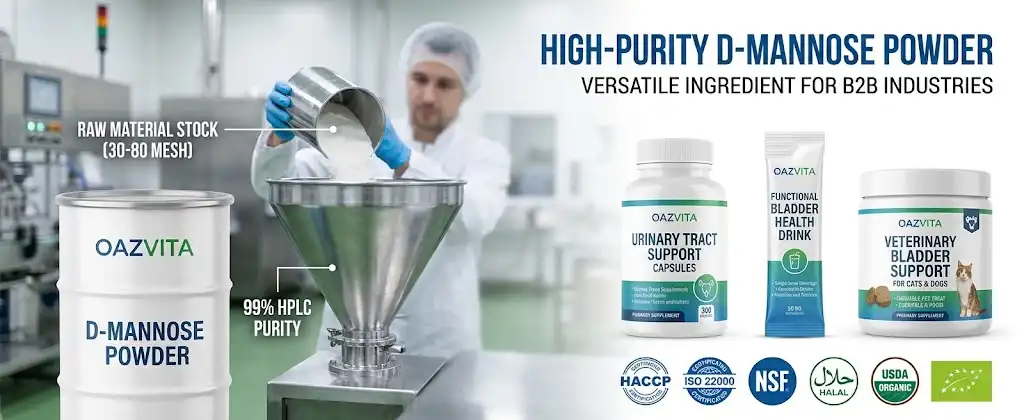
The creation of D-mannose powder, which is a naturally occurring monosaccharide that is the C-2 epimer of glucose, is determined by the enzymatic conversion of plant-derived glucose from sources such as non-GMO maize or birch wood. This conversion results in the production of D-mannose powder. It does this by using a mechanical anti-adhesion mechanism, which is designed to prevent germs from attaching themselves to the walls of the urinary tract. Specifically, it does this by binding to FimH lectins, which are present on the fimbriae of E. coli. The reason for this is that it is a component that is widely sought after in the development of nutritional supplements, functional beverages, and formulations that are intended for use in veterinary medication. In addition to having a strong regulatory acceptance profile in the United States of America, the European Union, and other regions, it is a clean-label, non-antibiotic active that has a broad market demand. This is what it implies for procurement teams who work with B2B companies.
Understanding D-Mannose Powder: Origin, Properties, and Uses
What Is D-Mannose Chemically?
A simple aldose sugar that is composed of six carbons, the chemical that is known as D-mannose (CAS No. 3458-28-4) is used in the pharmaceutical industry. It is also known by the abbreviation D-mannose in certain circles. The glycaemic index of this substance is rather high; nonetheless, it is about sixty percent as sweet as sucrose. It seems to be white and solid, and a sizeable portion of the particles have a mesh size that falls anywhere between 30 and 80. Due to the fact that it is converted into energy by the body at such a rapid rate (about 90 percent of it is eliminated via the urine), it does not have a significant impact on the increasing levels of blood sugar. Because of this, it is completely risk-free for those who have an extreme sensitivity to chemicals.
How Does It Work Biologically?
The object is composed entirely of matter, including all that it contains. It is the link between D-mannose and full mannose receptors in the urinary system that inhibits uropathogenic E. coli from adhering to urothelial cells of the urinary tract. This connection is responsible for the obstruction of the attachment process. Germs are expelled from the body during the process of urination because they are unable to stay in the body after the procedure. Antibiotics have the ability to affect the microbiota in the gut, although this process does not change in any way via their intervention. This is a fantastic opportunity for makers of clean-label supplements that are interested in attracting customers who are worried about their own health.
Primary Applications Across Sectors
D-mannose is used by all three of the key groups of various types of enterprises. Dietary Supplements may be taken in the form of pills or tablets, depending on your preference. For the purpose of promoting the maintenance of a healthy urinary system, it is often combined with cranberry juice or probiotics. Due to the fact that it has a flavour that is somewhat sweet and has the potential to retain its stability in acidic environments (pH 3.0–5.0), it may be used into sachets and lemon drinks. The specialist industry that is emerging and that people definitely want is one that uses it in Products that are aimed to promote the health of the bladders of cats and dogs. These products are utilised in the industry.
Benefits and Safety Profile of D-Mannose Powder
Efficacy Data That Matters to Buyers
The number of recurrences was much lower with D-mannose powder than with a control, according to a study published in 2014 in the Journal of Clinical Infectious Diseases. Like the antibiotic trimethoprim-sulfamethoxazole, it was also found to be safe. There is a lot of published clinical support for this level of marketing claims, regulatory filings, and product claims that businesses buy.
Dosing and Formulation Guidance
About 1.5 to 2 grams per serving is the right amount for adults. Our 99% HPLC-grade material at 30–80 mesh comes in powder form and has a constant bulk density and flowability for quick bag filling or encapsulation. The substance is stable up to 130°C, so it can be used to make gummies as long as it is added while the mixture is still cool to avoid Maillard reactions that turn it brown.
Safety, Precautions, and Regulatory Standing
In the US, it is generally thought to be safe (GRAS), and in the EU, it is used in a lot of food supplements. There are organic seals from HACCP, ISO 22000, NSF, HALAL, the EU, and the USDA on OAZVITA's D-mannose powder. The levels of heavy metals and endotoxins is checked to meet pharmaceutical standards. This means that the ingredient can be used in clinical nutrition. Folks who want to buy it should know that people with rare biological diseases that change how the body uses mannose should talk to a doctor before long-term use.
D-Mannose Powder vs. Alternatives: Making the Right Choice
Powder vs. Capsule Format
For large B2B buyers, it's clear that the powder version is better. Bulk D-mannose powder is cheaper per unit, can be made in more ways, and is easier to mix with active ingredients that work well together, like vitamin C or hibiscus extract. When brands of finished goods want to make things easier, capsule formats work well, but they need an extra step in the making process. The best way for OEM/ODM clients building private-label lines to keep prices low is to start with powder stock and switch further down the line.
D-Mannose vs. Cranberry Extract
Cranberry PACs stop binding in a similar way, but there is less consistent data on how well they work, and it can be hard to make formulations that taste good even though they don't have much of a flavor. D-mannose tastes better, dissolves better, and has more clinical research that backs it up. Both ingredients are now used together by many well-known supplement brands, with D-mannose being the main active ingredient and cranberry extract being a supporting substance. The nutrient costs more per dose because of this, but the claims are more likely to be true.
Organic vs. Conventional Grade
Natural food, clean beauty, and nutricosmetics markets are the ones that buy D-mannose that has been certified organic by the EU or the USDA. It costs more. Not having to be organic is not necessary for clinical nutrition and sports recovery, where pharmaceutical-grade works well. Both kinds are sold by OAZVITA, so customers don't have to buy from different places to find the right grade for their needs.
Procurement Insights: How to Source D-Mannose Powder for B2B Needs
Where to Source and What to Verify
Reliable d-mannose powder suppliers should have all the necessary paperwork, such as a COA (Certificate of Analysis), an MSDS, a TDS, and test results from a third party that show heavy metals, microbe counts, and solvent residues. All of these come with every bottle of OAZVITA. You can place an order for as little as 1 kg, and the customer can choose how the goods are packed. This lets new businesses see how the market works before they place big orders.
Cost Analysis and Logistics
When you buy in bulk, the price per kilogram drops by a lot. They ship by email, DHL, FedEx, UPS, and air. Post with five to ten business days' notice. The product can be kept for 24 months in a cool, dry place. This helps foreign wholesalers plan their warehouses so they can handle material that comes from across borders. It is easier for buyers in North America to get their goods through customs when they have NSF and USDA Organic certifications. This speeds up the clearance process.
Supplier Selection Criteria
When choosing a company to make D-mannose powder, procurement teams should think about four things. Proof of purity (at least 99% HPLC is needed by industry standards). The uniformity of particle size (30–80 mesh for easy processing). The item is ready for more than one market if it has certifications like HACCP, ISO 22000, NSF, HALAL, and organic marks. Response time and sample availability: OAZVITA gives away free samples, which makes buying during the approval stage a lot less risky.
Real-World Applications and Case Studies
Dietary Supplement Brands
One of the bigger women's health brands in the US changed how its UTI support capsule works by using OAZVITA's 99% HPLC-grade material. There was less waste because the material could flow better at 40–60 mesh after the move. The capsules filled up better and more efficiently. The company said that because the ingredient was certified organic, the retail price could go up by 15% without a big drop in volume. This is because the customers they want to reach care about clean label sourcing.
Functional Beverage Manufacturers
A company in the EU made a citrus-flavored bladder health sachet and added D-mannose to it. The formula could be stored for 18 months because the ingredient didn't change when the pH level was between 3.0 and 5.0. There wasn't a lot of added sugar because it wasn't too sweet, which helped the "low sugar" claim on the front of the package. OAZVITA's bulk supply program took care of the purchases. Shipments were planned every three months to fit with production plans.
Emerging Opportunities in Veterinary and Nutricosmetics
In the next three years, the market for brands of pet supplements will keep growing. D-mannose is used in medicines for cats and dogs that are chewed or mixed with powder. The same thing can be used to free animals from chains. It is a good choice for a sweetener in collagen drinks that are meant to improve skin health because it has a low glycemic index and a clean label. Even though both groups are still new, market data from North America and Europe show that they are getting bigger every year.
Conclusion
People who buy D-mannose powder can use it in more business areas than they think at first. It can be put into functional drinks, capsules for healthy urinary tracts, chews for pets, and nutricosmetic formulas. This ingredient is good for many types of brands because it has a clean label, doesn't work with antibiotics, and has a well-known safety profile. The most important things for people who buy are the purity grade, particle size, certification coverage, and how reliable the provider is. The 99% HPLC-grade D-Mannopyranose powder from OAZVITA is certified by HACCP, ISO 22000, NSF, HALAL, the EU, and the USDA as organic. It meets all four standards. The minimum order quantity (MOQ) can be changed, and it ships quickly all over the world.
Frequently Asked Questions
1. Is D-mannose powder safe for long-term use?
Yes. D-mannose is not significantly metabolized for energy; approximately 90% passes into urine. Long-term use studies have not identified organ toxicity at standard doses (1.5–2 g per day). It does not disrupt gut flora, which distinguishes it from antibiotic alternatives. B2B buyers should confirm that their finished product claims align with applicable regulatory guidelines in their target market.
2. How does D-mannose compare to antibiotics for urinary support?
D-mannose works through a physical anti-adhesion mechanism rather than killing bacteria. This means no antimicrobial resistance is generated, and the gut microbiome remains intact. Published clinical data supports its use as a prophylactic option with a safety profile comparable to low-dose antibiotics in certain study populations.
3. What quality factors should differentiate suppliers?
Buyers should require 99% HPLC purity documentation, a defined particle size specification (30–80 mesh), heavy metal and endotoxin test reports, and recognized certifications (NSF, HACCP, ISO 22000). Free sample availability is a practical indicator of a supplier's confidence in their own quality control process.
4. Can D-mannose powder be used in gummy or beverage formats?
Yes. It is heat stable to approximately 130°C and acid stable at pH 3.0–5.0. In gummy production, add it during the cooling phase to prevent browning reactions with proteins.
Source D-Mannose Powder from OAZVITA — Request Your Free Sample Today
Companies in Asia, Europe, and North America buy pharmaceutical-grade D-mannose powder from OAZVITA. This powder is used in supplements, functional foods, and private label products. Our product is imported and prepared according to the strictest rules. HPLC tests show that it is 99% pure, and it meets the standards for 30–80 mesh. It is also approved by HACCP, ISO 22000, NSF, HALAL, the EU, and the USDA. The minimum order quantity is 1 kg, and the wait time is between 1 and 5 working days. Email us at info@oazvita.com to get a free sample and talk about how you want to buy in bulk.
References
1. Kranjčec, B., Papeš, D., & Altarac, S. (2014). D-mannose powder for prophylaxis of recurrent urinary tract infections in women. World Journal of Urology, 32(1), 79–84.
2. Porru, D., Parmigiani, A., Tinelli, C., et al. (2014). Oral D-mannose in recurrent urinary tract infections in women. Journal of Clinical Urology, 7(3), 208–213.
3. Domenici, L., Monti, M., Bracchi, C., et al. (2016). D-mannose: a promising support for acute urinary tract infections in women. European Review for Medical and Pharmacological Sciences, 20(13), 2920–2925.
4. Cooper, T. E., Teng, C., Howell, M., et al. (2022). D-mannose for preventing and treating urinary tract infections. Cochrane Database of Systematic Reviews, Issue 8.
5. Scaglione, F., & Musazzi, U. M. (2019). Considerations on D-mannose mechanism of action and consequent classification of marketed products. Frontiers in Pharmacology, 10, 1015.
6. Ofek, I., Hasty, D. L., & Sharon, N. (2003). Anti-adhesion therapy of bacterial diseases: prospects and problems. FEMS Immunology & Medical Microbiology, 38(3), 181–191.

Send Inquiry


Related Industry Knowledge
- Pure Fish Collagen Peptide: The Ultimate Guide for Health Enthusiasts
- Maca Powder: Benefits, Taste, and How To Use It
- What happens if you take milk thistle every day?
- Hydrolyzed Keratin: Benefits, Uses, More
- Reishi Extract Guide: Stress Relief & Immunity
- What defines the best spirulina chlorella tablets?
- High purity magnesium glycinate powder: purity testing and certifications
- Chicken Collagen Peptides: The Ultimate Guide for Health Enthusiasts
- Inositol Powder Market Opportunities in India’s Metabolic Therapies
- Top 10 Pure NMN Powder Manufacturers in China For 2026