What is Natural Astaxanthin Powder? Benefits, Dosage and More!
Aug 07, 2026
Natural astaxanthin powder represents a breakthrough carotenoid antioxidant extracted from Haematococcus pluvialis microalgae, distinguished by its exceptional free radical scavenging capacity and membrane-spanning molecular structure. As a B2B ingredient, it addresses critical formulation challenges including oxidative stability, bioavailability enhancement, and clean-label compliance for brands developing nutraceutical supplements, functional beverages, sports nutrition Products, and nutricosmetics. This naturally occurring keto-carotenoid demonstrates approximately 6,000 times greater singlet oxygen quenching ability compared to vitamin C, making it an indispensable raw material for manufacturers seeking scientifically validated actives that resonate with health-conscious consumers demanding transparency and efficacy.
Understanding Natural Astaxanthin Powder
Origin and Extraction Process
Our astaxanthin extract powder only comes from Haematococcus pluvialis, a type of freshwater microalga that is grown in a controlled photobioreactor and makes astaxanthin on its own as a way to protect itself from external stress. Supercritical CO2 technology is used for the extraction. This gets rid of any solvent residues and protects the delicate polyene chain structure that gives it its antioxidant properties. This method breaks down cell walls at rates higher than 98%. This lets the most beneficial chemicals escape without any damage from heat.
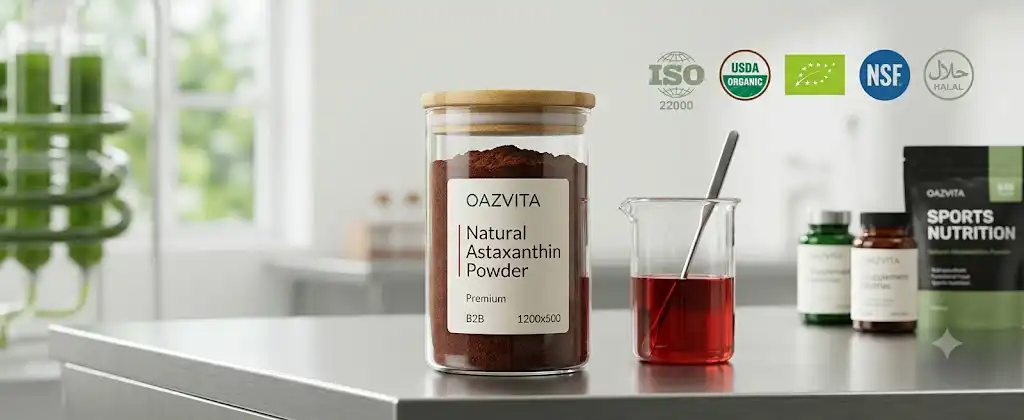
OAZVITA sells Natural Astaxanthin Powder that is good for pharmaceutical use. It comes in three quality levels: 1%, 2%, and 5%. HPLC analysis is used to check each batch, and each one comes with full COA paperwork. The fine, dark red to brownish-red powder sticks to fat better, but microencapsulated types that dissolve in cold water work better for ready-to-drink recipes that need watery ingredients.
Natural vs. Synthetic Differentiation
The main difference between natural and man-made versions is the stereoisomer profile for each. It is better for cells to take in astaxanthin from Haematococcus because it is mostly in the 3S,3'S form instead of the racemic mixture found in petroleum-based choices. Studies in humans have shown that natural sources are 20–50 times more bioavailable. This means that people need smaller amounts to get the same effect and do better, which is important for brands that want to make their wellness products seem high-end.
Rules are favoring natural sources more and more. Some of the groups that have approved our astaxanthin powder are the EU, the USDA, HALAL, and NSF. To get into North America and Europe, it has to pass strict rules. This is because synthetic carotenoids have to deal with labeling limits and buyer questions.
Quality Standards for Industrial Applications
When you buy from a business, you need to have high quality standards. The amount of heavy metals and pheophorbide must be kept below the EU standards, and the amount of bacteria must be kept below 1,000 CFU/g. This is to stop photosensitivity reactions. They test each batch for stability and make sure it can be stored for 24 months in a cool, dry, and out-of-direct-light place. This is useful for companies that make things and need to keep track of their stock and when things will be available.
Key Benefits of Natural Astaxanthin Powder for Health and Industry
Antioxidant Capacity and Cellular Protection
Besides its polar ionone rings on both sides, astaxanthin has 13 conjugated double bonds. This structure safeguards both lipid bilayers and water-filled cell compartments at the same time. There are two kinds of antioxidants that work in this direction across the membrane. These antioxidants eliminate reactive oxygen species that are made when the body is under metabolic stress, UV exposure, or physical stress. Researchers have found that amounts of oxidative biomarkers like 8-OHdG and malondialdehyde drop after taking supplements for a long time.
This means that supplement companies that make health pills or products for recovery can make claims about their products' real value that are backed up by research that has been reviewed by other experts. A company that makes sports nutrition products like astaxanthin claims it can help lower the reactive damage that exercise causes. This speeds up the healing process and eases muscle pain. These claims are backed up by clinical studies that show better measures of time to exhaustion and rates of lactate clearing.
Skin Health and Photoprotection
Astaxanthin has a special property that lets it build up in skin tissue. This protects skin from UV light and keeps collagen healthy. It has been shown that taking supplements by mouth for 6 to 12 weeks can make the skin more flexible, better at keeping water in, and less wrinkled. Astaxanthin is great for beauty companies that want to sell "beauty from within" goods because it can fight both oxidative stress and swelling.
Our powder is easy to mix into softgels, tablets, and even functional gummies, so formulators can choose how to deliver the drug. Since they dissolve in oil, they are best absorbed when mixed with lipid carriers. But our microencapsulated versions can be added to collagen shakes and drink mixes to meet the needs of the growing market for beauty products that you can eat or drink.
Cardiovascular and Metabolic Support
It was found that taking astaxanthin pills can change the lipid balance, make endothelial cells work better, and lower inflammation markers. Mechanistic studies show that astaxanthin makes it easier for nitric oxide to be absorbed and lessens the oxidation of LDL. It works well with CoQ10, omega-3s, and plant sterols in heart health products because of this.
Functional food companies that make protein bars or snacks with extra vitamins and minerals can use astaxanthin's consistency to make their products easier to process. Many carotenoids lose their usefulness when they come into contact with oxygen and heat, but astaxanthin powder that is properly enclosed stays active even after baking, extruding, and mixing. This means that the label claim is true for the whole shelf life of the product.
Vision Support and Ocular Health
Astaxanthin is one of the few carotenoids that can get into the retina from the blood. This makes it good for eye health. Research has shown that it can improve eye focus, speed up the process of accommodating, and protect photoreceptors from the damage that blue light does. Astaxanthin, lutein, and zeaxanthin are all antioxidants that improve eye health. Brands that want to help with digital eye pain or vision problems that come with getting older mix them.
Astaxanthin powder is now an important part of full supplement solutions made by OEM/ODM service providers because it has so many benefits. With MOQs that are flexible and start at 1 kg, you can try the product on the market to see if people like it before making a lot of it.
Dosage Recommendations and Safety Profile
Application-Specific Dosing Guidelines
Astaxanthin is usually given every day in the form of 4 to 12 mg, which is equal to 400 to 1,200 mg of 1% powder or less for higher amounts. A higher dose (8–12 mg) is usually found in sports nutrition products to deal with the oxidative stress that comes from exercise. A lower dose (4–6 mg) is usually found in beauty supplements to see skin benefits that can be seen during clinical study times.
Cold-water-dispersible powder lets you make steady solutions of 2 to 4 mg per dose that don't separate or lose their color. This can be used to make useful drinks. We have a technical team that checks for solubility and gives formulation tips to get the best taste and clarity across the pH ranges that protein shakes, teas, and juices usually have.
There are different ways to concentrate food for different uses with animals, such as aquaculture feed and pet treats. We ship feed manufacturers large amounts—more than 25 kg—and can help them come up with formulations that keep the color stable during extrusion processes and pelletization that is stable.
Clinical Safety and Regulatory Compliance
There are many studies that show Astaxanthin Powder for Nutritional Use is safe for many types of people. Studies on humans have shown that amounts of up to 40 mg per day for long periods of time are well handled. No major side effects or drug interactions have been seen. When people make things that people will use every day for a long time, this safety gap gives them peace of mind.
There are three international food safety standards that our companies follow: HACCP, ISO 22000, and GMP. This means that every batch meets these standards. There are many places in the world that need documentation packages like MSDS, TDS, food statements, and BSE/TSE reports. These are needed for things like customs processing and store compliance checks.
These certifications cover a lot of different customer groups and tastes, with names like kosher, halal, and organic. By cutting down on the time it takes to make new recipes, these certifications help private label buyers get their goods into specialty stores faster and for less money.
Contraindications and Interactions
Most people think that astaxanthin pills are safe, but you should still follow all the usual safety rules. To be safe, people who are allergic to fish should check that astaxanthin from algae is safe for them. However, real allergic reactions are still very rare. To find out how safe pregnancy and breastfeeding are, not controlled research but facts from everyday use are used. This is why conservative labeling ideas are made.
Since astaxanthin is safe for food, it doesn't seem to interact with drugs very often. But there are some things that might make you nervous, like drugs that lower blood pressure or weaken the defense system. Responsible brands use standard disclaimer language that tells people who take long-term drugs to talk to their doctor.
Comparing Natural Astaxanthin Powder with Alternatives
Natural vs. Synthetic Astaxanthin
Stereochemistry isn't the only thing that makes markets different. Things like how much it costs to make and how people feel about it also matter. It costs less per kilogram to use synthetic astaxanthin, but in many important countries, it has to go through a lot of rules before it can be used in food additives. Prices for natural sources are higher, and this is supported by clinical data, the fact that organic certification is possible, and the fact that people are willing to pay more for ingredients that come from algae.
When the same amount of natural astaxanthin is taken in, plasma values are always two to three times higher than when the same amount of manufactured astaxanthin is taken in. This means lower effective amounts, better cost-per-benefit ratios, and a better place compared to competitors who use synthetic options for brands that want to build their marketing stories around proof.
It's clear from what dealers say that natural sources are strongly preferred when providing brands in North America and Europe, where "clean label" trends and claims of "non-GMO" foods affect buying choices. When we grow Haematococcus, we don't use medicines, genetic modification, or man-made poisons. This helps with getting organic certification and putting on clean labels.
Benchmarking Against Other Antioxidants
Comparative ORAC tests show that astaxanthin is one of the most powerful antioxidants found in food, able to stop singlet oxygen more effectively than resveratrol, vitamin E, and beta-carotene. Astaxanthin is not the same as other antioxidants like vitamin C because it is lipophilic. This means that it can build up in cell membranes and tissues that are high in fat, like the skin, eyes, and muscles.
As functional food developers look for better ways to deal with oxidative stress, astaxanthin mixed with CoQ10, curcumin, or tocotrienols is becoming more trendy. We have a technical team that helps test for suitability and figure out the best amount to make multi-ingredient blends that are as stable and bioavailable as possible.
The success of new goods like daily multivitamins, pre-workout shakes, and anti-aging serums can be seen in case studies from real clients. People who buy brands say that their goods give them more energy, help them heal, and change the way their skin looks. There is a lot of clinical literature that backs up these results, which also back up high return buy rates.
Procurement Guide for Natural Astaxanthin Powder
Supplier Evaluation Criteria
You should make sure that the seller can do things in a lot of different ways so that you can work with them well. The basis of verification is that it is real. The company is following the rules if you ask for their original GMP, ISO, organic credentials, and records of third-party testing. Our quality management system keeps track of the whole process, from growing the algae to testing it, extracting it, and packing it. Batch-specific certificates that can be requested show this.
Brands that are moving from a new start to known distribution should make sure they have enough goods and the ability to make enough. We've shown that we can help our clients grow without having to worry about supply problems by sending more than USD 15 million worth of goods abroad every year and delivering more than 99% of the time. Orders are filled quickly, even when there is a lot of demand, because regional warehouses are planned and a good stock of raw materials is kept.
Strategic partners are different from commodity suppliers because they can offer expert help. It takes less time to make a new product because our R&D team helps with recipes, checks for stability, and writes application guides. Our OEM/ODM clients can get complete solutions that include formula development, choosing the right dosage form, designing the packaging, and putting together the regulatory paperwork. This speeds up the building process, which used to take months or weeks.
Pricing Factors and Order Considerations
The prices of Private Label Natural Astaxanthin Powder change based on how much algae is taken out of the water, how well it is removed, and how demand changes in the market. Astaxanthin that comes from nature usually costs between 800 and 2000 USD per kilogram. The exact price depends on the purity grade, the amount that is ordered, and the need for certification. We have clear prices, and savings for buying in bulk start at 5 kg, 25 kg, and 100 kg. This means that both new and well-known companies can compete.
Our minimum order number starts at 1 kg so that we can do samples and work on new products. One type of flexible packaging is aluminum foil bags, another is fiber drums, and a third is custom specifications that fit the client's warehouse systems. Giving away free samples with all the analytical paperwork makes it less risky to buy and easier to test within the company before committing to large orders.
Coordinating transportation through DHL, FedEx, air freight, and sea shipping makes sure that production plans are met by the time things arrive. Custom formulation projects usually take between 2 and 3 weeks to finish, depending on how hard they are. Lead times for stock items are usually between 1 and 5 working days. Our customer service team is here for you 24 hours a day, seven days a week to help you track shipments, fill out customs paperwork, and quickly solve problems so that the supply chain stays on track.
Quality Verification Protocols
A third party tests the goods once they arrive to make sure the supplier's claims are true and to protect the brand's image. To make sure of the amount of astaxanthin, we recommend HPLC analysis. To make sure the product is sterile, microbe testing is recommended. Heavy metal screening is recommended to make sure safety rules are followed. Because we're sure of the quality of our products and the honesty of our manufacturing process, we're happy to give clients samples that they can keep and check.
It is possible to guess how long something will last on the shelf in real life by testing its stability under fast conditions (40°C, 75% RH). This is used to set the expiration date and storage requirements. We give you stability data that can be used for 24 months if it is stored correctly. For customers with specific needs, we can also conduct tests that look at certain conditions for packaging or formulation.
By setting clear rules for communication and giving each account a specific boss, you can avoid confusion and make sure that everyone is on the same page about needs, goals, and quality standards. Our service team speaks more than one language, so there are no language barriers. Also, going to industry events like Vitafoods and SupplySide West makes it easier to meet new people and share technical information.
Conclusion
It has been proven by science that Natural Astaxanthin Powder from Haematococcus pluvialis is the best antioxidant on the market. And businesses that sell to other businesses can use it in many ways in the beauty, health, sports nutrition, and functional food industries. Companies that make high-end wellness items for smart customers use it a lot because it is bioavailable, safe, and good for a lot of different parts of the body. It's important to look at a provider's qualifications, professional help, and supply reliability when making your choice. This will help you get your goods off the ground and stay ahead of the competition in the world markets, which move quickly.
FAQ
1. Is natural astaxanthin safe for all age groups?
Clinical studies show that natural astaxanthin is safe for adults of all ages and from a wide range of backgrounds. People who have used it before say that most people can handle it, but there aren't many controlled studies on children or pregnant women, so these groups are told to be careful when labeling.
2. How does natural astaxanthin compare to synthetic versions?
The 3S,3'S stereoisomer structure of astaxanthin from Haematococcus is 20–50 times more accessible than racemic mixes that are made in a lab. It is also possible for natural sources to be recognized as organic. People who like health products that come from natural sources will pay more for them.
3. What certifications should buyers verify before bulk purchasing?
Some of the most important licenses are ISO 22000 food safety management, certified organic (USDA/EU), and third-party testing proof (NSF). Ask to see the original paperwork, including a COA, MSDS, and TDS for each batch that shows it is pure, doesn't contain harmful microbes, and meets the heavy metal requirements for the places you want to sell it to.
Partner with OAZVITA for Premium Astaxanthin Extract Powder Supply
Certified Private Label Natural Astaxanthin Powder from OAZVITA meets the high standards of functional food companies, health supplement brands, and sports nutrition brands all over the world. Our Haematococcus pluvialis-based powder comes in grades of 1%, 2%, and 5%. It is safe to use all over the world because it is approved by HACCP, ISO 22000, NSF, HALAL, EU Organic, and USDA Organic. We help you get your product to market faster by giving you free trials, a MOQ that can be changed from 1 kg to any amount you want, and full expert support. We are a well-known company that sends Natural Astaxanthin Powder for sale to markets in the Asia-Pacific region, Europe, and North America. We can keep up with your growth. Get in touch with us at info@oazvita.com to find out about our astaxanthin solutions, bulk pricing, and how they can help your health products stand out in a market that is already very competitive.
References
1. Ambati, R.R., et al. "Astaxanthin: Sources, Extraction, Stability, Biological Activities and Commercial Applications." Marine Drugs 12.1 (2014): 128-152.
2. Fassett, R.G., and Coombes, J.S. "Astaxanthin in Cardiovascular Health and Disease." Molecules 17.2 (2012): 2030-2048.
3. Guerin, M., Huntley, M.E., and Olaizola, M. "Haematococcus Astaxanthin: Applications for Human Health and Nutrition." Trends in Biotechnology 21.5 (2003): 210-216.
4. Nishida, Y., et al. "Quenching Activities of Common Hydrophilic and Lipophilic Antioxidants against Singlet Oxygen Using Chemiluminescence Detection System." Carotenoid Science 11 (2007): 16-20.
5. Tominaga, K., et al. "Cosmetic Benefits of Astaxanthin on Humans Subjects." Acta Biochimica Polonica 59.1 (2012): 43-47.
6. Yuan, J.P., Peng, J., Yin, K., and Wang, J.H. "Potential Health-Promoting Effects of Astaxanthin: A High-Value Carotenoid Mostly from Microalgae." Molecular Nutrition & Food Research 55.1 (2011): 150-165.

Send Inquiry


Related Industry Knowledge
- Pure Quercetin Powder | Everything about effect, intake & dosage
- The Truth About Blue Copper Peptide Powder No One Really Talks About
- Benefits of Pearl Powder: What the Research Says About This Ancient Ingredient
- Complete Guide to Choosing the Best OEM/ODM Pure Bovine Collagen Peptides for Your Health Supplement Business
- Coconut Milk Powder: A Secret Ingredient for Anti-Aging
- How To Use Cacao Powder?
- Pure NMN powder formulation trends: bioavailability and delivery tech
- Pure Inositol Powder vs Myo-Inositol: Key Differences Explained
- 2026 Best OEM/ODM Pure Fish Collagen Peptide Suppliers for Skincare Industry
- Shilajit resin supplement: regulatory status, research gaps and evidence