Can biotin improve blood sugar?
Jun 17, 2026
A new study shows that biotin may help keep blood sugar levels in check by working with glucose metabolism. Pure biotin powder, which is also called vitamin B7 or vitamin H (CAS No. 58-85-5), helps carboxylase enzymes do their job in gluconeogenesis, the process by which glucose is made from things other than carbohydrates. Although it is not a cure-all, high-quality crystalline pure biotin powder may help control blood sugar when added to other wellness Products. This makes it an interesting ingredient for B2B product makers who are making products for metabolic health markets.
Understanding Biotin and Blood Sugar Regulation
What is Pure Biotin Powder?
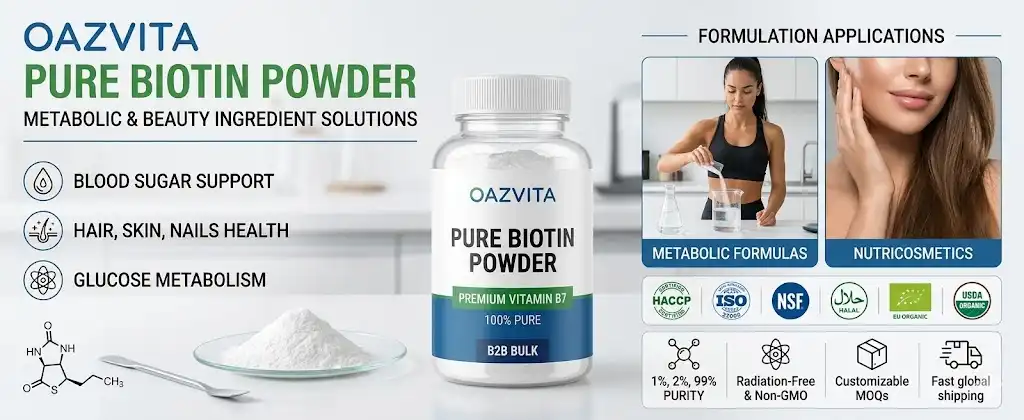
Pure Biotin Powder is the most concentrated solid form of the medically active isomer D-Biotin. This water-soluble B-complex vitamin stays more stable at high temperatures than pill or liquid forms, which have trouble staying stable. OAZVITA's Pure Biotin Powder comes in three different concentrations: 1%, 2%, and 99%. This helps with the problem of microdosing that comes up when making supplements. The 1% and 2% amounts use maltodextrin carriers to make sure that the ingredients are spread out evenly in bulk recipes. This keeps the ingredients from separating, which could affect the structure of the product.
Biotin can strongly bind to avidin and streptavidin proteins because of the way it is chemically structured. This changes how it is taken and how it is tested to make sure it is pure. Manufacturers need to know that the powder form gives them a lot of options for making special recipes, whether they're making pills, tablets, healthy drinks, or foods with added nutrients. The standards for being radiation-free, non-GMO, and allergen-free meet strict rules in foreign markets.
Biotin's Role in Glucose Metabolism
Aspartate carboxylase enzymes (phytase), acetyl-CoA carboxylase, propionyl-CoA carboxylase, and 3-methylcrotonyl-CoA carboxylase all need biotin to work properly. Piracoacetate carboxylase changes pyruvate into oxaloacetate. This is a basic step in the process of creating glucose. We need this chemical pathway a lot when our bodies need glucose from somewhere else, like when they're hungry or don't have any carbs on hand.
It has been shown in people that not getting enough biotin may make it harder for the body to handle glucose. People who didn't have enough biotin had changes in how their blood sugar and insulin tolerance worked. Biotin changes how cells use glucose and insulin, so the process may have something to do with that. Gene translation changes the enzymes that break down glucose. Biotin helps keep this process under control.
Biotin seems to work better on blood sugar when chromium is added to it. Tiny amounts of chromium also help insulin do its job. This is something that people who work with drugs and vitamins should know. You can make healthy things if you use more than one thing from this link. Biotin is broken down in water, so the body can only store a small amount of it. It has to be taken every day. To put it another way, people will always need to buy drugs.
Safety and Regulatory Considerations
Biotin has a high safety ranking because it is not harmful, and there is no known upper intake amount. Most people should get between 30 and 100 micrograms every day, but much higher amounts—often 5,000 to 15,000 micrograms—have been used for healing purposes in study settings without major side effects. But companies that sell biotin tablets should let people know that too much biotin can mess up some lab tests, especially those that use biotin-streptavidin technology.
Pure biotin powder from OAZVITA has many approvals, such as HACCP, ISO 22000, NSF, HALAL, EU organic, and USDA organic compliances. These licenses give foreign distributors peace of mind, especially in places with a lot of rules, like North America and Europe. There are Certificates of Analysis (COA), Material Safety Data Sheets (MSDS), and Technical Data Sheets (TDS) in every batch, which makes it easy to integrate them into quality control systems.
Many government groups say that biotin is safe to use in food supplements and to make foods healthier. The ingredient is safe to use in functional drinks and snacks that need extra nutrition because it is food-grade. When companies make recipes to help with blood sugar, they should make sure that the claims on the labels are backed up by studies and don't use remedial words that would make the products a drug.
Benefits of Pure Biotin Powder Beyond Blood Sugar
Hair and Skin Health Applications
Because it helps make keratin, a very important protein, biotin has a good name in beauty and personal care. You can see keratin in your skin, hair, and nails. It gives them shape. Cell studies show that biotin changes how genes are made. These genes help the skin layer work and keep hair follicles healthy. That's why nutraceuticals have grown so quickly: they work on living things. It is possible to eat healthy foods that work from the inside out.
More and more people don't want to get plastic surgery, so the market for makeup keeps growing quickly. People who make things can use pure biotin powder because it helps their metabolism and makes them look better. This means that recipes can appeal to a lot of different types of people, such as health-conscious people looking for a variety of ways to exercise. It's easy to use the right amount in beauty sweets, pills, or drinks that are meant to keep hair and skin moist because it comes in powder form.
Versatility in Product Applications
I find it amazing that pure biotin powder can be used in so many different things. Because it helps break down macronutrients, biotin is used by sports nutrition makers in energy metabolism mixes and items that help the body heal. Because some people want to know what's in their food, functional food companies add pure biotin powder to health drinks, meals with extra nutrients, and protein bars. The fact that it doesn't contain any radiation, GMOs, or allergens means that it can be used with weak recipes.
Nutrition for pets is a new area of application, as supplements for pets are becoming more like supplements for people. Biotin helps dogs and cats keep their coats healthy and their metabolisms running smoothly, which opens the door for veterinarian vitamin lines. Stable ingredients during production—whether extrusion, tableting, or encapsulation—make it easier to scale up production. With a shelf life of 24 months if kept cool and dry, it's easy for wholesalers who handle foreign supply lines to keep track of their stock.
People who like to make their own supplements like using pure biotin powder to make their own blends, which drives direct-to-consumer market groups. This demand from regular people shows that the market as a whole is okay with it, which smart B2B buyers can use to help them place new goods. OAZVITA has customizable MOQs that start at just 1 kg, which lets you test the market without having to spend a lot of money. Before buying in bulk, formulators can use free samples to test how well the ingredients dissolve, how they affect taste, and how well they mix.
Comparing Pure Biotin Powder with Other Biotin Forms
Absorption and Bioavailability Advantages
When talking about bioavailability, the medicinal theory "dose determines effect" makes sense. Pure biotin powder offers direct absorption advantages over bound or esterified forms. When properly formulated with appropriate carriers, the powder achieves rapid dissolution in the gastrointestinal tract, facilitating uptake across the intestinal epithelium. Comparative pharmacokinetic studies suggest that crystalline pure biotin powder demonstrates bioavailability comparable to naturally occurring protein-bound biotin after digestive liberation.
Tablets and capsules introduce additional variables—disintegration time, excipient interactions, and coating materials—that can delay or reduce biotin release. Gummy formulations, while consumer-friendly, typically contain lower biotin concentrations due to stability challenges in high-moisture matrices. Liquid forms face oxidative degradation, requiring preservatives and specialized packaging that increase production costs. The powder format eliminates these complications while maintaining ingredient integrity throughout product's shelf life.
Manufacturers focused on efficacy can leverage powder formulations to achieve clinically relevant dosing in compact serving sizes. Using 2% concentration powder, a single 500mg capsule can deliver 10,000 micrograms of biotin, meeting therapeutic thresholds without requiring multiple-unit dosing. This concentration efficiency reduces per-dose costs and enhances consumer compliance—critical factors in competitive supplement markets.
Cost-Efficiency and Customization Potential
Bulk procurement of pure biotin powder delivers significant economic advantages over pre-encapsulated or pre-tableted forms. Raw material flexibility allows manufacturers to optimize formulations for target price points without sacrificing quality. Custom concentration blending—combining pure 99% biotin with carrier materials—enables precise cost management while maintaining label claim accuracy.
OEM and ODM operations particularly benefit from powder formulations, as they support rapid product iteration and brand differentiation. Different goods can be made from the same basic ingredient, such as a high-potency metabolic support capsule, a moderate-dose beauty supplement, or a light daily health powder. This adaptability shortens time-to-market for private label brands, testing consumer preferences across segments.
Storage and handling costs remain minimal compared to finished goods requiring controlled environments. OAZVITA's packaging accommodates customer specifications, whether bulk drums for high-volume production or smaller units for batch manufacturing. The 1-5 working days' lead time ensures production schedules stay on track, avoiding costly delays. International shipping via DHL, FedEx, UPS, or sea freight provides route optimization based on urgency and budget constraints.
Procurement Considerations for Pure Biotin Powder
Supplier Evaluation Criteria
Selecting a qualified pure biotin powder supplier requires assessment across multiple dimensions. Manufacturing certifications provide the foundational quality assurance—HACCP and ISO 22000 confirm food safety management systems, while NSF certification validates ingredient purity and label accuracy. HALAL and organic certifications expand market accessibility, particularly for brands targeting faith-based or natural product consumers.
Production capacity directly impacts supply reliability during demand surges or seasonal peaks. Suppliers with diversified production lines and redundant equipment minimize disruption risks. OAZVITA's annual export volume exceeding USD 15 million demonstrates operational scale and financial stability, reducing supply chain vulnerability. The company's 99% on-time delivery rate reflects logistical competence critical for just-in-time manufacturing operations.
Technical support capabilities distinguish exceptional suppliers from commodity vendors. Access to formulation guidance, application notes, and stability data accelerates product development cycles. OAZVITA's R&D team provides consultation on dose optimization, excipient compatibility, and regulatory compliance strategies. This collaborative approach transforms suppliers into development partners, particularly valuable for brands entering new product categories or geographic markets.
Pricing Dynamics and Value Analysis
Pure biotin powder pricing fluctuates based on purity grade, order volume, and market supply conditions. Pure 99% biotin commands premium pricing reflecting purification complexity, while 1% and 2% dilutions offer budget-friendly alternatives for higher-volume applications. Understanding total formulation costs—including excipients, encapsulation, and packaging—enables accurate margin calculations.
Volume commitments typically unlock tiered pricing structures, though manufacturers must balance cost savings against inventory carrying costs and obsolescence risks. OAZVITA's 1kg minimum order quantity provides procurement flexibility for emerging brands and product testing phases. Established brands scaling production can negotiate long-term supply agreements, securing preferential pricing and allocation priority during tight market conditions.
Currency fluctuations and shipping costs significantly impact landed Pure Biotin Powder ingredient costs, particularly for international procurement. Working with suppliers offering multiple shipping options—air freight for urgent orders and sea freight for cost-optimized bulk shipments—provides tactical flexibility. The availability of free samples reduces procurement risk by enabling physical and functional testing before financial commitment.
Conclusion
Biotin's potential role in blood sugar management, combined with its established benefits for hair, skin, and metabolic health, positions Pure Biotin Powder as a versatile ingredient for supplement and functional food developers. The powder format offers superior formulation flexibility, cost-efficiency, and stability compared to alternative forms. Rigorous supplier evaluation focusing on certifications, production capacity, and technical support ensures procurement success. As metabolic wellness and nutricosmetics markets continue expanding, biotin powder represents a strategic ingredient for brands seeking science-backed, multi-functional formulations that meet diverse consumer needs across international markets.
FAQ
1. How much biotin should be included in blood sugar support formulas?
Research studies examining biotin's effects on glucose metabolism have used dosages between 5,000 and 15,000 micrograms daily. Product designers should consider combining biotin with complementary ingredients like chromium to create synergistic effects while maintaining moderate individual ingredient levels. Formulations should align with target demographics and product positioning, whether addressing general wellness or more specific metabolic support needs.
2. Can pure biotin powder be used in beverage applications?
Pure biotin powder demonstrates excellent dispersibility in aqueous solutions, making it suitable for functional beverages, protein shakes, and wellness drink mixes. The 1% and 2% concentration options on maltodextrin carriers ensure uniform suspension without grittiness. Manufacturers should conduct taste testing to optimize flavor masking, though biotin generally exhibits minimal taste impact at typical supplementation levels.
3. What certifications should I look for when sourcing biotin powder?
Priority certifications include HACCP, ISO 22000, and NSF for quality and safety validation. Brands targeting specific markets should seek HALAL certification for Muslim consumers and USDA Organic or EU Organic for natural product channels. Each batch should include COA, MSDS, and TDS documentation supporting regulatory compliance and quality management systems.
Partner with OAZVITA for Premium Pure Biotin Powder Supply
OAZVITA stands as a trusted pure biotin powder supplier with comprehensive certifications, including HACCP, ISO 22000, NSF, HALAL, and organic compliance. Our vitamin H powder specifications—radiation-free, non-GMO, allergen-free—meet the most stringent international standards. We offer flexible concentration options of 1%, 2%, and 99% with a minimum order quantity of just 1kg, enabling market testing without substantial capital commitment. Free samples allow your R&D team to evaluate dissolvability, formulation compatibility, and product performance before bulk procurement.
Our 24/7 customer support team and dedicated account managers provide personalized service throughout your product development cycle, from formulation consultation to logistics coordination. With a 99% on-time delivery rate and multiple shipping options via DHL, FedEx, UPS, and sea freight, we ensure your production schedules stay on track. Contact our team at info@oazvita.com to discuss your specific requirements and receive customized solutions for your supplement, functional food, or nutricosmetics formulations.
References
1. Mock, D.M. (2017). Biotin: From nutrition to therapeutics. Journal of Nutrition, 147(8), 1487-1492.
2. Fernandez-Mejia, C. (2005). Pharmacological effects of biotin. Journal of Nutritional Biochemistry, 16(7), 424-427.
3. Zempleni, J., Wijeratne, S.S., & Hassan, Y.I. (2009). Biotin. BioFactors, 35(1), 36-46.
4. Patel, D.P., Swink, S.M., & Castelo-Soccio, L. (2017). A review of the use of biotin for hair loss. Skin Appendage Disorders, 3(3), 166-169.
5. McCarty, M.F. (1999). High-dose biotin, an inducer of glucokinase expression, may synergize with chromium picolinate to enable a definitive nutritional therapy for type II diabetes. Medical Hypotheses, 52(5), 401-406.
6. Albarracin, C., Fuqua, B., Geohas, J., Juturu, V., Finch, M.R., & Komorowski, J.R. (2007). Combination of chromium and biotin improves coronary risk factors in hypercholesterolemic type 2 diabetes mellitus. Diabetes/Metabolism Research and Reviews, 24(1), 41-51.

Send Inquiry

Related Industry Knowledge
- Applications of Vitamin D3 Powder Bulk
- High purity magnesium glycinate powder: elemental composition and chelation
- Manufacturing and stability of high purity magnesium glycinate powder
- Australia Import Considerations for Premium Black Seed Oil Softgels
- Fish Collagen Peptides Driving Functional Food Growth in Australia
- Pure Bovine Collagen Peptides vs Marine Collagen: Key Differences Explained
- Top 7 Benefits of Using Pure Inositol Powder in Mental Health
- Serving Asia-Pacific with Scalable NAD+ and NMN Powder Supply
- Trusted NAD+ Powder Supplier for Pharmaceutical Buyers in the United States
- Typical dosage and timing for the best creatine monohydrate powder