
Coenzyme Q10: benefits and dosage
Oct 27, 2026
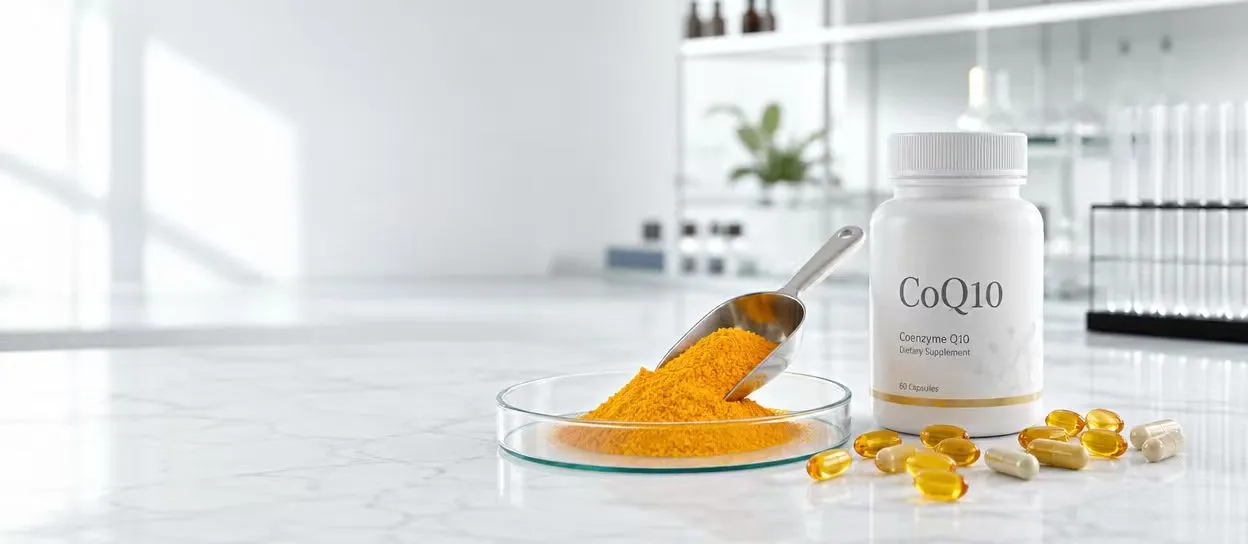
There is a fat-soluble molecule called coenzyme Q10, which is also referred to as CoQ10. This chemical is naturally present in each and every cell in the human body. It is mostly located in the mitochondria, which is the organelle that is accountable for the production of ATP thanks to its participation. As the demand from consumers for energy, cardiovascular, and anti-aging Products continues to rise, it is becoming more necessary for companies to get high-quality CoQ10 in order to meet their needs. Because it possesses a purity level of at least 98% as determined by high-performance liquid chromatography (HPLC), pure coenzyme Q10 powder offers supplement companies, sports nutrition manufacturers, and functional food makers the raw material flexibility they require to confidently construct products that are ready for the market.
Understanding Pure Coenzyme Q10 Powder
What It Is Chemically
The powdered form of pure CoQ10 is often referred to as ubiquinone-10. The chemical form of it has a formula of C₉₉H−O₄, and there are 863.34 grams of it now in existence. As can be seen, the Co Q10 powder that is sold by OAZVITA (CAS No. 303-98-0) is a solid powder that ranges from yellow to orange in colour. It has a mesh size of 60–80 and is 98% pure according to HPLC. In spite of the fact that it does not dissolve in water at all, it does dissolve in chloroform, acetone, and ether. It is possible that this will alter the decision-making process that those who manufacture final items will use in the future.
How It Differs from Other Delivery Forms
This crystalline form of coenzyme Q10 is not a completed softgel or liquid; rather, it is a component that is used in the production of active pharmaceutical ingredients (APIs). To put it another way, the producers decide on the dose, particle size, carrier oils, and emulsification process. The powder form allows you to produce numerous dosage forms from a single bulk purchase, such as tablets, sweets, functional beverages, and cosmetics that you apply to your skin. When you buy in bulk, the powder form reduces the cost per unit, makes it simpler to deal with customs as a raw ingredient, and makes it possible to manufacture these different dosage forms.
Biological Mechanism
The electron transport chain in mitochondria (I, II, and III) contains CoQ10, which is located in the center of the chain. In order to produce ATP, atoms are shifted about. Moreover, it acts as a lipophilic antioxidant, which eliminates free radicals that are present in cell walls. Endogenous CoQ10 levels are observed to decrease with age and when patients use statins, according to a research that was published in Biofactors. Due to this, there has been an increase in the number of people who are interested in taking supplements. Due to the fact that it is so essential for living things, sources consider CoQ10 to be a very vital ingredient.
Recommended Dosage and Usage Guidelines
Standard Dosage Ranges
According to the findings of clinical research, ingesting between 90 and 300 milligrams of CoQ10 on a daily basis may be beneficial to your heart and your health in general. It is common for sports nutrition solutions to include between 200 and 300 milligrams per dosage in order to combat the chemical stress that is caused by physical activity. In most cases, the dosage range for capsules that promise to promote skin health and slow down the ageing process is between fifty and one hundred and fifty milligrams per day. According to HPLC, the powder that OAZVITA uses is 98% pure, which means that formulators do not need to employ significant correction factors in order to get the appropriate quantity of the active ingredient.
Bioavailability and Timing Considerations
Because of its lipophilic nature, coenzyme Q10 is more readily absorbed when it is associated with fat compounds. Businesses that include CoQ10 in oil-based softgels or self-emulsifying delivery systems (SEDS) claim that these formulations are more beneficial to the body than powdered tablets that are simply taken. Particle size is another factor that should not be overlooked. It is simpler for the powder to dissolve in carrier oils because the surface area-to-volume ratio of micronised powder is higher than that of powder that is not micronised. People who prepare beverages with water should transform the raw powder into a grade that dissolves in cold water (CWS) so that the product remains stable and consumers enjoy it. This will ensure that the results are satisfactory.
Safety Profile and Regulatory Notes
Pure coenzyme Q10 powder has been safe for a long time. Studies on tolerability have shown that healthy people who took up to 1,200 mg/day did not have any serious side effects. When the doses are too high, small stomach problems can happen, but they generally go away when the doses are split. There is a high level of confidence that CoQ10 is safe (GRAS-affirmed) in the US, and it has been approved as a novel food in the EU. Before a brand goes on sale, it needs to make sure it knows the local rules for labeling and the highest doses that can be given.
Comparing CoQ10 Powder Options for B2B Procurement
Powder vs. Capsules vs. Liquids
When purchasing teams assess the pricing and manufacturing options for CoQ10 that is available in liquid or pre-encapsulated form, bulk powder is always the decision that goes forward. This is the reason why it is essential for manufacturers to compare:
- Raw powder gives your research and development team the ability to change the excipients, binders, and delivery methods of your product to precisely match the target claim of your product, which is something that pre-filled capsules are unable to do.
- When opposed to purchasing completed ingredient mixes, purchasing API-grade powder in bulk results in a considerable reduction in the cost per kilogram. This is particularly crucial when expanding production above 100 kilograms per month.
- When properly kept, crystalline powder has a shelf life of twenty-four months, much longer than liquid CoQ10 emulsions, which are more susceptible to oxidative destruction during transportation. This is because crystalline powder is cold, dry, airtight, and stored at temperatures below twenty-five degrees Celsius.
Quartz powder has a shelf life of twenty-four months if it is stored at a temperature below twenty-five degrees Celsius, in a dry, cold, and packed environment. In contrast to liquid CoQ10 emulsions, which are more likely to get oxidised and degrade while they are being transported, this kind of product has a longer shelf life.
Ubiquinone vs. Ubiquinol
It is possible to purchase both ubiquinone, which is the oxidised form, and ubiquinol, which is the reduced form, from retailers. It has been shown that the ubiquinone powder manufactured by OAZVITA is effective in clinical investigations that have been ongoing for many decades. Additionally, it is more stable and less expensive to produce. It is possible that this particular kind of ubiquinol is more suitable for some individuals, such as those who are elderly or who have difficulty absorbing nutrients. Because of its consistency, low cost, and scientific backing, ubiquinone that is at least 98% pure is the most suitable option for the majority of business-to-business applications.
Fermentation-Derived vs. Chemically Synthesized
Rhodobacter sphaeroides strains, for example, are only capable of producing the all-trans isomer when they are used in the production of CoQ10 for fermentation. The shape that humans have is identical to this. During the process of chemical synthesis, it is sometimes feasible to combine cis and trans isomers. It is believed that the cis form is harmful since it does not have any biological activity. Since OAZVITA's CoQ10 is produced by fermentation, you can rest certain that it is completely free of any transgender components. In accordance with the regulations that have been established by the USP, EP, and JP for medicines, this assists with placement in high-end markets while maintaining a clean name.
How to Source CoQ10 Powder for Business Use
Key Supplier Criteria
A low-price quote isn't enough to get bulk coenzyme Q10 powder for supplements for business use. To rate suppliers, you should have a clear set of rules to follow. A reliable company that sells CoQ10 powder should have a number of market certifications that cover things like food safety, quality management, and certain consumer groups. The company OAZVITA has been approved by HACCP, ISO 22000, NSF, HALAL, EU Organic, and USDA Organic. There is also a COA, MSDS, and TDS for each batch. They help people in North America, Europe, and the Middle East buy products and pass government checks.
MOQ, Packaging, and Lead Times
The buyer has the ability to choose the manner in which the items are packaged, and the smallest order that OAZVITA would accept is one kilogram. This implies that companies may use it to test out new markets or to produce small quantities of their products. You have the option of receiving your items by air, sea, DHL, FedEx, UPS, or airmail, and the anticipated delivery time ranges from one to five business days. Brands that need to get a product out to customers as rapidly as possible without having to retain additional stock or make a significant investment right away recognise the significance of this speed.
Quality Assurance in Procurement
There is a distinction between a decent seller and a great seller due to the fact that each batch is identical to the one that came before it. Whenever anything is manufactured, it is required to go through a series of quality tests all the time. For instance, you may request a certificate of analysis (COA), compare the purity of the HPLC sample to the standard of 98%, or make use of optical rotation data to demonstrate that the isomer in question is an all-trans isomer. OAZVITA provides prospective purchasers with free samples as well as all of the necessary analytical documentation before they commit to placing large-scale purchases. Purchasing something from this vendor puts you in a less dangerous position, and your relationship with them is more transparent.
Practical Applications and Future Outlook
Current Industrial Applications
It goes without saying that powdered CoQ10 may be included into a wide variety of various sorts of final goods. As a means of assisting the heart and providing you with energy, supplement companies transform it into tablets and softgels. It is included in recovery blends and endurance stacks by firms that manufacture sports nutrition in order to assist mitochondria in functioning more effectively while athletes engage in strenuous physical activity. Coenzyme Q10 is used in anti-aging tablets manufactured by nutraceutical firms in order to combat free radicals and to make the skin more elastic. Protein bars and energy drinks that already include a significant amount of protein are given blended CoQ10 grades by companies that manufacture functional foods and beverages on a regular basis. It is possible for each of them to get advantages from a starting material that is very pure and the result of fermentation.
Emerging Trends in CoQ10 Formulation
CoQ10 is being found in an increasing number of products that are available for purchase. A study conducted by Grand View Research revealed that the market was estimated to be worth more than 830 million US dollars in the year 2023. The growth is expected to continue until the year 2030. This pattern is primarily being driven by an ageing population, an increase in the number of individuals learning about heart health, and an increase in the number of people adopting dietary adjustments. Liposomal transport and nanoparticle packing are two methods that researchers are investigating as potential ways to increase the bioavailability of powders beyond what they now are. In the event that they possess both conventional solid powder and emulsified CoQ10 grades, they will be in a better position to fulfill the requirements of the subsequent generation of items.
Conclusion
Years of study on heart health, oxidative stress, and mitochondrial energy have shown that CoQ10 is one of the most stable ingredients in the supplement business. The quality of the raw materials that brands use affects how well their recipes work when they become trusted brands. All-trans CoQ10 powder made from fermentation is used by serious formulators as pure coenzyme Q10 powder. It is ≥98% pure according to HPLC. It's easier to defend every other formulation choice when you start with the right ingredient specifications, whether you're adding to an existing line of products or going into a new market.
Frequently Asked Questions
1. What purity grade should I look for in a CoQ10 powder ingredient?
For dietary supplement and pharmaceutical applications, a minimum purity of 98% by HPLC is the industry standard, aligning with USP, EP, and JP pharmacopoeial monographs. OAZVITA's CoQ10 meets this specification and confirms the all-trans isomer configuration, which directly relates to biological compatibility and regulatory compliance.
2. Can CoQ10 powder be used directly in water-based formulations?
No. CoQ10 is lipophilic and practically insoluble in water. For water-based beverages or liquid supplements, you need a cold-water-soluble (CWS) emulsified version rather than the raw crystalline powder. For oil-based softgels or capsules, the pure crystalline form works well with appropriate carrier oils.
3. What is the difference between ubiquinone and ubiquinol for commercial products?
Ubiquinone is the oxidized, more stable form, suited for most supplement and functional food applications. Ubiquinol is the reduced form, which may offer absorption advantages for specific consumer segments. For cost-effective, large-scale production with strong stability data, ubiquinone powder at high purity is the preferred starting material.
4. How should CoQ10 powder be stored to maintain its shelf life?
Store CoQ10 in an airtight, light-resistant container in cool, dry conditions below 25°C. Exposure to heat above 50°C can cause clumping due to its low melting point, and UV light accelerates degradation and color change. Proper storage ensures the full 24-month shelf life stated on the product specification.
Partner with OAZVITA for Premium CoQ10 Supply
OEMs, supplement brands, sports nutrition brands, functional food brands, and people in North America and around the world buy pure coenzyme Q10 powder from OAZVITA, a trustworthy company. Our CoQ10 (CAS 303-98-0) is made through fermentation, and it is fully certified by HACCP, ISO 22000, NSF, HALAL, the EU, and the USDA for organic use. Prices start at 1 kg, and lead times are between 1 and 5 days. You can get free samples and a COA if you ask. Send an email to info@oazvita.com to get a price.
References
1. Bhagavan, H. N., & Chopra, R. K. (2006). Coenzyme Q10: Absorption, tissue uptake, metabolism and pharmacokinetics. Free Radical Research, 40(5), 445–453.
2. Littarru, G. P., & Tiano, L. (2007). Bioenergetic and antioxidant properties of coenzyme Q10: Recent developments. Molecular Biotechnology, 37(1), 31–37.
3. Molyneux, S. L., Florkowski, C. M., George, P. M., et al. (2008). Coenzyme Q10: An independent predictor of mortality in chronic heart failure. Journal of the American College of Cardiology, 52(18), 1435–1441.
4. Crane, F. L. (2001). Biochemical functions of coenzyme Q10. Journal of the American College of Nutrition, 20(6), 591–598.
5. Pravst, I., Zmitek, K., & Zmitek, J. (2010). Coenzyme Q10 contents in foods and fortification strategies. Critical Reviews in Food Science and Nutrition, 50(4), 269–280.
6. Grand View Research. (2023). Coenzyme Q10 Market Size, Share & Trends Analysis Report. Grand View Research, Inc.

Send Inquiry
Related Industry Knowledge
- What are the benefits of Pure Quercetin Powder?
- How to use Tongkat Ali? 5 Different Ways to Best Consume Tongkat Ali
- Chicken Collagen Peptides vs Bovine Collagen: Key Differences Explained
- The Truth About Blue Copper Peptide Powder No One Really Talks About
- Discover the Health Benefits of Cordyceps Sinensis Extract Powder
- Reishi Extract Guide: Stress Relief & Immunity
- Liquid Shilajit Drops: Benefits, Dosage & Comparison
- Top 7 Benefits of Using Pure Bovine Collagen Peptides in Skincare
- Pure Bovine Collagen Peptides vs Marine Collagen: Key Differences Explained
- Germany Market Insights: Standardized Withanolides in Pure Ashwagandha Capsules