How great kava powder is made: processing steps explained
Sep 16, 2026
Kava extract powder starts its journey as dried rhizomes and roots of Piper methysticum, a noble plant cultivated across the South Pacific for centuries. The finished product you source today is the result of a carefully controlled manufacturing sequence — root selection, solvent extraction, filtration, drying, and standardization — engineered to deliver a consistent kavalactone profile between 30% and 70%. Understanding each step helps B2B buyers verify supplier credibility, anticipate quality benchmarks, and make procurement decisions grounded in technical reality rather than marketing claims.
Understanding Kava Extract Powder: From Root to Standardized Ingredient
It is a pepper plant called Piper methysticum, and the kavalactones that are found in its lateral roots are the highest. The well-known benefits of the plant for lowering uneasiness, nervous tension, and poor sleep are attributed to these bioactive compounds, which are found in the plant. The only varieties of roots that are suitable for commercial use are noble cultivars, which are mostly sourced from Vanuatu, Fiji, and Tonga. Due to the fact that Tudei cultivars, also known as two-day cultivars, contain high amounts of Flavokawain B, a chemical that is understood to cause damage to the liver, they are purposefully excluded from responsible supply chains.
Why the Chemotype Profile Matters for Formulators
There is a six-digit chemotype code on Premium Kava Extract Powder that shows the amount of six different kavalactones: kavain, dihydrokavain, methysticin, dihydromethysticin, yangonin, and desmethoxyyangonin. Extracts that are high in kavain and dihydrokavain (chemotype codes like 423xxx) make you feel calm and relaxed without making you sleepy for a long time. This reliability is important for formulators who are making health pills, functional drinks, or gummy mixes. Standardized extract can do it on an industrial scale, but variable-potency raw root powder can't.
Core Processing Steps of Great Kava Extract Powder
In the last twenty years, the way things are made has changed a lot. Early makers used coarse grinding and drying in the open air, which made batches that were very different in how strong they were and didn't last long. To get rid of that inconsistency, modern facilities use pharmaceutical-grade engineering at every step.
There are five separate steps in the process, and each one builds on the last one.
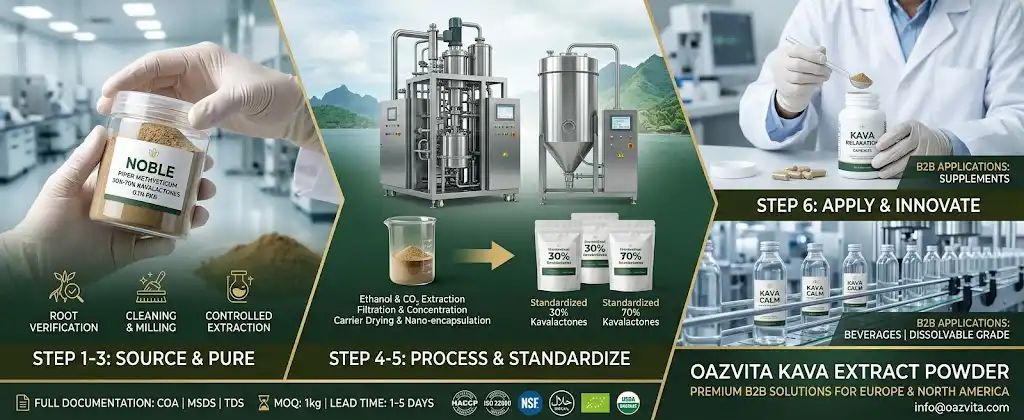
Phase 1: Root Source Verification for piper methysticum root powder: In the production stream, only lateral roots and rhizomes from known Noble cultivars are allowed to go. Agricultural checks are done on producers of raw materials, and roots that come in are checked for heavy metals, microbial load, and Flavokawain B concentration before they are accepted. It is a must for responsible producers to only get their Products from approved farms in Vanuatu or Fiji.
Step 2: Clean up and reduce the size: Roots that have been accepted go through mechanical washers that remove soil and other surface debris. They then go into milling equipment that makes the particles smaller without using too much heat. At this point, it is known that heat can break down kavalactones. To keep the biological structure throughout the milling process, temperatures are kept under control.
Phase 3: Extraction under Control: For broad kavalactone recovery, ethanolic extraction is still the usual method. On the other hand, supercritical CO₂ extraction makes a cleaner, solvent-free concentrate that is better for high-end formulas. Aqueous extraction can be used for grades that can dissolve in water and are meant for use in beverages. Each method aims for a different solubility profile. Since kavalactones are naturally lipophilic, the extraction parameters are set to get the highest yield while keeping the chemotype intact.
Phase 4: Filtration and concentration: After extraction, the liquids go through several stages of filtering to get rid of sticky particles and plant fiber. The concentrate is turned into a thick resin through membrane filtration and spinning. This resin contains all the kavalactones, but it needs more work to be turned into a steady powder that can be handled.
Phase 5: Drying and Adding the Carrier: The liquid concentrate is turned into a free-flowing powder by spray-drying it with maltodextrin or cyclodextrin carriers. Freeze-drying is only done on the most expensive types, where keeping the flavor and bioactive compounds alive is more important than saving money. Nano-encapsulation technology is used in water-dispersible grades to make sure that the ingredients are evenly distributed in aqueous beverage formulations, which is a key functional requirement for functional drink manufacturers.
Together, these five steps turn a variable agricultural raw material into a standard, stable ingredient that is ready to be used in later steps. Each step is meant to get rid of a specific failure mode that made earlier production methods less reliable.
Comparing Kava Extract Powder to Other Commercial Forms
Buying groups often check to see if powdered extract, tinctures, capsules, or teas work best for their production model. The answer relies on the size, type, and format of the final result.
Powder vs. Tincture and Capsule Forms
Tinctures are quickly absorbed by the body, but they can be hard to name in some export markets because of the alcohol content. Pre-filled capsules work well for retail SKUs, but they cost more per unit, and that cost goes up as production volumes go up. Kava Extract Powder is the only form that works well in all of the next steps; it can be put into capsules, pressed into pills, mixed into candies, or mixed into drinks using the right carrier systems. Clean-label product lines come in EU Organic and USDA Organic varieties that meet the needs of both the North American and European markets.
Ensuring Safety, Purity, and Compliance in Production
Safety is not a selling point; it is a condition for buying plant-based relaxation extract powder. When buying Botanical Extracts for regulated markets, business-to-business buyers need to make sure that each batch meets certain levels of contamination before it gets into their supply chain.
The following rules are followed by responsible companies that make kava extract:
- Flavokawain B control: Levels are kept below 0.1% to tell the difference between Noble and non-Noble material and lower the chance of liver damage.
- Heavy metal screening: In every production batch, the levels of lead, arsenic, cadmium, and mercury are checked against the standards set by the USP and the EU.
- Microbial limits: Before the product is released, the total aerobic plate count, yeast, mold, and pathogen absence are checked.
- Kavalactone potency verification: HPLC research shows a standard potency range of 30% to 70% as required.
The Kava Extract Powder (Awa Extract) from OAZVITA is certified by HACCP, ISO 22000, NSF, HALAL, EU Organic, and USDA Organic. The Certificate of Analysis (COA), Material Safety Data Sheet (MSDS), and Technical Data Sheet (TDS) are all fully filled out and sent with every batch. These papers are essential for buying teams to pass legal audits in the US and European markets. They are not extras that can be left out.
Procurement Insights: Buying Bulk Kava Extract Powder with Confidence
Standardized Kava Extract Powder is sold at a price that is determined by the quantity of kavalactone that it contains, the method that was used to extract it, and the number of certifications that it has. It is more expensive to purchase a 30% kavalactone ethanol extract than it is to purchase a 70% supercritical CO2 grade that is 100 percent organically certified. In the long run, purchasers who combine the two based on price per kilogram often find themselves confronted with quality issues.
In the field of logistics, precision is of equal importance. When you ship from OAZVITA, you have the option of using air, sea, DHL, FedEx, UPS, or even airmail post. The firm has a record of arriving sooner than 99% of the time. Following the confirmation of an order, the lead time might vary anywhere from one to five working days. The smallest possible order amount is one kilogram, and the packaging may be altered to suit the specific requirements of each individual client. For firms that want to test out new SKUs before committing to large-scale production runs, this makes it feasible for them to engage in procurement at an entry-level setting. For up to twenty-four months, items should be stored in a cool, dry environment that is shielded from ultraviolet radiation. This is the standard storage regulation. Before making a purchase choice, potential purchasers who meet the requirements may get free samples, which can be put through direct scientific testing procedures.
Conclusion
It takes a focused, multi-step process to make good kava extract powder. It starts with getting real Noble root and ends with a standard, compliance-documented ingredient that is ready to be mixed with other ingredients. Each step—the extraction method, the drying technology, the control of chemotypes, and the batch testing—determines whether the finished powder works consistently and passes regulatory tests in markets with lots of competition. If a business-to-business buyer knows how this process works, they can evaluate sellers more honestly and protect the value of their brand. Quality starts with the raw materials, and the choices made during processing either keep it up or break it down.
FAQ
1. What kavalactone concentration is standard for commercial formulations?
Most businesses use extracts that are regulated to have between 30% and 70% kavalactones by HPLC measurement. Makers of drinks and functional foods usually use grades that dissolve in 30% to 50% water, while makers of supplement capsules usually ask for grades that dissolve in 50% to 70% water for higher-potency SKUs.
2. How does OAZVITA control hepatotoxicity risk?
OAZVITA only buys from Noble cultivars and makes sure that Flavokawain B levels in every batch are less than 0.1%. Before it is released, each production lot goes through independent HPLC testing. With every shipment, there is paperwork like a COA, MSDS, and TDS.
3. Is the extract suitable for organic-certified product lines?
Yes. The Kava Extract Powder from OAZVITA is certified as organic by both the EU Organic and the USDA Organic. This means that it can be used in clean-label products in North America and Europe.
4. What is the minimum order quantity?
The minimum order quantity is 1 kg. The packaging is set up based on what the buyer wants. If you are interested in buying in bulk, you can get free trials first.
Source Your Kava Extract Powder Supplier Through OAZVITA
OAZVITA supplies standardized kava extract powder to health supplement brands, functional beverage manufacturers, and private-label buyers across North America, Europe, and beyond. Every batch is certified under HACCP, ISO 22000, NSF, HALAL, EU Organic, and USDA Organic standards — and ships within 1–5 working days with full documentation. Request a free sample or bulk quote directly: info@oazvita.com.
References
1. Lebot, V., Merlin, M., & Lindstrom, L. (1997). Kava: The Pacific Elixir. Yale University Press.
2. Sarris, J., LaPorte, E., & Schweitzer, I. (2011). Kava: A Comprehensive Review of Efficacy, Safety, and Psychopharmacology. Australian & New Zealand Journal of Psychiatry, 45(1), 27–35.
3. Teschke, R., & Lebot, V. (2011). Proposal for a Kava Quality Standardization Code. Food and Chemical Toxicology, 49(10), 2503–2516.
4. Showande, S. J., & Fakeye, T. O. (2022). Kavalactone Delivery Systems and Bioavailability Enhancement Strategies. Journal of Ethnopharmacology, 283, 114714.
5. European Food Safety Authority (EFSA). (2016). Safety of Kava-Kava (Piper methysticum) Root Extract. EFSA Journal, 14(11).
6. United States Pharmacopeia (USP). (2023). Botanical Ingredient Standards and Verification Procedures. USP General Chapter 2750.

Send Inquiry

Related Industry Knowledge
- Yucca - History, Benefits and Uses
- Pure Bulk Curcumin: Overview of Extraction Methods, Health Benefits
- Hericium Erinaceus Extract Powder: Benefits, Uses & Science Explained
- Do Chewable Probiotic Gummies Really Work? The Sweet Truth About Chewy Gut Health Supplements
- Top 7 Benefits of Using Chicken Collagen Peptides in Health Supplements
- What Is Pure NAD+ Powder and How Does It Work in Anti-Aging
- Advances in Glutathione Powder Production for Asian Pharma Markets
- Pure NMN Powder vs NMN Capsules: Key Differences & Benefits
- United States Longevity Market Demand for High-Purity NMN Supplement Capsules
- How does pure NMN powder support cellular energy and repair?