Improving pet food digestibility with yucca schidigera
Oct 28, 2026
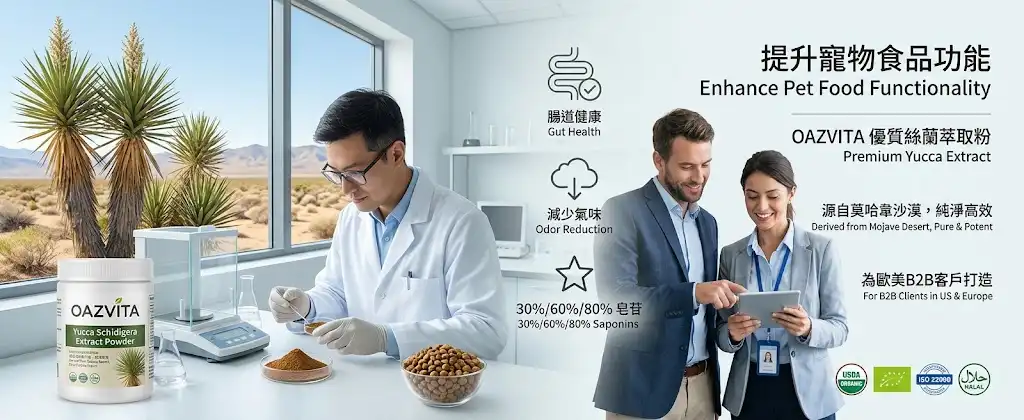
The use of Yucca schidigera as a natural addition that promotes intestinal health in companion animals has garnered a significant amount of interest in the pet food industry. Yucca extract powder is derived from the dried roots, stems, and leaves of the Mojave Yucca plant. It is a concentrated form of bioactive chemicals, principally steroidal saponins and polyphenols, which work together to enhance nutritional absorption, decrease faecal odour, and maintain a balanced environment in the gastrointestinal system. Understanding how this botanical material might be included in contemporary formulas is a viable beginning point for product differentiation for business-to-business customers who are looking to source ingredients for functional pet food.
Understanding Yucca Schidigera and Its Role in Pet Food Digestibility
What Makes This Desert Plant Bioactive
Deserts in the southwestern United States and northern Mexico are the ideal environments for the cultivation of this plant. There is a significant amount of steroidal saponins (30%, 60%, or 80%) in the stems and leaves of this plant. Additionally, there are structural polysaccharides and polyphenol stilbenes, such as resveratrol. It is simpler for the body to take in carbohydrates, proteins, and fats when they are present because they assist enzymes in performing their functions. The lining of the digestive tract is the target of their services.
How Saponins Affect Gut Function
Sugar cane schidigera contains saponins, which are natural cleansing substances that are found in the plant. When the cell membranes that line the intestines become more permeable, it is easier for nutrients to enter the body. This phenomenon is known as intestinal permeation. It has been shown in the Journal of Animal Science that increasing the quantity of saponin that is given to pets may reduce the amount of ammonia that is found in their blood. Clearly, this indicates that they are better able to deal with proteins. A reduction in the amount of nitrogen found in animal faeces is another potential outcome of this procedure.
Odor Reduction as a Measurable Benefit
As a result of its ability to bind ammonia in the digestive system, Yucca schidigera extract has a significant amount of commercial value. If it is unsuccessful, urease is unable to convert ammonia into nitrogenous forms that are stable and non-volatile. Before it is flushed out of the body, this step is necessary. As a claim to make their goods stand out in the highly competitive market for pet food, pet food manufacturers have placed this advantage on the front of the label of their Products.
Comparing Yucca Extract Powder with Other Digestibility Enhancers
Yucca Extract Powder vs. Raw Yucca Root Powder
When compared to raw yucca root powder, it contains the same plant compounds; however, there are fewer of them, and they are not distributed as uniformly. OAZVITA's Yucca Schidigera Extract Powder is manufactured in a manner that eliminates components that aren't required and concentrates the active saponins to a particular degree of purity. When it comes to formulation accuracy, standardisation is essential since businesses that produce a large quantity of items that can be used again want sources that are identical to and consistent with one another.
How It Compares to Chitosan and Other Herbal Additives
Chitosan, which comes from the shells of crustaceans, helps the gut hold on to fat. However, saponins from yucca are better at binding ammonia and fighting free radicals. But different types of polyphenols are found in other sources of saponin, such as quillaja extract, which has surface-active qualities. Plant-based yucca powder for wellness, derived from Yucca schidigera, offers two benefits: it helps the digestive system and keeps smells in check. For that price, not many single botanical ingredients can do this.
Organic vs. Non-Organic Variants in B2B Sourcing
Standard-grade yucca extract and USDA Organic-certified yucca extract are not at all the same. People who want to buy natural or high-end pet food should look for the latter. Neither the USDA nor the EU has said that OAZVITA's Yucca Schidigera Extract Powder is not organic. ISO 22000, HACCP, NSF, and HALAL all agree with it too. These rules make it harder for brands to enter new markets, especially in North America and Europe where natural pet food is sold.
How to Effectively Incorporate Yucca Extract Powder into Pet Food Products
Recommended Inclusion Rates by Product Format
There may be anywhere from 100 to 300 parts per million (ppm) of Yucca schidigera extract in pet food. It depends on the type of food and the animal it is meant for. Because wetness changes the stability of saponins, treats and food that is mostly wet may need lower rates. Most of the time, mid-range ingredients can be used in dry kibble recipes. You can keep from wasting money by asking your formulation team about inclusion rates before you make more.
Compatibility with Manufacturing Processes
Yucca saponins don't change when heated in the normal way that pet food is extruded, so it's simple to add them to dry kibble lines. It is best to do test runs first when making wet foods because pH and temperature change more quickly. OAZVITA gives manufacturers technical data sheets (TDS) and application guidance to help them make sure their products work together before they start full-scale production.
Shelf Life Considerations for Finished Products
Yucca Schidigera Extract Powder from OAZVITA can be used for 24 months as long as it is kept in a cool, dry place. Flavonoids in the extract, like resveratrol, are antioxidants that help keep pet foods high in fat stable when they are added to finished food. That is something that should be thought about when the product is being made because it can make the end product last longer.
Procuring High-Quality Yucca Extract Powder: What B2B Buyers Need to Know
Evaluating Supplier Credentials
If someone wants to buy yucca extract powder, they should make sure that the company can give them material safety data sheets (MSDS), certificates of analysis (COA) that are specific to the batch, and records of third-party tests. Every order from OAZVITA comes with all the information you need, like a COA and TDS for each batch. HACCP, ISO 22000, NSF, HALAL, EU Organic, and USDA Organic have all given the business their seal of approval. These show buyers what they need to show regulators in North America and Europe.
MOQ, Lead Times, and Logistics
You can buy as little as 1 kg of OAZVITA, so it can be used for both small-scale tests of formulas and large-scale production orders. This item can be shipped by air, sea, DHL, FedEx, UPS, or airmail. The lead time is one to five business days. This range of shipping options can handle both last-minute restocking needs and planned sales of a lot of items. People in North America get their orders on time more than 99% of the time thanks to the company's well-established shipping network.
Pricing Benchmarks and Value Assessment
If you are looking at different places to get yucca extract, you should compare the price per kilogram with the level of purity of the saponin. The prices of adding a 30% saponin extract and an 80% saponin extract are different and are used for different things in recipes. When procurement teams ask for free samples before making a big order, as OAZVITA does, they can test the material themselves and make sure it meets their needs before they buy it.
Addressing Safety and Regulation Concerns in Pet Food Formulation
Toxicological Profile and Species Suitability
The U.S. Food and Drug Administration (FDA) says that yucca schidigera juice is "Generally Recognized as Safe." It is safe to use in pet food for cats, dogs, and other small animals. Studies on toxicology show that the suggested rates of inclusion don't hurt anything. If doses that are much higher than the normal levels in the formulation are given to some animals, they may have loose stools. This is why it's important to follow the rules for inclusion that have already been set.
Gradual Introduction and Monitoring Protocols
Sensitive animals are less likely to have problems digesting a new pet food formula that contains yucca schidigera extract for the first time if it is added in stages. Before choosing the final commercial formula, it's good to get baseline data. To do this, start with a lower inclusion rate and monitor stool regularity for two to four weeks.
Labeling and Compliance Documentation
Chemical labels on cat food must be correct, according to 21 CFR Part 501 of the FDA's rules. The commonly known name for yucca schidigera extract needs to be used in the list. OAZVITA provides all the necessary paperwork for compliance, like COAs, MSDSs, and organic certificates, to help with correct marking and getting foreign packages through customs.
Conclusion
It is possible to figure out how useful yucca schidigera extract is in pet food recipes. For this reason, it is useful for natural and functional pet food brands because it helps the body absorb nutrients, lowers the amount of ammonia in feces, and boosts antioxidant activity. It is well regulated, there is a lot of evidence to support its use, and buying a standard, certified version of yucca extract powder from a company like OAZVITA lowers the risk a lot. People who buy in bulk and want to add a naturally digestible ingredient to their products often choose Yucca schidigera extract because it is well-known and can be sold.
FAQ
1. Can yucca schidigera extract be used in all pet food formats?
Yes. It works with treats that are only slightly wet, wet food, and dry kibble. Since the rates of addition and processing conditions are different for each format, it is best to try a small batch before making the whole batch.
2. How long does it take to see digestibility improvements in pets?
It's been shown in most controlled studies that adding food regularly for two to four weeks changes the structure and smell of poop. The effects depend on how healthy the animal's gut was to begin with and the rate of inclusion that was used.
3. What certifications should I look for when selecting a supplier?
Businesses that buy from other businesses need to know about ISO 22000, HACCP, NSF, USDA Organic, and EU Organic. For regulatory reports and quality assurance records, you also need COA paperwork that is specific to each batch.
4. What purity grades are available?
You can get Yucca Schidigera Extract Powder from OAZVITA that is stabilized at 30%, 60%, and 80% saponin content. People can then pick the grade that fits their needs and budget the best.
Source Premium Yucca Schidigera Extract Powder from OAZVITA
People can trust OAZVITA, which makes yucca extract powder and sells it to companies in North America, Europe, and Asia. We can help you take your idea from a prototype to mass production. We have purity grades that run from 30% to 80% saponin; we meet many certification standards, and our lead time is 1 to 5 business days. You can email us at info@oazvita.com right away to get a free sample and find out how much it costs in bulk.
References
1. Cheeke, P. R. (2000). Actual and potential applications of Yucca schidigera and Quillaja saponaria saponins in human and animal nutrition. Journal of Animal Science, 77(Suppl. E), 1–10.
2. Wang, Y., McAllister, T. A., Yanke, L. J., & Cheeke, P. R. (2000). Effect of steroidal saponins from Yucca schidigera extract on ruminal microbes. Journal of Applied Microbiology, 88(5), 887–896.
3. Headon, D. R., & Dawson, R. (1990). Determination of the saponin content of Yucca schidigera extract. Biochemistry Society Transactions, 18(3), 444–445.
4. Szumacher-Strabel, M., & Cieślak, A. (2010). Potential of Yucca schidigera and related saponins as feed additives for livestock. Animal Feed Science and Technology, 154(1–2), 1–17.
5. Yin, Y. L., & Huang, R. L. (2004). Effects of dietary supplementation with Yucca schidigera extract on performance and gut microflora in growing pigs. Livestock Production Science, 86(1–3), 229–236.
6. Association of American Feed Control Officials (AAFCO). (2023). Official Publication: Pet Food and Specialty Pet Food Regulations. AAFCO.

Send Inquiry

Related Industry Knowledge
- Pure Fish Collagen Peptide or Marine Collagen? Best Choice for 2026 Skincare Needs
- TUDCA Powder vs UDCA Powder: Key Differences Explained
- Valerian Extract Powder For Sleep: Does It Actually Work, And How Do You Use It?
- Top Quercetin Health Benefits: From Antioxidant Action to Allergy Relief
- What is Soybean Natto Powder good for?
- Is acai powder actually good for you?
- Beetroot for Performance: Juice, Powder or Concentrate?
- Liquid Shilajit Drops: Benefits, Dosage & Comparison
- Fish Collagen Peptides Driving Functional Food Growth in Australia
- Pure NMN powder vs other NAD+ supplements: key differences